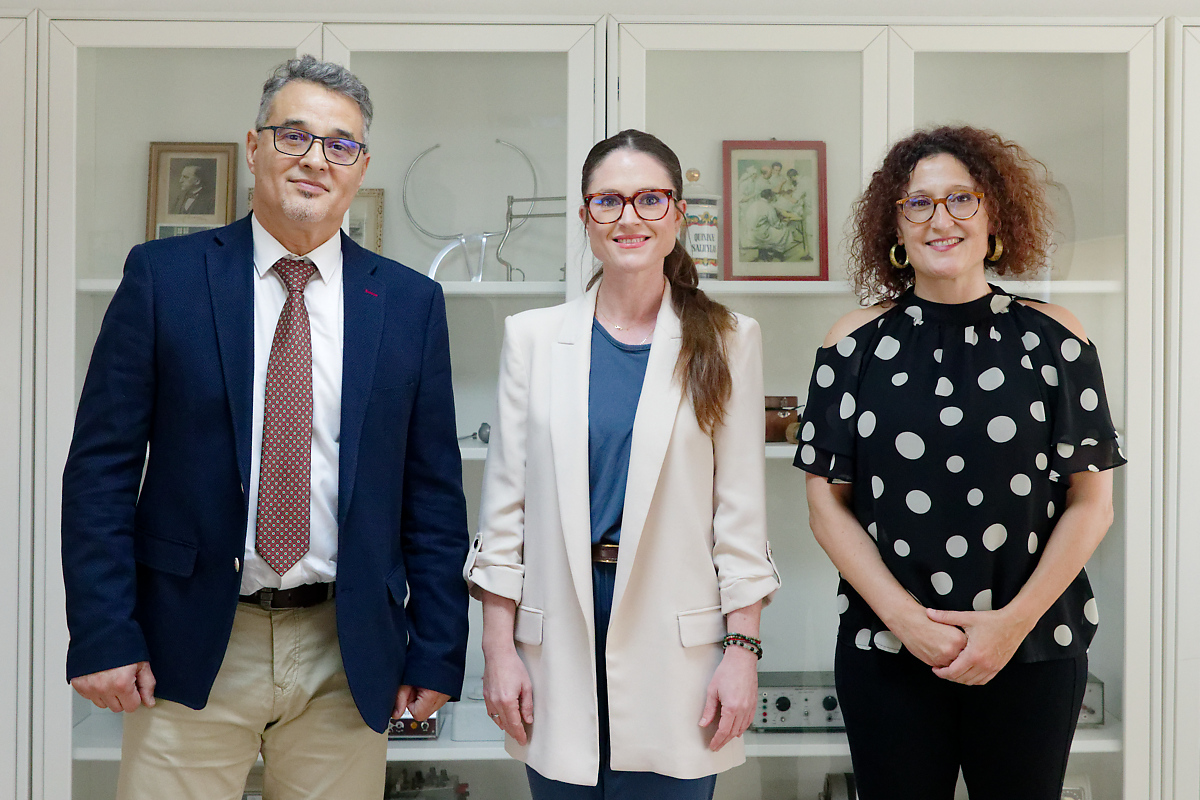
The Department of Medicine at the University of La Laguna recently hosted the defense of the doctoral thesis "Benefits of Dance Movement Therapy in relation to the practice of conventional physical exercise", presented by Obdulia María Bustos Rodríguez within the Doctoral Program in Medical and Pharmaceutical Sciences, Development and Quality of Life.The work was directed by Norberto Marrero, Professor of Human Anatomy and Embryology at the University of La Laguna, and supervised by Miriam González, Professor [Name], a tenured professor in the Department of Basic Medical Sciences specializing in Human Anatomy and Embryology, and a researcher affiliated with the University Institute of Neuroscience and the University Institute of Biomedical Technologies. The research analyzes the influence of the playful and expressive component of movement on physical and emotional health parameters compared to conventional exercise. The examining committee was chaired by [Name]. Herminia Pérez, professor at the University of La Laguna. He acted as secretary Antonio Ramos, from Las Palmas de Gran Canaria, and participated as a member Victor Alonso, also from ULPGC.
The research begins with a key question in the field of health promotion: what factors make physical activity a true agent of holistic well-being? In contrast to models focused exclusively on performance or physiological adaptation, the thesis delves into the importance of the emotional and creative component of movement. To this end, it takes as its reference point the Dance Movement Therapy, a discipline that emerged in the mid-twentieth century in hospital settings, especially linked to mental health, where it began to be used as a non-pharmacological therapeutic tool.
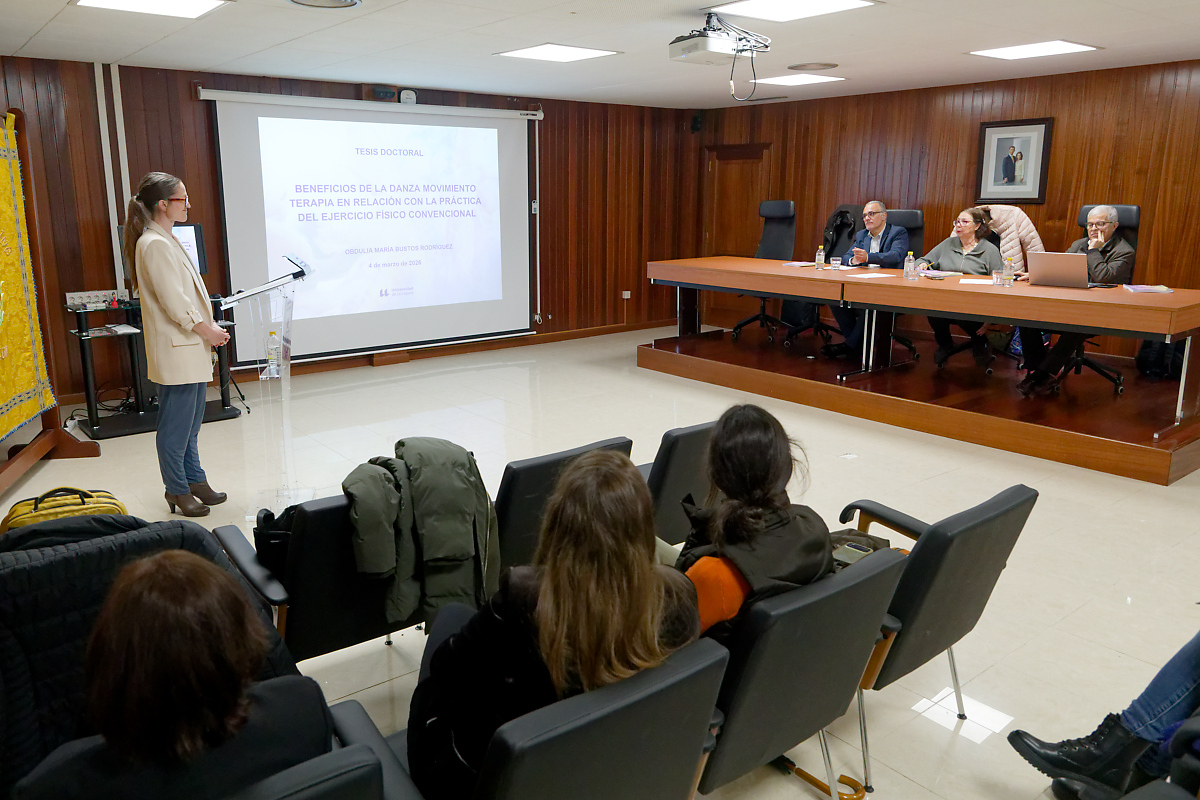
A moment from the doctoral defense.
The study was conducted with an adult population between 25 and 55 years old, divided into three profiles: people who practiced Dance Movement Therapy, people who exercised regularly, and sedentary people. The objective was to compare not only the physiological effects, but also the emotional and subjective effects associated with each type of activity.
The methodology combined the analysis of biological parameters—heart rate, blood pressure, lactate and salivary cortisol, the latter related to the stress response—with validated instruments to assess the perception of effort and life satisfaction, and a questionnaire on emotional state.
The results show significant improvements. Physiologically, decreases were observed in systolic blood pressure and cortisol levels, indicating better stress regulation and positive effects on the cardiovascular system. Psychologically, an increase in life satisfaction and a general improvement in mood were noted. The subjective perception of effort was low, indicating that the activity was experienced as pleasurable. This positive experience was also reflected in benefits such as the release of muscle tension, mental relaxation, temporary relief from worries, improved interpersonal relationships, and a boost in self-concept and self-esteem.
In this work, the author integrates her dual artistic and healthcare background. A graduate in Spanish Dance and Flamenco and a graduate in Nursing, with professional experience in Primary Care, she began to delve into the relationship between movement and health during her Master's thesis, in which she explored the effects of Dance Movement Therapy on children from the Asperger-ASD association in Tenerife. That pilot experience led to a broader study, incorporating biomedical markers and validated assessment tools to analyze the impact of regular and sustained practice in the adult population.
The thesis thus proposes Dance Movement Therapy as a complement to other sports practices, differentiating it from those focused exclusively on physical performance. From an applied perspective, its conclusions support the promotion of healthy habits from a holistic approach that considers physiological, cognitive, and emotional dimensions, and underscore the importance of the motivational component in adherence to exercise, especially in groups where continuity is a challenge.
Among the future lines of research, the author proposes expanding the sample size and strengthening the methodological design to increase the validity of the results. She also suggests incorporating a neuroscientific approach to analyze potential changes in brain activity, connectivity, and plasticity associated with sustained practice of Dance Movement Therapy using neuroimaging techniques, in collaboration with research groups at the University of La Laguna.
During the study, the doctoral candidate collaborated with Sheila González, José Francisco Rojas, Marta Sáez, and Viviana Marrero, who participated as external observers and as part of the research team in preparing articles and scientific communications derived from the research. She also expressed her gratitude to DXD (Sports for Fun) for providing their facilities for the practical sessions.

 Spanish
 English
 French