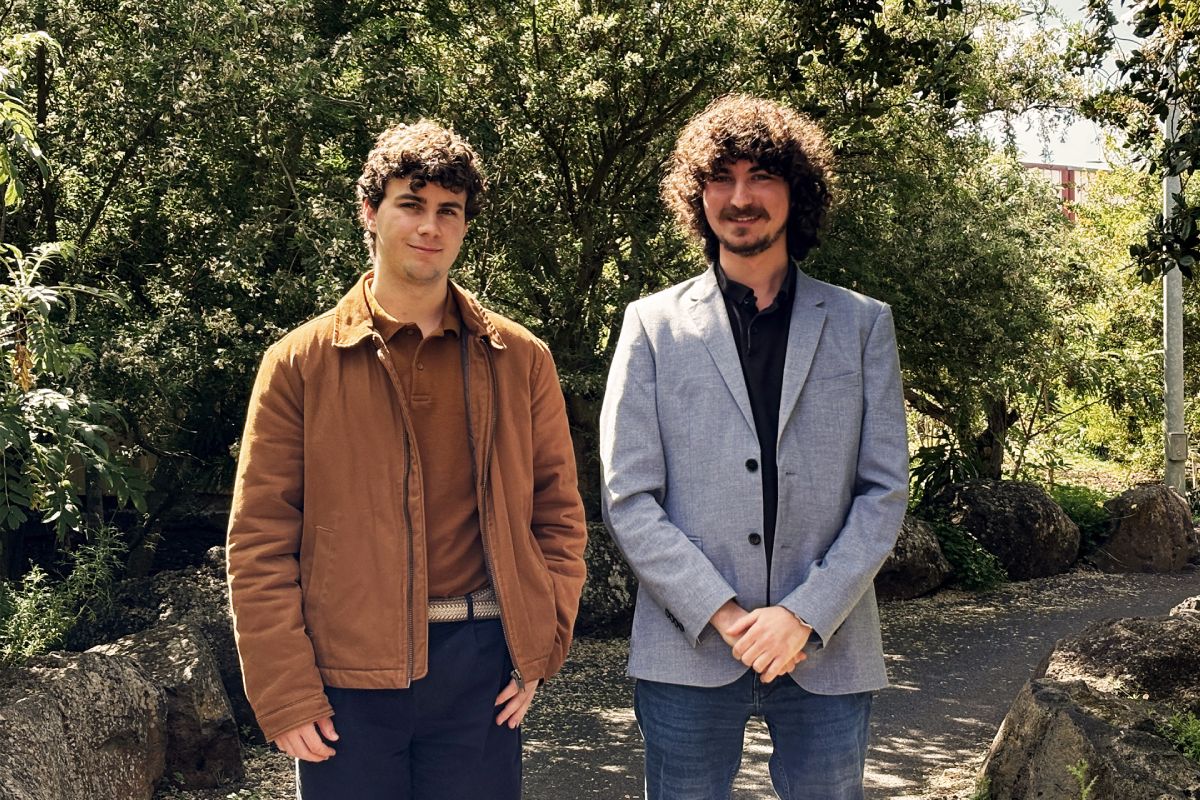
A group of researchers from the University of Laguna, made up of Daniel Escánez Expósito, Jorge García Díaz, Daniel del Castillo, the professor Pino Caballero Gil And Professor Eduardo Sáenz de Cabezón, from the University of La Rioja, has developed an innovative approach to studying the Game of Life, the famous mathematical experiment created by John Conway in 1970. His work, entitled “QGoL: Quantum Game of Life”, proposes a probabilistic version of the game and a quantum model capable of efficiently simulating its evolution, even in complex scenarios that would be difficult to address with traditional methods.
The classic Game of Life consists of a board filled with square spaces, called cells, which can be either alive or dead and change state, generation after generation, following very simple rules. To apply these rules, each cell counts its living neighbors. The next turn is decided based on this number and the current state of the space: that is, whether it is alive or dead in the current generation. Despite its simplicity, the game produces curious patterns: some structures remain unchanged, others oscillate like a clock, or move around the board like small "ships.".
“The Game of Life is very well known; I think all computer science students are familiar with it, because it always appears as an exercise in the first years of study,” explains Escánez Expósito. “It’s truly surprising how such complex behaviors emerge from very simple rules,” he adds.
He study, published in the magazine Quantum Information Processing, It leverages the non-deterministic nature of quantum computing to generalize this game. Instead of cells being completely alive or dead, with the quantum approach they behave probabilistically, potentially being in both states simultaneously. This makes the patterns less predictable, as if they were living systems with more complex behaviors.
Regarding how this probability works: “When we're in this quantum framework, the cell is no longer simply alive or dead. Now it can have, for example, a 50% probability of being alive and a 50% probability of being dead, like flipping a coin and getting heads or tails. Furthermore, we can manipulate these probabilities as much as we want, achieving different weightings: 70-30, 60-40, 0-100—any combination that adds up to 100 is possible. So, to apply the rules, it's no longer trivial to count the living neighbors. Now your neighbors have probabilities, and you have to calculate how they affect the cell in the next generation. This was the first problem we faced, and through quantum computing, it could be expressed simply and directly,” explains Escánez Expósito.
Using quantum computing, the research team can calculate many possibilities simultaneously. “If you had to do it with a classical computer or by hand, you would have to perform an exponential number of multiplications,” he points out. “But with quantum computing, the circuit performs all those operations at once, naturally, thanks to superposition,” he adds.
To demonstrate this, the group developed two versions of the model: a classical one, programmed in Rust; and a quantum one, using Qiskit, IBM's software for working with quantum computers. The quantum version allows for the efficient exploration of more complex patterns and rules. Furthermore, the research team created a mechanism called a "quantum Hamming weight counter," which measures the probabilistic influence of each cell's neighbors on its evolution, adapting to different neighborhood configurations, board sizes, or rules.
This article has applications in artificial intelligence and simulations of complex systems. “The quantum Game of Life can model any application of the classic game, but by computing it using quantum mechanics,” Escánez Expósito points out. “It can be used to study probabilistic phenomena, such as biological, social, or economic systems, and understand how simple rules generate varied behaviors,” he explains.
For example, the researcher recounts a striking case: “In another article, Also published by colleagues in the group, a modification of the Game of Life was used to model the behavior of vehicle parking lots. The aim was to predict how parking evolves over time based on a set of rules. It illustrates very well how a simple system can simulate processes that change from generation to generation.”.
The work also contributes to research in basic quantum computing. “We don’t always look for the direct application of things,” notes Jorge García Díaz. “The fact of studying these quantum advantages already adds value to the University of La Laguna and the cryptology research group.”, CryptULL”,” he adds.
Escánez Expósito emphasizes the importance of developing science independently of its applications, especially in an emerging technology like quantum computing: “It is still unclear in which areas it will have the greatest impact. With the hardware that exists today, the technology still needs development to deliver the expected results. Once this barrier is overcome, cryptography and chemistry appear to be the first disciplines affected. In any case, research will continue to drive technological advancement,” he concludes.

 Spanish
 English
 French