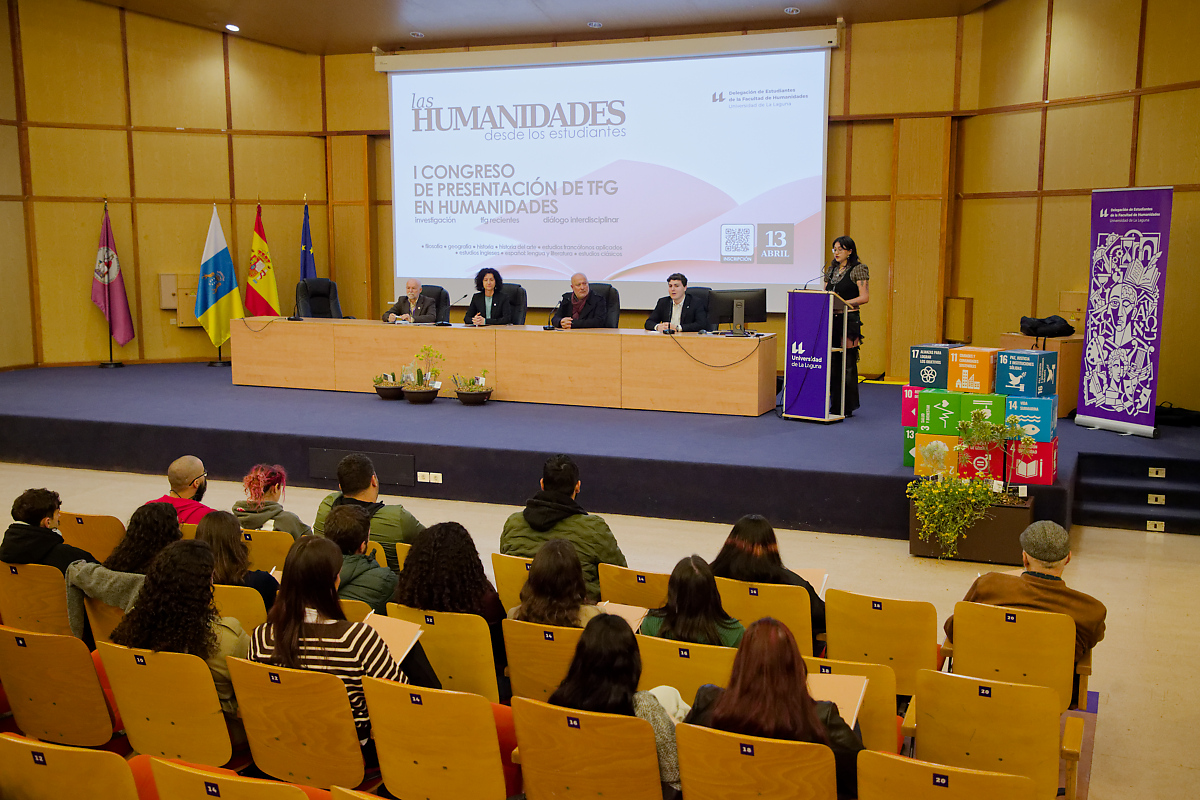
The University of La Laguna held today, Monday, April 13, in the César Manrique Lecture Hall on the Guajara Campus, the 1st Congress for the Presentation of Final Degree Projects (TFG) in Humanities, an initiative promoted by the Student Delegation of the Faculty of Humanities to give visibility to recent student research and to promote dialogue between different areas of knowledge.
The event, supported by the Vice-Rectorate for Students, included an opening ceremony, an inaugural presentation, parallel sessions of presentations by subject area, a public speaking workshop on preparing and defending final degree projects, an interdisciplinary round table discussion on the question "What is the purpose of the Humanities today?", and a closing ceremony. Furthermore, the initiative included the participation of students from the University of Las Palmas de Gran Canaria, as part of a collaboration between student representatives from both public universities in the Canary Islands, with the aim of strengthening ties and creating shared spaces for academic exchange.
At the opening ceremony, the Vice-Rector for Students, Rosario Hernández, highlighted the recent creation of the Student Delegation of the Faculty of Humanities and the impetus given by this group to an initiative conceived by and for the students themselves. The academic official emphasized the strong sense of belonging to the University of La Laguna and underscored that this congress represents a significant step for a faculty that encompasses multiple areas of knowledge.
Next, Sergio Cordobés, president of the Student Delegation of the Faculty of Humanities, explained that the congress arose from a concern shared by students in the final stages of their studies: to prevent their final year projects from being limited to their defense before the examining board and subsequently forgotten. In this regard, he pointed out that this initiative allows for the sharing of research, the generation of debate, and the opening of new perspectives within the field of Humanities.
In subsequent statements, Cordobés emphasized that the congress offers students the opportunity to learn about other approaches and reflect on the current role of these disciplines: “The congress serves not only to present the work, but also to understand it and question what the humanities are for today.” He also defended the importance of interdisciplinary dialogue, highlighting that the Humanities at the University of La Laguna encompass a diversity of areas and approaches that mutually enrich each other. The Dean of Humanities, Javier Medina, congratulated the delegation for having launched this initiative in such a short time and particularly valued its focus on placing students at the center of academic activity. During his address, he stressed that the final degree project (TFG), depending on the degree program, represents either a first approach to research or a fundamental exercise for developing skills such as academic writing and critical thinking.
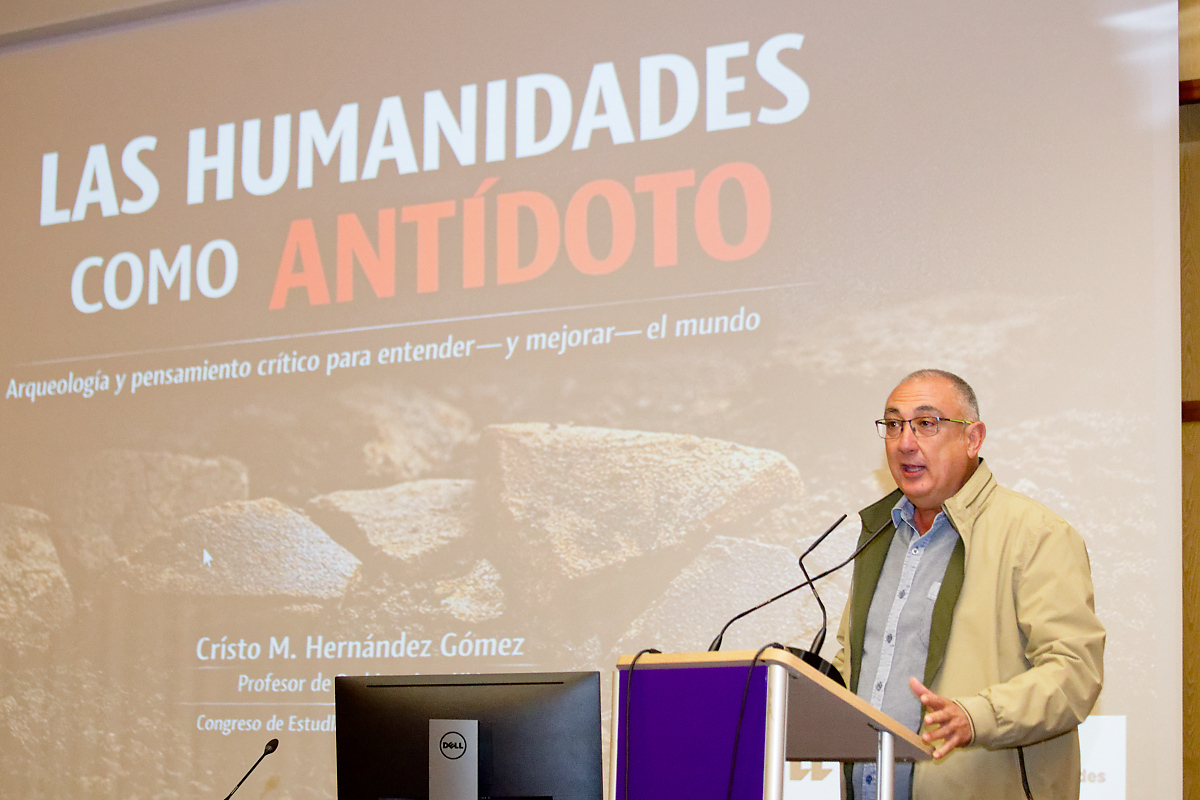
Cristo Hernández, at the opening conference.
For his part, the president of Alumni ULL, Luis Ortigosa, highlighted the value of research and interdisciplinary dialogue as the cornerstones of the congress, and defined the event as a space born from the enthusiasm and curiosity of the student body. He also emphasized the importance of collaboration and knowledge as a shared process built through the exchange of ideas. The day also featured an opening presentation entitled “The Humanities as an Antidote: Archaeology and Critical Thinking to Understand and Improve the World,” delivered by Cristo Manuel Hernández, Professor of Prehistory and Vice Dean of Quality and Innovation in Teaching for the Department of Geography, History, and Art History. The program was structured around thematic sessions that addressed works related to areas such as History, Geography, Art History, Philosophy, English Studies, Applied Francophone Studies, Spanish Language and Literature, and Classical Studies, fostering the exchange of diverse perspectives within the field of the Humanities.
Among the participants were students from both public universities in the Canary Islands. This was the case for Óscar López, a History student at the University of Las Palmas de Gran Canaria, who explained that his participation stemmed from a desire to "build bridges" between institutions and strengthen the relationship between student delegations. For him, presenting his work in this context represents an opportunity to share his research and take a first step in the academic field.
Laura Marcano, a History graduate from the University of La Laguna, also participated, presenting a paper focused on the role of women in the independence processes of the Pan-American colonies. Her research offers a critical revision of the traditional view, highlighting the value of women's contributions to these historical events. The graduate emphasized that the research process involves analyzing and questioning sources, and encouraged students to approach their final degree projects as a learning opportunity. Participating in the conference, she affirmed, also provides a chance to showcase the importance of the Humanities.
The congress included a public speaking workshop to improve the preparation and defense of academic papers, as well as an interdisciplinary round table discussion with researchers from various fields, creating a space for reflection on the current social, academic, and professional role of the Humanities. With this first edition, the Student Delegation of the Faculty of Humanities is promoting an academic forum where students take a leading role as generators of knowledge and promoters of university debate.

 Spanish
 English
 French