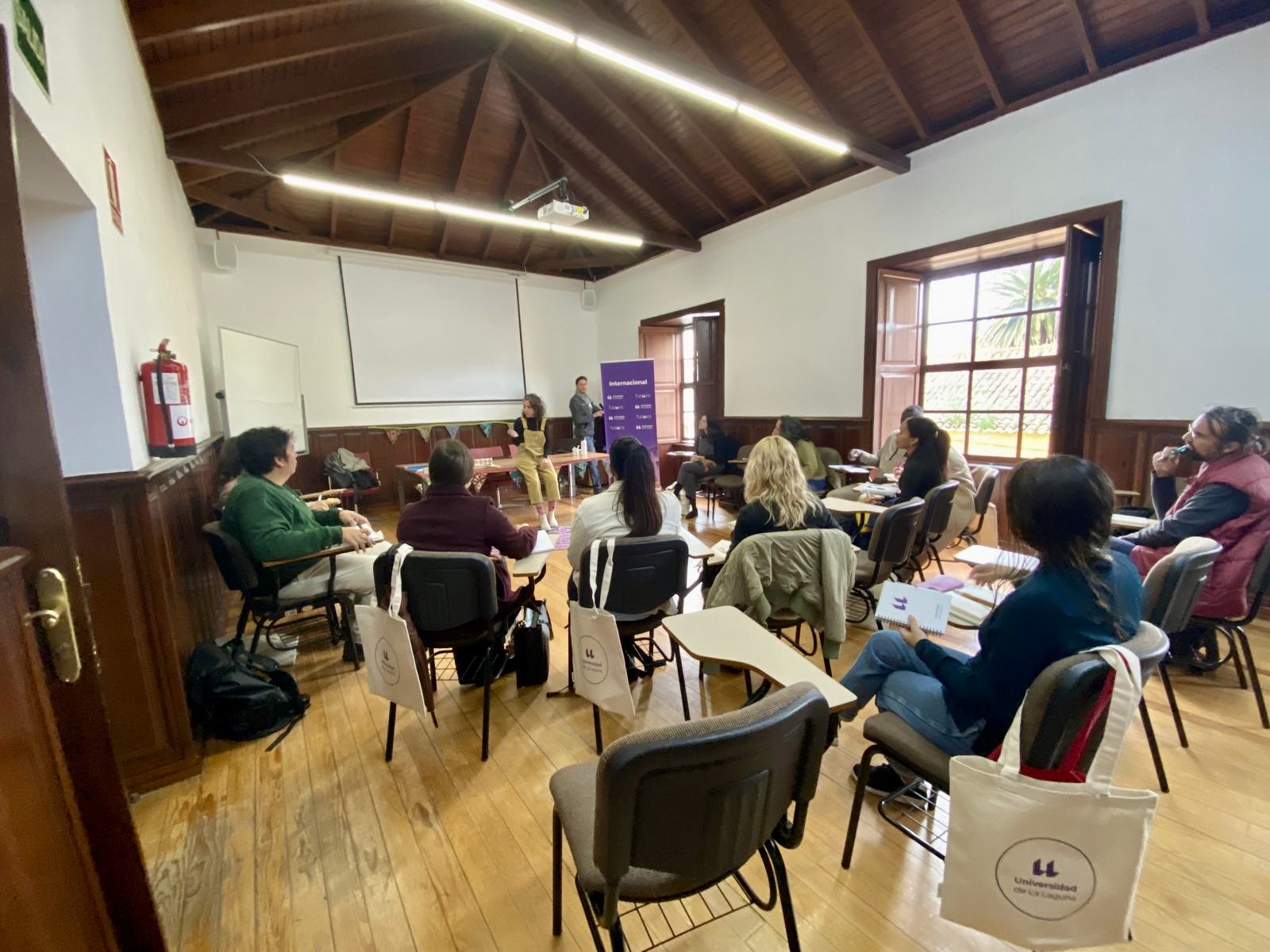
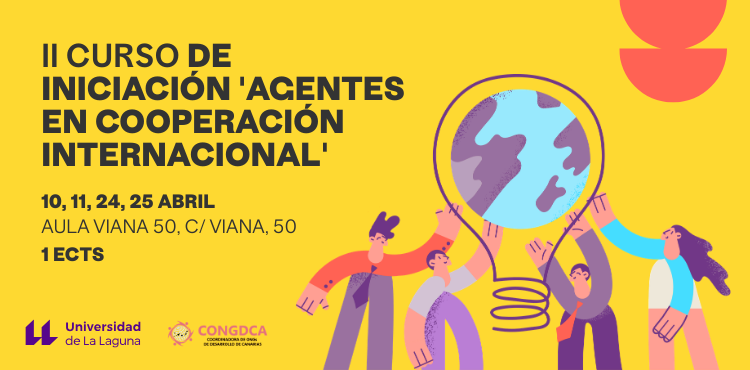
The University of La Laguna has begun the second edition of the introductory course “Agents in International Cooperation”, a training initiative promoted by the Vice-Rectorate for Internationalization and Cooperation, in collaboration with the Foreign Action of the Island Council of Tenerife and the Coordinator of Development NGOs of the Canary Islands, in which thirty people participate.
The opening ceremony was attended by the Director of the Secretariat for Cooperation and Mobility with Africa and Latin America, who, representing the Vice-Rector for Internationalization and Cooperation, highlighted the importance of strengthening student training in international cooperation to promote a critical and committed global citizenship from the public university.
 Alba Rodríguez García emphasized the need to rethink international cooperation, moving away from paternalistic and top-down approaches and focusing on horizontal relationships based on mutual respect, the exchange of knowledge, and the joint construction and validation of knowledge and experiences. In this regard, she pointed out that public universities have a responsibility to educate citizens capable of questioning traditional aid frameworks and strengthening more ethical, critical, and transformative practices in dialogue with the contexts and actors of the Global South.
He also emphasized that this training is not limited to the third sector, but also opens up possibilities for future employment for diverse profiles (health sciences, education, engineering, social sciences or management and many others) who will undoubtedly find dynamic, exponentially growing and strategic professional spaces in African, Latin American or Southeast Asian contexts.
The course, which will allow participants to obtain one ECTS credit, is once again directed by Daniel Buraschi, a lecturer in the Department of Theory and History of Education at the University of La Laguna (ULL). This edition begins with an initial session focused on Introduction to Cooperation, taught by Sara Rodríguez de Vega (head of the Tenerife office of the Canary Islands Development NGO Coordinator), in which the fundamentals of international cooperation and the role of the various actors involved are addressed.
The second day will focus on the Decolonizing Cooperation approach, incorporating a critical perspective on traditional practices in the sector. The third day will address Intercultural Competencies: reflexivity, communication, and conflict management, and will be geared towards developing intercultural skills and tools for the constructive management of conflicts in cooperation contexts. Finally, during the fourth and final session, entitled Communication for Social Change and Cooperation, students will work on designing communication strategies aimed at social transformation.
Throughout the course, students will have the opportunity to learn about the main actors, strategies, and regulatory frameworks of international cooperation in the Canary Islands, and to engage with real-world experiences that will allow them to identify challenges, innovations, and best practices. They will also work with communication and education tools for global citizenship, which are key to developing projects with social impact.
The course methodology is based on a participatory and reflective approach, combining theoretical presentations with case studies, group dynamics, practical exercises and spaces for critical reflection. This structure fosters meaningful learning and the development of key competencies for intervention in international contexts.
With this initiative, the University of La Laguna reinforces its commitment to training in development cooperation and to the promotion of a critical global citizenry, trained to understand and act in a complex, interdependent and constantly changing international context.

 Spanish
 English
 French