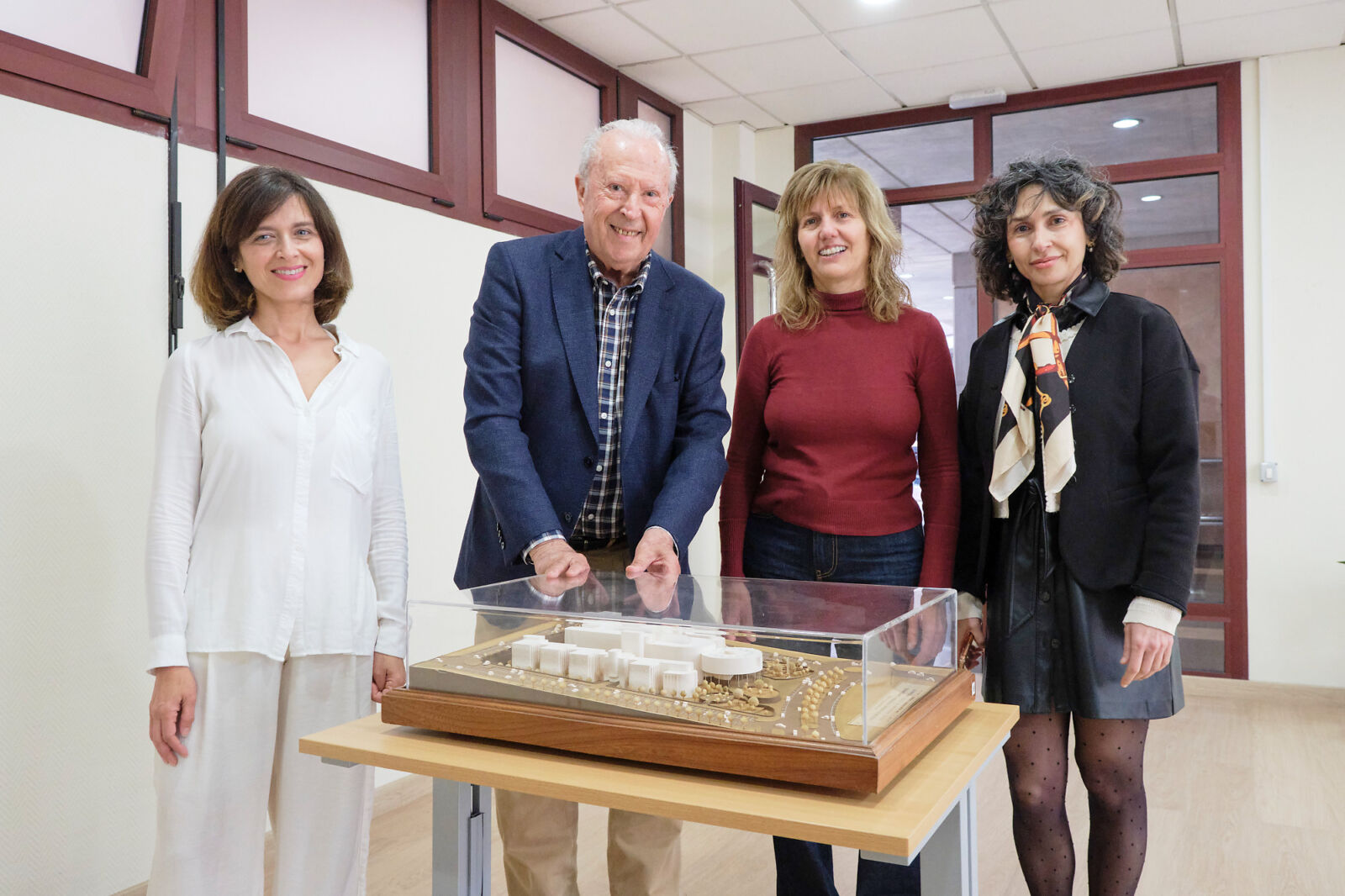
The Faculty of Economics, Business and Tourism The center experienced a day of special institutional and cultural significance with the visit of architect José Miguel Molowny, who came to the center last Friday on the occasion of the VI Conference on Women and the Economy.
The architect's presence was marked by the interdisciplinary nature of the event, highlighting the presentation of the TOTEM project, an initiative promoted by Judit Mendoza, professor in the Department of Economics, Accounting, and Finance, and Juan Carlos Martín Bello, retired professor in the Department of Business Administration and Economic History. This artistic proposal brings architecture and contemporary art into dialogue, integrating one of Molowny's sculptures, located in the Faculty Library, with an innovative blend of dance and music that enriched the aesthetic experience of the attendees.
Beyond his participation in the day's events, Molowny's visit provided a moving journey through the living history of the building that houses the Faculty's degree programs. The architect took the opportunity to visit the commemorative model on display in the center, installed to mark the 50th anniversary of the Faculty's founding in 1975, the seed that led to the construction of the current building in 1992.
During the tour, the architect was accompanied by professors Judit Mendoza and Diana Martín, the latter a member of the Center's Equality Commission, responsible for organizing the VI Conference on Women and the Economy.
This visit served to highlight the center's history and its architectural significance within the university landscape. As a gesture of recognition for his contribution to the design and development of the facilities, the Dean of the Faculty, Inés Ruiz, asked José Miguel Molowny to sign the plan with the original elevation of the main façade.
During the ceremony, the dean thanked Molowny for his legacy and the emotional and functional impact of his work. "We want to thank him for leaving us a space that, beyond its walls, has gathered, gathers, and will continue to gather the stories, hopes, and concerns of thousands of students who shaped their future within these walls. A building that, recently, has been enhanced with fantastic acoustics for music, as demonstrated by the activities organized in the newly opened Cultural Space in its lobby.".
This meeting, held in a close-knit atmosphere, symbolizes the union between the architectural legacy that defines the physical space of the Faculty and the vibrant academic and cultural work that has been developed within it for more than five decades.

 Spanish
 English
 French