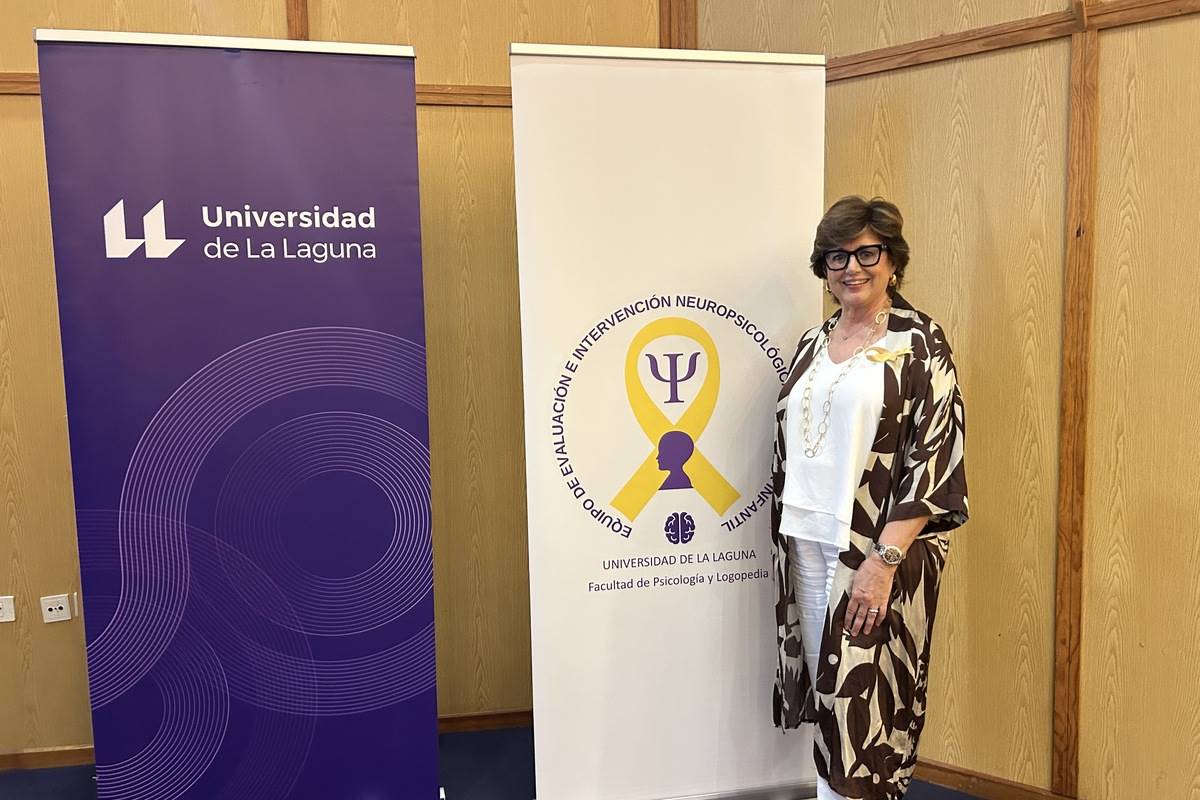
Within the framework of III Congress on Childhood Cancer: Strengthening Lives in the Canary Islands, At the congress recently held at the University of La Laguna, Dr. Ana Fernández-Teijeiro Álvarez, head of the Pediatric Onco-Hematology section of the Virgen Macarena University Hospital, opened the congress with the lecture “Pediatric Cancer in the 21st Century: Advances, Challenges and New Horizons”.
The meeting, organized by the team of Neuropsychological Assessment and Intervention in Childhood Cancer, Furthermore, in collaboration with the Chair of Childhood and Adolescence and other entities at the University of La Laguna, the project has focused on an increasingly relevant reality: the increase in survival rates. This collective achievement not only reflects medical progress but also opens a new scenario in which more and more children are overcoming the disease and reaching adolescence and adulthood, which raises the need to improve their long-term follow-up and quality of life.
During her presentation, the specialist highlighted the improvement in survival rates over the last few decades: “In the 1980s, the five-year survival rate was around 50%, and currently it stands at 84%,” an advance she attributed to the development of treatments, research, and improvements in healthcare organization. Globally, she noted that “around 400,000 cases of childhood cancer are diagnosed worldwide,” while in Spain, approximately 1,500 new cases are registered each year. Although its incidence is low, it remains the leading cause of death from disease in childhood.
Among the main challenges, Fernández-Teijeiro pointed out the difficulty of early diagnosis, since the initial symptoms can be confused with common illnesses. She also warned about the situation of adolescents, a group that falls into a middle ground within the healthcare system, and stressed the need to promote protocols that strengthen the care of adolescents by ensuring they are treated within both pediatric and adult settings.
In the clinical setting, he emphasized the need to improve outcomes for central nervous system tumors. “Survival rates for brain tumors in Spain are clearly improvable,” he stated, advocating for the centralization of interventions in specialized centers. The increase in survival rates has brought new challenges. He explained that approximately 70% of patients experience treatment-related sequelae, and 40% suffer serious effects, which can impact their cognitive, emotional, and social development. In this regard, he stressed the importance of psychological support and rehabilitation, and highlighted the need to strengthen the presence of neuropsychologists within the healthcare system to improve care for these patients.
The specialist also highlighted the role of international collaboration through European networks and the involvement of various institutions, which facilitate the exchange of knowledge, access to innovative treatments, and the development of common strategies to combat the disease. Despite the progress, she noted that there is still a percentage of patients who cannot be cured, making it essential to continue researching and improving comprehensive care.
In conclusion, Fernández-Teijeiro emphasized the current guiding principle of pediatric oncology: to continue advancing not only in cure rates, but also in the quality of life of patients. In this regard, she stated that the challenge is "to continue improving cure rates and, above all, reducing side effects, offering each patient the treatment that guarantees their survival under the best possible conditions.".

 Spanish
 English
 French