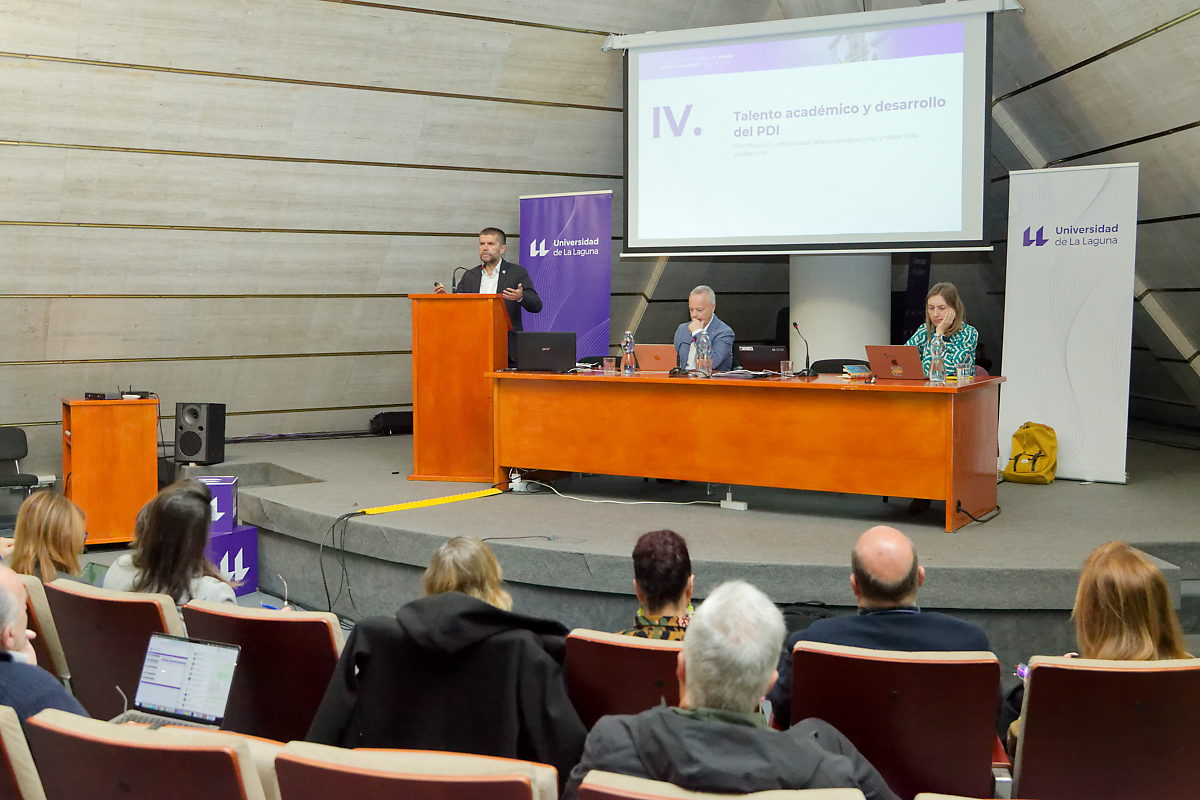
The University of La Laguna's Senate held its annual debate on the state of the academic center today, April 24th. During the session, the rector, Francisco García, presented his report on the current state of the institution, which was then answered by the Senate groups.
This debate is taking place at the midpoint of the rector's term, which Francisco García described as "a changing landscape, with profound budgetary constraints, while new private operators are entering the market and creating tension, all of which demands adaptability." For the rector, the immediate strategic priority is ensuring financial sufficiency in the medium and long term, "in order to move forward with transformation projects within a context of profound societal change, working from a foundation of integration and internal cohesion," he said.
The university is taking steps toward a more flexible academic offering, addressing the generational shift in its faculty and restructuring its teaching staff. It must also strive for robust research connected to the local community, greater international reach, cultural activities perceived as beneficial to society, and policies aligned with the challenges of the ecological transition.
The rector explained that this year's budget reaches €181.5 million, representing a 4.1% increase over the previous year. However, compared to accumulated inflation of 30.1% between 2009 and 2025, what has actually occurred is a loss of spending capacity of 18.1%. This means that the regional funding share, which was 84.1% in 2009, will only amount to 80.1% in 2025. If the Organic Law of the University System stipulates the importance of capturing 1.1% of GDP, "we are very far from this objective, as we are only reaching 0.41%," the rector pointed out.
In this context, La Laguna has launched an administrative modernization plan, with six main areas of action and 50 defined projects, 36 of which are underway this year. These include work on the automated management of invoices, the implementation of dynamic procurement systems, and various collaborative projects with other government bodies. The city has also achieved the highest possible rating in transparency, among other accomplishments.
In terms of social responsibility, the third Equality Plan, covering 2026-2030, is currently under evaluation, while the harassment protocol and equality training are being refined. The university is also involved in several projects related to a single data policy, fostering a shared digital culture, developing a master plan for technological infrastructure, and upgrading perimeter security devices and data processing capabilities.
Francisco García reported that 718 teaching positions have been advertised during this period, resulting in 494 formal contracts and thus lowering the average age of the staff by 2.5 years. “We need to reduce administrative complexity, reorient the teacher recruitment policy, and consolidate the substitute teacher pools,” he added. He also mentioned the recent addition of 35 permanent PTGAS (Technical Support and Support Group) positions, the necessary reform of the staffing levels for both contract and civil servant personnel, which is already underway, and the implementation of flexible scheduling and digital records.
The University of La Laguna (ULL) currently has a total of 21,011 undergraduate, master's, and doctoral students, representing an increase of 1,300 students since 2020. "This is a steady and sustained growth in a highly competitive environment," García stated. She also addressed the need to adapt the course catalog, following a comprehensive analysis of over sixty indicators for each degree program conducted at the beginning of her term, which is already resulting in some changes. She mentioned the introduction of conditional enrollment in master's programs for students with a final degree project (TFG), the regulations for academic programs with successive pathways, the regulations for microdegrees, and the eight official double degrees offered starting this academic year.
He also announced the new regulations for university-specific programs and the creation of the Center for Continuing Education, where a total of 205 micro-credentials have been approved so far. “We are the only university in the Canary Islands that offers this type of training, to work more closely with the productive sector, and in fact we are going to generate 2,000 professional certifications,” the rector stated.
Regarding new degree programs, there are eleven proposed official degree programs currently under review. These would include five new bachelor's degrees and six master's degrees, as well as a double degree in Nautical Studies, Maritime Transport, and Marine Technologies. Work is also underway on a dual international official Master's degree in renewable energies, in collaboration with the University of Milan. Full in-person instruction is also planned for the next academic year at the South Campus and the La Palma Campus.
The rector highlighted the consolidated network of 270 research groups, 14 university institutes, and 21 corporate chairs. This network has resulted in nearly 4,000 scientific publications in 2025, placing the university 22nd in the expanded Shanghai Ranking and 702nd in the world. The rector also emphasized the excellence contracts, predoctoral fellowships, and doctoral placements in companies designed to promote knowledge transfer, as well as the 95 active national and regional projects and 57 ongoing European projects.
Francisco García stated that one of the university's objectives is to move from occasional mobility to structural internationalization, for which they are working on five joint degrees with the universities of the European alliance STARS EU, while there has been an increase of 10% in Erasmus mobility.
In the cultural sphere, the University of La Laguna (ULL) boasts an art collection of over 4,000 cataloged works. One of its key features is the Paraninfo (Great Hall), which has hosted over 50,000 attendees at 210 events. Regarding infrastructure, the drafting of the project for a new Faculty of Education has been put out to tender, a project for the new Faculty of Medicine is being finalized in partnership with the Island Council, and the expansion of the Institute of Biomedical Technologies has already been agreed upon. Meanwhile, work continues with various public and private stakeholders to create new university residences.
Cloistered groups
Following the rector's address, the various student groups had the opportunity to express their own vision of the university. The group representing the PTGAS sector emphasized the precarious situation of this professional group, which is in need of structural reorganization, increased recruitment of talent, and staff shortages in many departments.
For their part, Ágora, the student group, referred to infrastructure improvements, the need for more teachers, and the strengthening of sustainability policies. The spokesperson for COMPAS, from the PTGAS (Galician Technology Park), acknowledged the progress made in personnel policies, while also expressing concern about the privatization of services and the state of the infrastructure, although she maintained that progress is evident. She also noted her dissatisfaction with insufficient funding and the glaring absence of a program contract.
ACE, the student body, focused its speech on the opportunities for social mobility and equity offered by public universities, in contrast to the relentless growth of private institutions, which it considers a clear social setback. It called on the university to be more courageous and determined in defending its institutional interests.
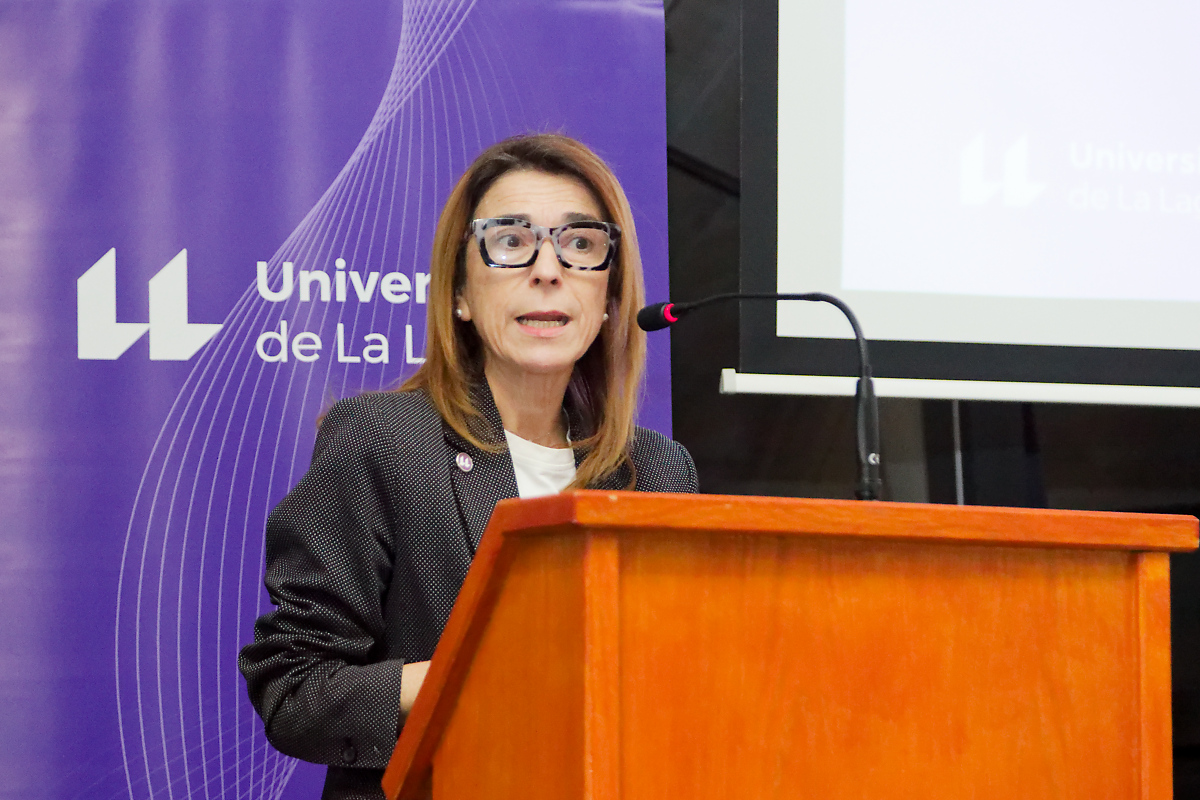
Lidia Pereira, manager.
The Alternative Faculty Platform group stated its aspiration for a university rooted in its region, capable of competing internationally, and its spokesperson pointed out that the university is currently poorer in real terms than it was twenty years ago. “We must build a university so valuable that it becomes politically untenable not to invest in it,” argued the spokesperson, who also mentioned the competition from private institutions of questionable quality. The group advocated for greater impact in research, increased organizational efficiency, and more competitive degree programs.
Annual accounts
The manager of the academic center, Lidia Pereira, presented her report on the execution of the 2025 annual accounts to the Faculty Council at the end of the morning. She reiterated the need for a stable and clear financial instrument to be able to work without uncertainty.
He explained that the University of La Laguna has an increasingly greater capacity for budget execution. Initial revenue projections for the fiscal year were €174,452,000, and the final figure was €281,282,137. Regarding expenditure, the initial budget allocation was €173,819,000, which was subsequently modified by €100,726,779, resulting in a final budget allocation of €273,329,779.

 Spanish
 English
 French