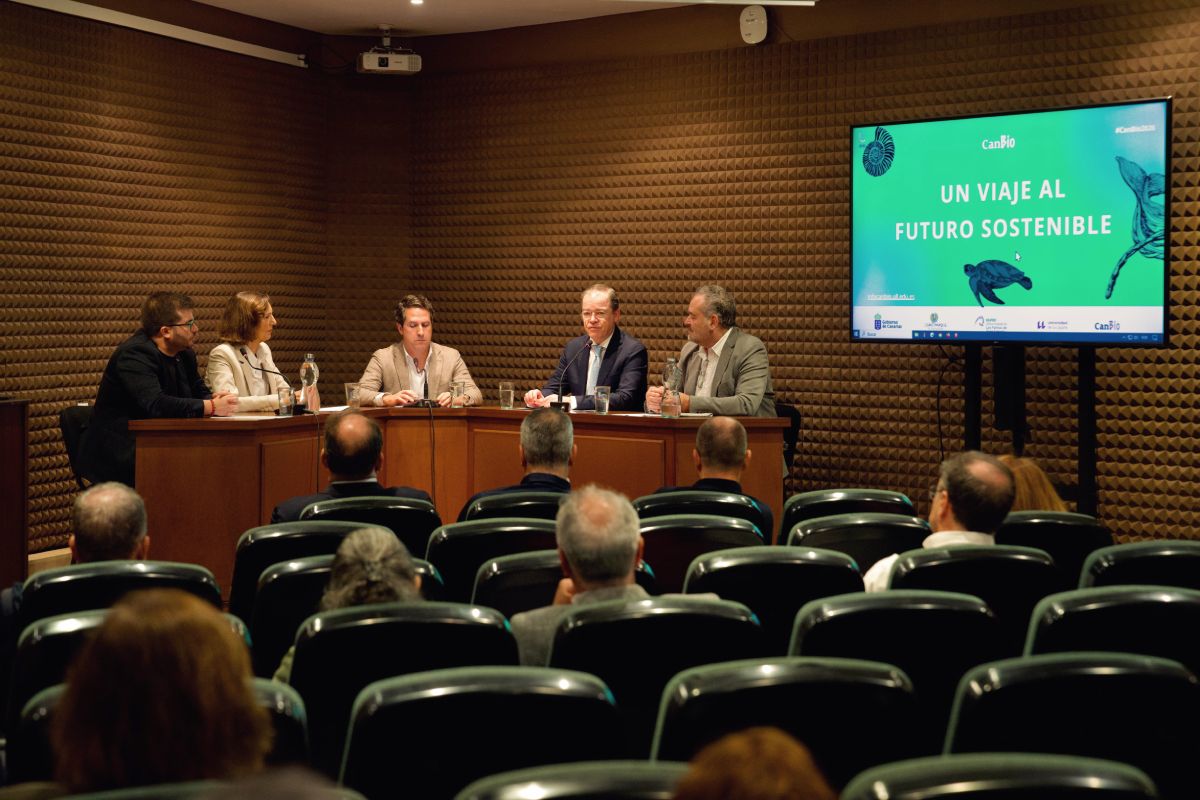
The University of La Laguna hosted the 6th Conference “A Journey to a Sustainable Future,” an academic and scientific outreach event where the results of the CanBIO project were presented. This program, developed jointly with the University of Las Palmas de Gran Canaria (ULPGC), analyzes climate change and its effects on the threatened biodiversity of the Canary Islands over a six-year period. The event was held in the Lecture Hall of the La Pirámide de Guajara building at the University of La Laguna. Faculty of Social Sciences and Communication It brought the main advances of this investigation closer to the public.
At the opening ceremony, María del Mar Afonso, The dean of the Faculty of Sciences at the University of La Laguna pointed out that the CanBIO project has generated relevant knowledge about marine and terrestrial biodiversity, in addition to fostering a space for collaboration between science and society with a strong commitment to scientific dissemination.
Christoph Kiessling, president of the Loro Parque Foundation, emphasized that the Canary Islands can conduct world-class research due to its efficiency, quality, and results. Similarly, Aridane González, director of Research and Scientific Policy at the University of Las Palmas de Gran Canaria (ULPGC), underscored the importance of the Canary Islands as a natural laboratory and as an exporter of scientific knowledge.
On the other hand, Ángel Montañés, Director General of Ecological Transition and the Fight against Climate Change of the Government of the Canary Islands, stated that research is key to combating misinformation about climate change, as it provides data that allows us to understand the reality and make informed decisions.
Francisco Javier Almunia, A researcher in the Zoology Department at the University of La Laguna and coordinator of the CanBIO project, highlighted that the project has become a benchmark in monitoring climate change and its effects on the ocean. He emphasized the importance of having built long time series of data, fundamental for understanding the evolution of systems and their changes. He added that, at this point, the time series is already consolidated and allows for a more precise interpretation of the processes being observed.
The Vice-Rector for Research and Transfer at the University of La Laguna, Antonio Aparicio Juan, emphasized that projects like CanBio exemplify the importance of knowledge transfer: “These conferences demonstrate the fundamental role and duty of universities not only to develop robust research on topics as relevant as climate change, but also to incorporate a strong knowledge transfer component for society.” He also stressed the need to strengthen public-private collaboration between public universities that produce top-quality knowledge and private initiatives interested in supporting research strategies addressing these issues.
The meeting was also attended by the Vice-Rector for Research at ULPGC, Juan Alberto Corbera Sánchez, who highlighted CanBio's contribution to expert knowledge on the effect of climate change on ecosystems and threatened species in the Canary Islands: "To be able to protect our natural heritage we have to know it and without a doubt this is the best investment that society makes to achieve a scientific understanding of our environment.".
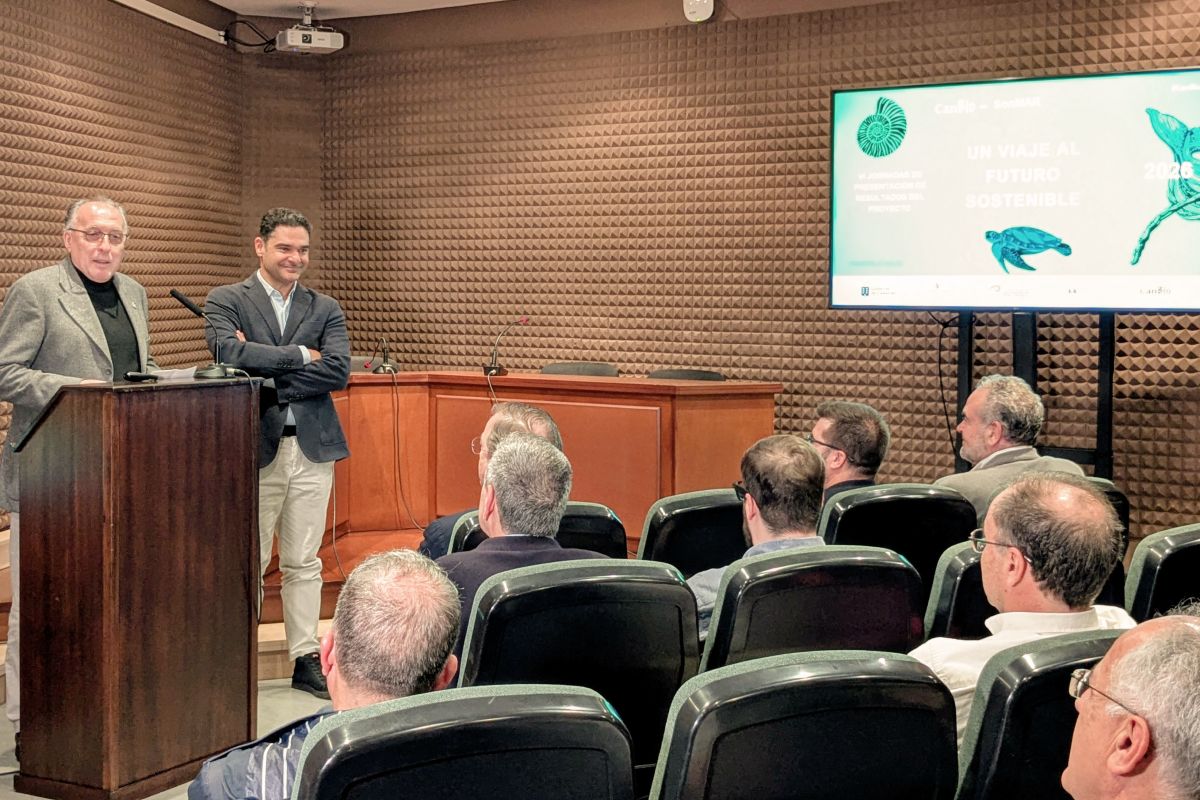
The Vice-Rector of the ULL during his speech.
Presentation of results
Almunia, as lead researcher of the SonMAR subproject, presented the results of this research with which he has managed to collect more than 33,000 hours of marine acoustic recordings throughout the archipelago, especially in areas of special conservation.
Apart from Almunia, the subprojects led by research staff from the University of Laguna are “BuoyPAM – Passive acoustic monitoring, noise and underwater landscapes”, from Fernando Rosa (Industrial Engineering); “BioTER Gastropods – The thermometer of climate change on Earth: reassessment of the threat level of land snails”, by Carolina Castillo (Paleontology); and “BioTER Arthropods – From the re-evaluation of terrestrial arthropods to the evaluation of aquatic macroinvertebrates”, by Felipe Rodríguez (Biology).
The other subprojects are “CanOA – Machine Learning ”To increase knowledge of ocean acidification in the Canary Islands“, by Irene Sánchez (ULPGC); ”BioACU – Advances in the monitoring of acoustically tagged marine fauna from autonomous vehicles“ and ”MacPAM – New data on the seasonal presence of cetaceans in the Canary Islands“, by Jorge Cabrera (ULPGC); ”BioMAR – Distribution, biology and ecology of elasmobranchs in the Canary Islands“, by David Jiménez (ULPGC); and ”BioMAR Turtles – Citizen science at the service of conservation”, by Antonio Gallardo, managing director of the Fuerteventura Biosphere Reserve.
Finally, Patricia Delponti, Professor [Name], a tenured professor in the Department of Audiovisual Communication and Advertising at the University of La Laguna, along with the CanBIO communications department, spoke about the CanBIO project's communication strategy. Their research revealed that traditional communication methods lack the reach necessary for such a critical issue as climate change. Therefore, they are committed to a more accessible approach to science communication, employing transmedia storytelling and other unconventional channels. They also presented the various educational activities, citizen science initiatives, and exhibitions related to climate change that have been carried out.
CanBIO is a public-private partnership funded equally by the Loro Parque Foundation and the Government of the Canary Islands, with a budget of 4 million euros. Almunia indicated that the agreement will be in effect until 2027. The project analyzes the effects of climate change on the marine environment, underwater noise, ocean acidification, and their impact on critically endangered marine and terrestrial biodiversity in the Canary Islands.

 Spanish
 English
 French