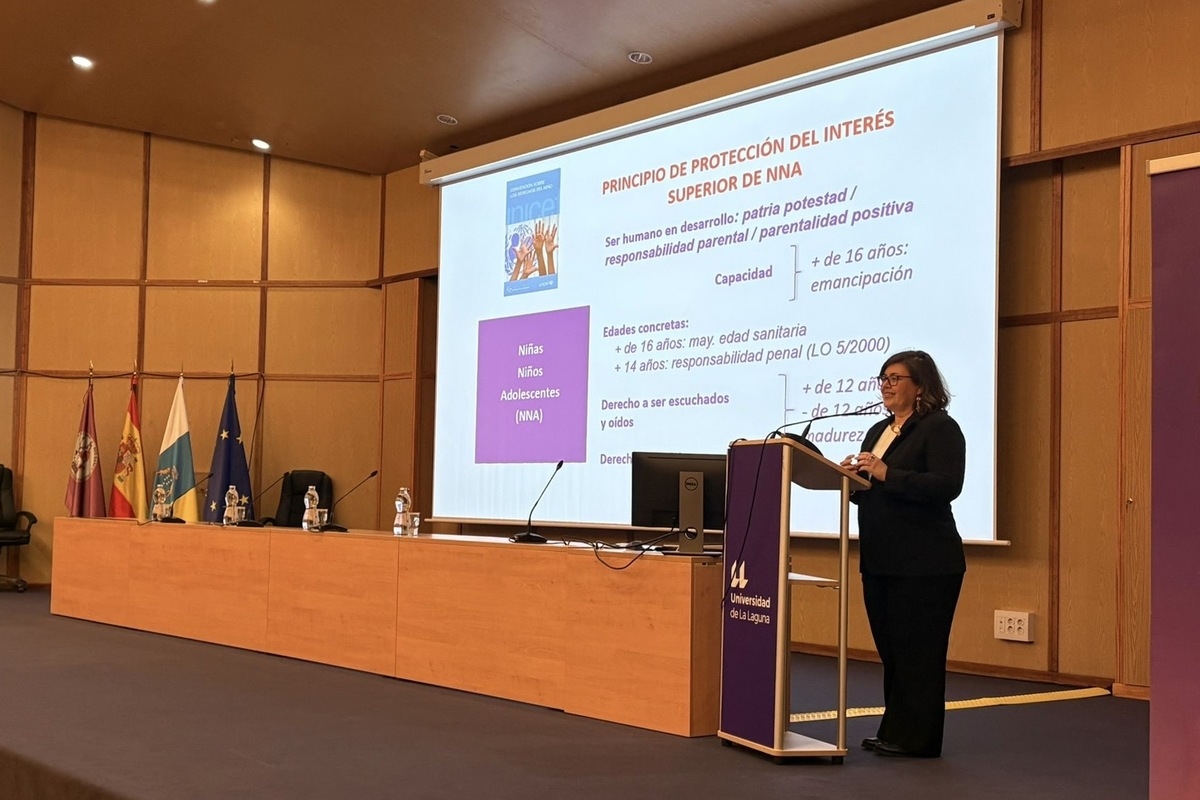
Last Thursday, April 23, 2026, Mª Aránzazu Calzadilla Medina, tenured professor of Civil Law, coordinator of the Research group “Law, person and family” and director of the Chair of Childhood and Adolescence at the University of La Laguna, gave an invited lecture at the III Congress on Childhood Cancer in the Canary Islands: Strengthening Lives.
The conference, entitled '‘The legal protection of children with cancer: rights, guarantees and challenges’, The aim was to highlight the legal status of minors in the context of this disease, as well as to address the crucial legal position of their families and, of course, healthcare professionals. The speaker, before an audience of university professors, university students, healthcare professionals of various categories and specializations, and families, was divided into three distinct parts.
First, after a brief overview and introduction, the Professor addressed the current status of minors under Spanish law, emphasizing that the adult-centric view of them as "objects of law," which has characterized virtually all periods of history, has been abandoned in favor of recognizing them as true "subjects of law" today, both within the Spanish legal system and internationally. She noted that "the turning point in this process of recognizing rights and establishing guarantees can undoubtedly be identified with the 1989 UN Convention on the Rights of the Child." She also highlighted, as a crucial and momentous milestone, the entry into force of the 1978 Spanish Constitution, which, for the first time, established the equality of all children before the law, regardless of their origin or the circumstances of their parents.
After noting that the principle of protecting the best interests of the child is the central axis of the entire system, from which all other rights and guarantees are derived, Dr. Calzadilla Medina discussed the content of various rights, highlighting in detail the right to be heard, the right to participate, the right to education, and the right to information, among others. All of this is framed within the progressive capacity now recognized for this sector of the population, with the caveat that some regulations establish specific ages for certain actions. In this regard, she pointed out that 12 years of age marks a turning point—because from that moment on, for example, children must always be listened to—although even when they are younger but mature enough to understand the specific situation, they should be given the opportunity to exercise their rights. On the other hand, she reminded the audience that the age of 16, although it does not confer full legal capacity, is a crucial factor in determining whether or not a child can exercise their rights. per se Reaching the age of majority does grant a different position in the health field, as this group of adolescents, as a general rule, can now decide for themselves.
Secondly, regarding families, he emphasized their crucial and vital role in this entire process, as well as the position that parental authority (parental responsibility) confers upon parents, highlighting their right to maintain a relationship with their children. The fulfillment of their duties becomes essential, and in this context, their representative role is very important, although it must be exercised within the framework described. To illustrate this, he gave a real-life example that clearly demonstrated that, despite the importance of the family's role, the central focus should never shift away from guaranteeing the rights of children and adolescents under the age of 18.
Thirdly, she addressed the situation from the perspective of healthcare professionals, acknowledging their vital role and providing examples of scenarios with legal implications, such as potential disagreements between families and these professionals when making decisions. She noted that in such cases, the conflict could be brought before the courts, in which case the Public Prosecutor's Office would also weigh in. However, she advised strengthening the dialogue process between the parties (families, healthcare professionals, and, where applicable, the patient) through mediation to avoid such extreme situations. She also emphasized that mediation is a safeguard for children, as the court will always decide, based on the technical reports submitted and the specific circumstances of each case, in the best interests of the minor.
Finally, after some insightful reflections, the Professor concluded that generic solutions or patterns cannot be applied; rather, each specific case must be analyzed, considering its circumstances, context, and the precise moment in which it arises, in order to make the best decisions in the best interests of the child. She also emphasized that "we must not forget that children with cancer never cease to be children," criticizing the increasingly common practice of classifying human beings based on certain conditions or situations, insofar as this can lead to "forgetting" that we are dealing with true human beings. Thus, children with cancer, or those who have suffered from it, are and will continue to be part of a group that receives special attention from the legal system, and this can never be ignored, only adapted to the different phases and situations they may experience during the illness and in the period following their recovery.
The Chair of Childhood and Adolescence was a collaborating entity of this important Congress, co-directed by one of its members, Prof. Dr.. Sergio Hernández Expósito.

 Spanish
 English
 French