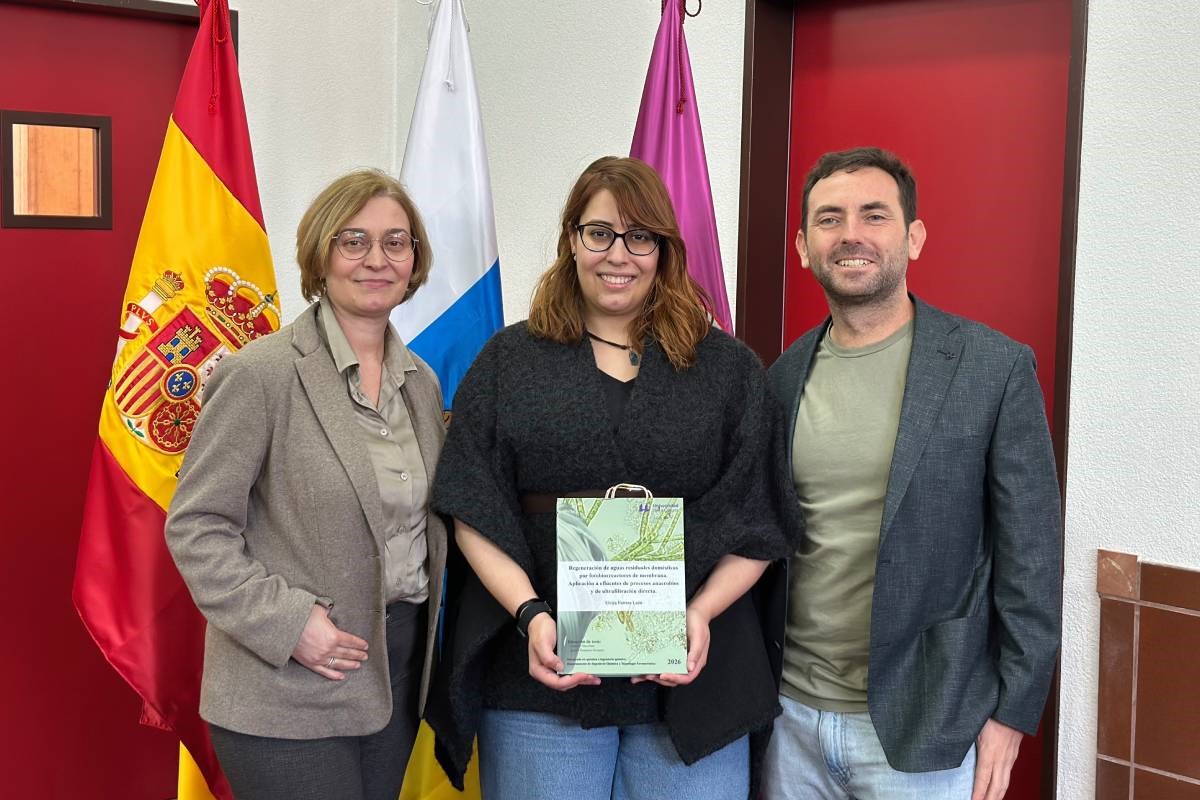
The Chemistry Department at the University of La Laguna recently hosted the doctoral defense of Elvira Ferrera León's dissertation, "Regeneration of domestic wastewater by membrane photobioreactors. Application to effluents from anaerobic and direct ultrafiltration processes." The research, conducted by the newly minted doctor, analyzed the capacity of various novel and emerging technologies for the treatment of urban wastewater under a sustainable management model based on the circular economy. This is crucial in a global context marked by water scarcity, increasing resource demand, and the need to improve waste management.
The research proposes a paradigm shift in conventional wastewater treatment, traditionally focused on removing organic matter and nutrients from urban wastewater generated during its use and application in homes, residences, hotels, etc., so that it can be safely discharged into the receiving environment (subsoil or sea, in the case of the Canary Islands) or, if its treatment level allowed, regenerate it to a quality level that would allow its reuse.
The change of model on which Ferrera León's research pivots involves the conceptualization of new water treatment facilities as biofactories, where water is recovered as high-quality regenerated water, so that it can be reused, as well as the recovery and valorization of other resources present in urban wastewater, such as organic matter and nutrients.
To this end, low-energy technologies have been studied that also allow for the recovery and concentration of organic matter present in wastewater, for its transformation into biogas by means of anaerobic bacteria. Biogas, due to its high methane content, is of interest for energy valorization. In one case, an upflow anaerobic sludge blanket (UASB) reactor was used directly, while in the second case, a direct membrane filtration (DMF) unit was used, which eliminates the need for biological treatment and allows for the concentration of organic matter for its subsequent anaerobic transformation, producing a filtered effluent free of suspended solids.
Both units were integrated with an emerging advanced technology: a tubular membrane photobioreactor (MPBR) unit, in order to produce high physicochemical quality effluents and promote the valorization of by-products.
The study is notable for its use of microalgae-bacteria consortia developed in the MPBRs (Microalgae-Bacteria Recycling Systems). In these consortia, the microalgae capture nutrients present in the water treated by the UASB (Ultra-Anaerobic Sludge Blanket) or the DMF (Dynamic Microorganism Treatment), assimilating them and developing more microorganisms that constitute a biomass with different valorization pathways. On the one hand, it is a form of organic matter that can be digested anaerobically to produce more biogas at the facility, or it can be used for agricultural purposes.
In fact, one of the most outstanding results of Ferrera León's doctoral thesis is the viability of the biomass produced in the membrane photobioreactor, operated outdoor during the regeneration treatment of the effluent from a UASB reactor, as a biostimulant and biofungicide against a fungus very common in Canary Island crops, the Fusarium oxysporum.
Furthermore, the microalgae present in the microalgae-bacteria consortia are capable, through photosynthesis, of capturing carbon dioxide from the water and producing oxygen. This oxygen is used by the heterotrophic bacteria present, both to transform more complex organic molecules into simpler ones, such as the carbon dioxide used by the microalgae, and to facilitate the nitrification of ammonia nitrogen present in the wastewater. Additionally, the filtered water produced by the membranes operating in the membrane photobioreactor to separate the biomass from the water in which it is cultivated has proven to be a fertilizing agent for millet plants.
Furthermore, the research analyzed and optimized different operating modes and strategies for the submerged ultrafiltration membranes used in photobioreactors, with the aim of mitigating fouling. This fouling, caused by the accumulation of species on the filter layer of the membranes, is the main limitation and represents the highest operating cost of this equipment.
The work developed by Ferrera León evaluates not only the operation and energy balance of the direct membrane filtration (DMF) units and the UASB reactor, but also their operational and energy integration with membrane photobioreactors, demonstrating the viability of integrating these low energy consumption technologies with phototrophic processes, offering a technically, environmentally and economically viable alternative to meet the new regulatory requirements.
The doctoral thesis, carried out within the framework of the nationally competitive projects PID2021-125404OB-I00 and RTI2018-093736-B-I00, funded by the Spanish Ministry of Science, Innovation and Universities (MICIU), the Spanish Agency for International Development Cooperation (AEI), and the European Regional Development Fund (ERDF), received support from the Tenerife Island Water Council. This support enabled the researchers to conduct a large part of the experimental trials at one of its facilities: the Northeast Wastewater Treatment and Regeneration Plant, located in Valle Guerra and operated by SACyR Agua. Furthermore, some of the experimentation was performed in a membrane filtration unit (MFU) designed and built with support from a project funded by the Cajacanarias Foundation and the La Caixa Foundation.
The work has been carried out within the Water Treatment and Reuse (TyRA) group under the direction of its head, Professor of Chemical Engineering Luisa Mª Vera Peña and the contracted PhD professor in the same area, Ignacio Ruigómez Sempere.
The panel responsible for evaluating Ferrera's doctoral thesis consisted of Professor José Alberto Herrera Melián, from the University of Las Palmas de Gran Canaria; Professor María Filomena Barreiro Filipe, from the Polytechnic Institute of Bragança, Portugal; and Juan Cristo Luis Jorge, from the University of La Laguna. In its final argument, the panel emphasized the strategic relevance of the integrated solutions evaluated in the research for regions like the Canary Islands, where pressure on water resources is particularly high.

 Spanish
 English
 French