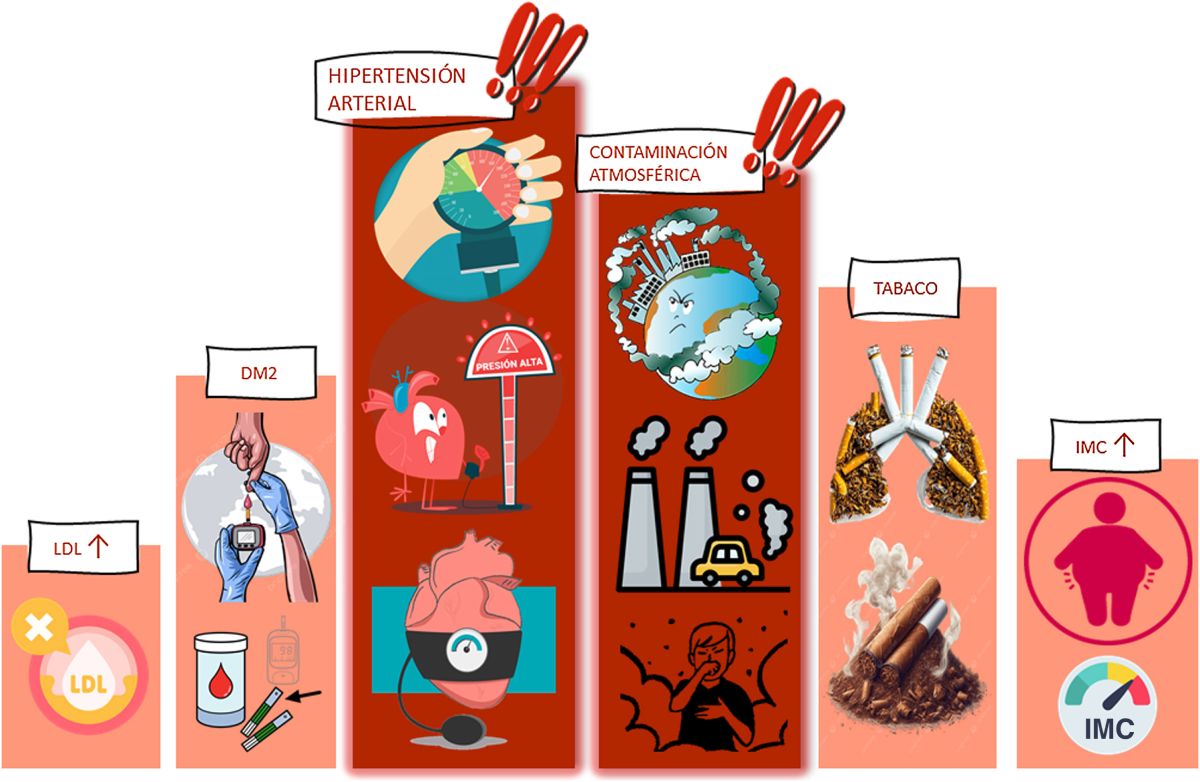
Air pollution has become a major global health risk, according to a recent editorial published in the Spanish Journal of Cardiology. Researchers emphasize that exposure to polluted air has become established as one of the main risk factors for mortality worldwide, ranking among the top factors alongside classic factors such as high blood pressure, smoking, and obesity.
The editorial was written by a team led by the professor and researcher Alberto Domínguez, from the Cardiology area of the University of La Laguna, with the collaboration of Daniel Hernández, from the Health Research Institute of the Principality of Asturias, and Néstor Baéz, from the Cardiology service of the University Hospital of the Canary Islands.
According to the World Health Organization (WHO) and the State of Global Air report from the U.S. Institute on the Health Effects of Air, air pollution is responsible for approximately 8.1 million deaths annually, equivalent to more than one in eight deaths worldwide. Much of this pollution is found in urban areas, where more than half of the world's population lives, and originates primarily from the burning and use of fossil fuels, biomass, and industrial processes.
In addition to human emissions, natural phenomena such as dust storms, wildfires, and extreme heat waves increase the presence of particulate matter and harmful gases. Among the most dangerous pollutants are PM2.5 and PM10 particles, carbon monoxide (CO), and nitrogen oxides (NOx).x), sulfur dioxide (SO₂)2) and tropospheric ozone (O3These particles are capable of penetrating deep into the lungs, reaching even the alveoli, and triggering serious respiratory and cardiovascular problems.
Scientific evidence demonstrates that these pollutants significantly increase the risk of acute myocardial infarction (AMI) and other cardiovascular diseases. For example, in Madrid, an increase in PM2.5 was associated with a 6.61-times-three-day (TP3T) increase in AMI mortality. Recent studies across Spain show that elevated PM2.5 levels during the three days prior to hospital admission increase the probability of in-hospital death following a heart attack by 7.11-times-three (TP3T).
The editorial also underlines the importance of environmental factors such as temperature and humidity, which can amplify the body's physiological response to environmental stress, increasing cardiovascular risk during heat waves, extreme cold, or high humidity.
Experts emphasize that air pollution cannot be considered a secondary risk. In fact, it is estimated to be responsible for 281% of deaths from ischemic heart disease, particularly affecting urban and vulnerable populations. Therefore, cardiovascular prevention strategies must explicitly incorporate measures against air pollution, at the same level as those addressing hypertension, diabetes, obesity, or smoking.

 Spanish
 English
 French