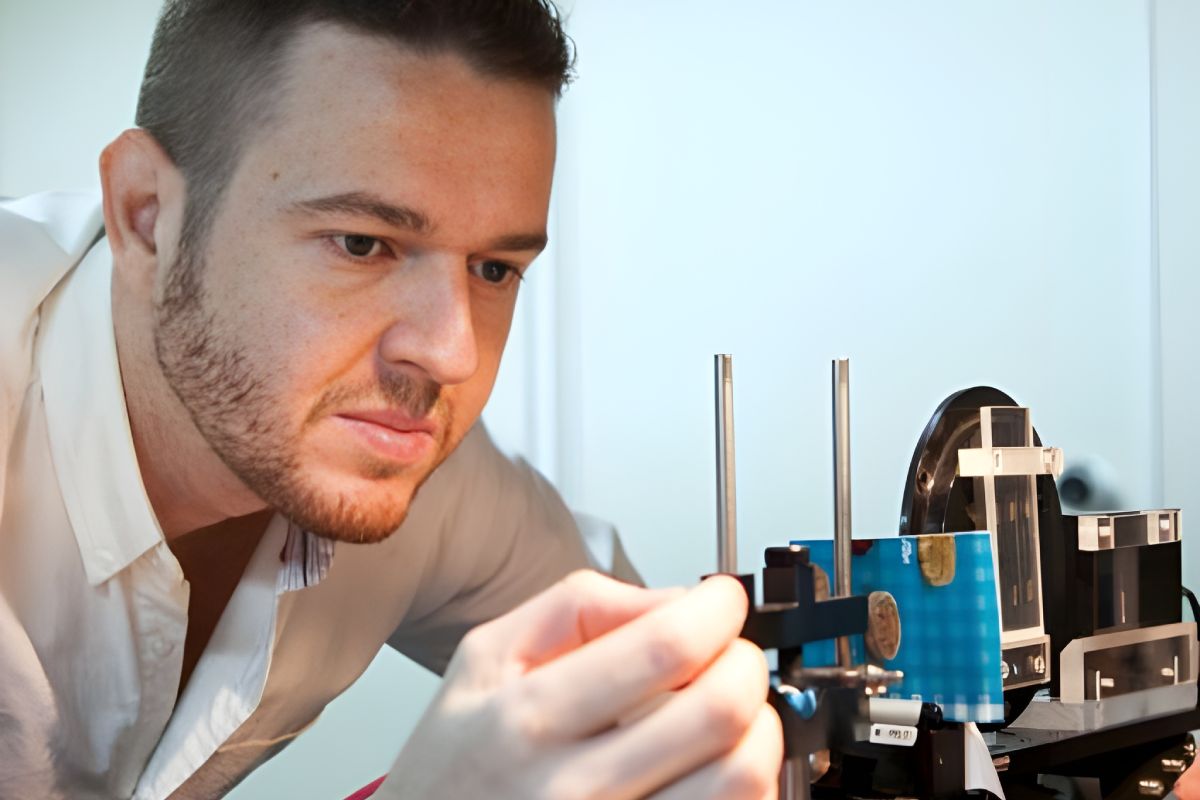
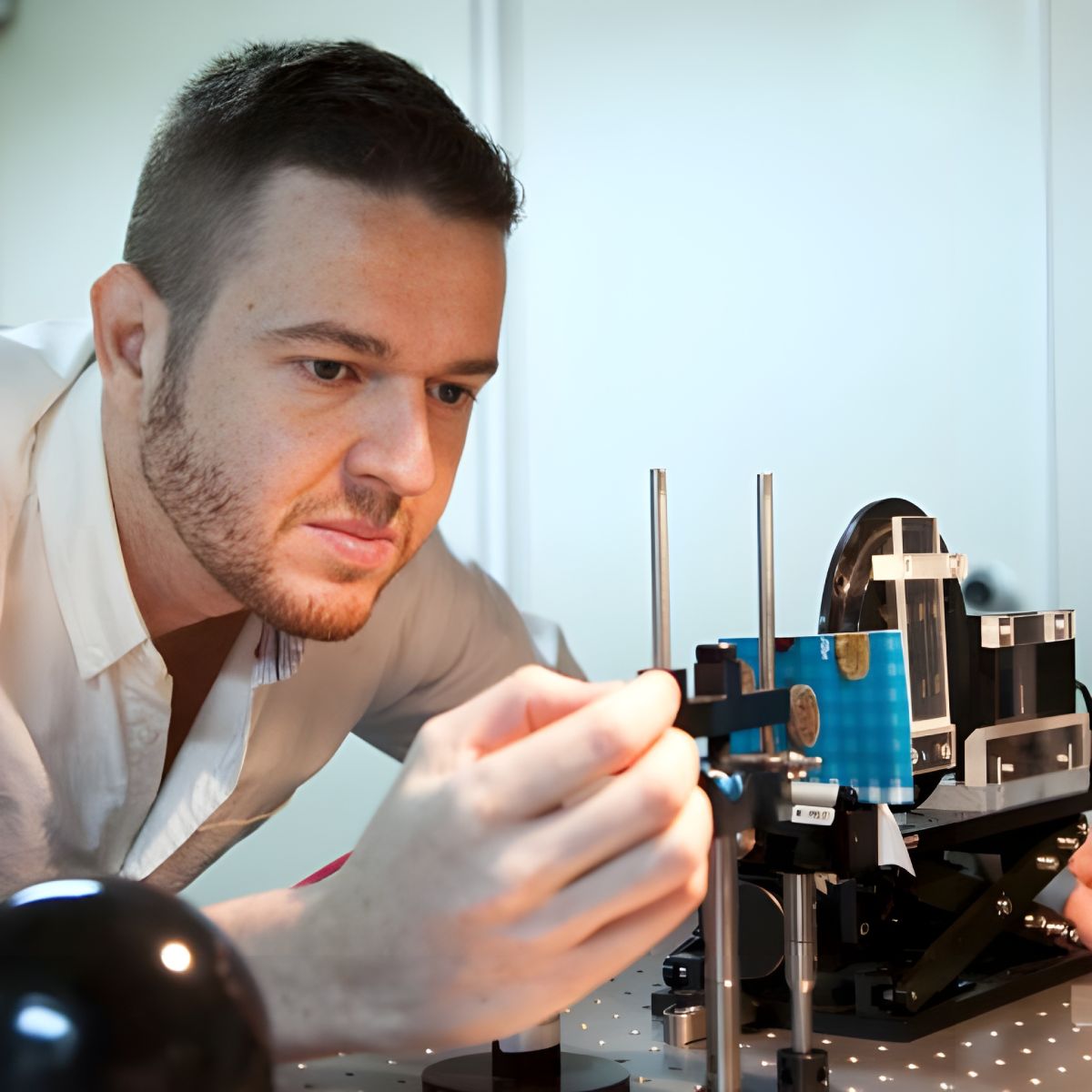
Sergio Bonaque-González, Viera y Clavijo postdoctoral researcher at the University of La Laguna and lead author of the work.
A research group at the University of La Laguna has developed a technology with the potential to change one of the most basic routines of modern astrophysics: measuring the temperature of stars. The work, titled “Diffraction-driven photometry: a novel method for stellar temperature determination”, has been accepted into the journal Astronomy & Astrophysics, one of the most prestigious in the field, and proposes an idea that is as simple to explain as it is difficult to imagine until now: obtaining that information from a single image of the star.
Knowing the temperature of a star is not trivial and is one of the first steps in understanding its nature. From this data, astronomers can begin to deduce other fundamental properties, such as its size, its evolutionary state, and estimates related to its distance and physical characteristics.
For nearly a century, the standard way to estimate a star's temperature has been to observe it at least twice under different conditions, usually using different filters. The two images are then compared, and the temperature is calculated from the difference. This is a robust and well-established method, but it requires repeated observations and the incorporation of filters, switching mechanisms, and greater instrumental complexity.
The new work proposes a novel alternative: instead of relying on two images, the research team has shown that the star's thermal information was already contained in a single shot, encoded in the image's structure itself.
“The quality of astronomical images is limited by an inevitable and natural physical phenomenon called diffraction, which occurs because light behaves like a wave,” explains the doctor. Sergio Bonaque González, Viera y Clavijo, a postdoctoral researcher at the University of La Laguna and lead author of the study, explained, “This causes a star, which ideally should appear as a point, to appear on camera as a small luminous patch. For a long time, this patch has been considered merely a limitation of the image. What we have discovered is that it is not simply noise: its structure contains physical information about the star, including its temperature, and we have shown that this information can be recovered relatively easily with existing telescopes, without needing to add new equipment.”.
The proposal changes how this optical effect is interpreted, transforming what was previously considered a limitation into a new source of information. If this technology becomes established, its applications could be particularly relevant in space exploration, as it would allow telescopes to dedicate more time to observing new objects instead of repeatedly measuring the same ones.
“If we can extract information from a single image that previously required several observations, the impact on efficiency can be enormous. In scientific terms, that's equivalent to significantly increasing throughput and, in certain scenarios, virtually doubling its useful observational capacity,” says Bonaque González. “That means more science in less time, less instrumental complexity, and potentially lighter, more compact, and cheaper systems. On small space platforms, this idea can be especially powerful.”.
The researcher insists, however, that this is foundational work. “This result opens a door, but now we have to walk the path. Classical methods have been calibrated and refined for decades, so any new technique will have to go through a similar validation process. The potential is very high, but time, experimental testing, and engineering challenges will determine how far it can go.”.
This advance reinforces the role of the University of La Laguna in the development of new photonic technologies at a time when science is increasingly dependent on more precise and efficient instruments, and demonstrates that even in a field as mature as astronomy there are still new ways of looking at the sky.
“Although the work originated in the field of astrophysics, its physical principles have broader applications. In fact, the University of La Laguna has already filed a patent application related to one of its potential technological uses, and we hope to be able to share relevant news about this in the near future,” the researcher adds.
This scientific work has been made possible thanks to funding from the Canary Agency for Research, Innovation and the Information Society.

 Spanish
 English
 French