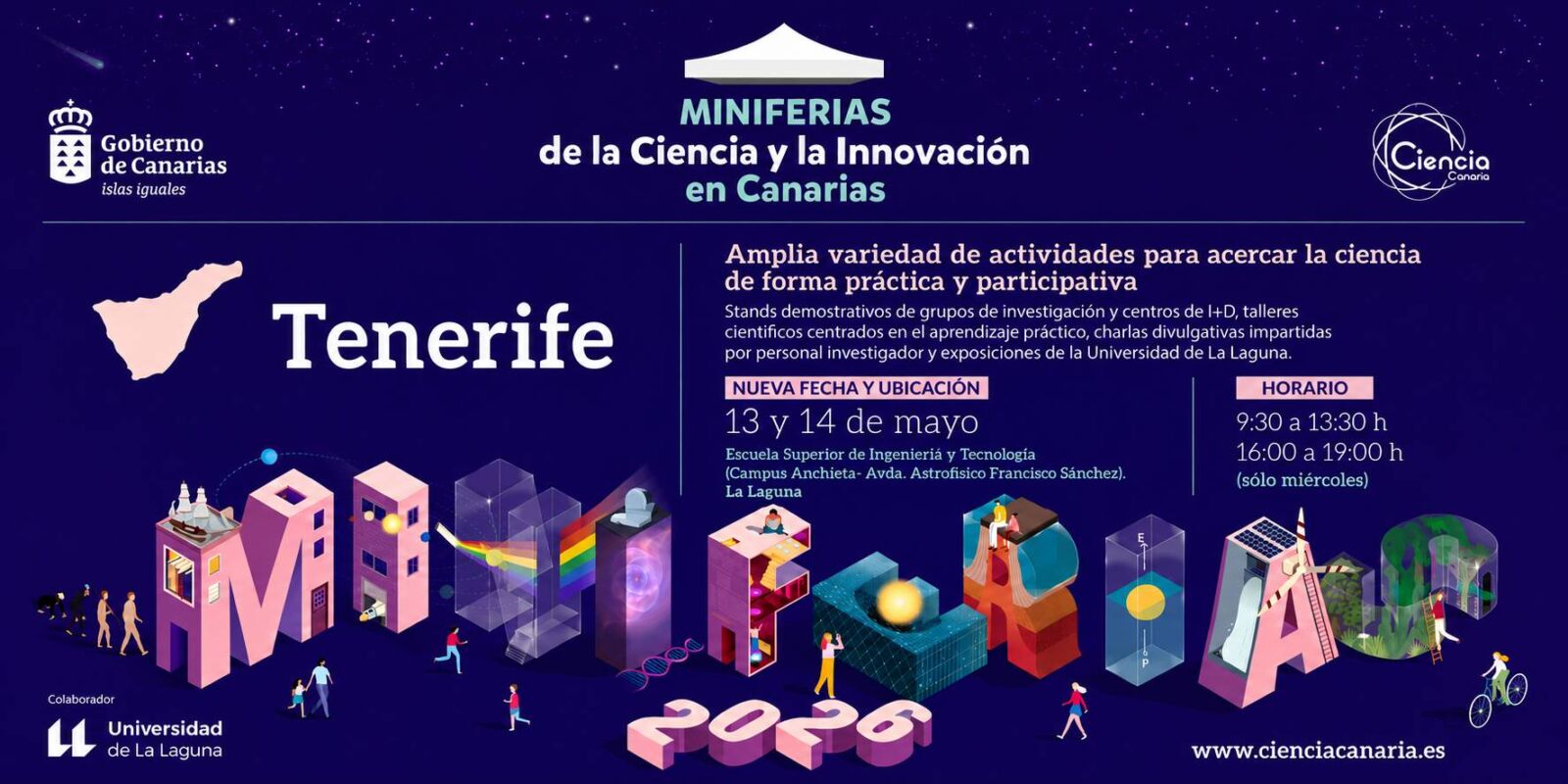
The University of La Laguna, through its Scientific Culture and Innovation Unit (Cienci@ULL), is organizing this week the Mini Science and Innovation Fair in Tenerife. This is a science outreach project promoted by the Canary Islands Agency for Research, Innovation and the Information Society of the Government of the Canary Islands, in which nearly a thousand students from schools across the island will participate. The event will be held on May 13th and 14th at the Higher School of Engineering and Technology, from 9:30 a.m. to 1:30 p.m. and from 4:00 p.m. to 7:00 p.m. on the first day, and only in the morning on the second. Its objective is to bring scientific and technological knowledge closer to the public in an accessible and practical way through workshops, talks, activities, and demonstration stands.
The Mini-Fair aims to promote scientific culture and inspire interest in fields such as science, technology, engineering, arts, and mathematics (STEAM), especially among school students. To achieve this, researchers from the University of La Laguna and professionals from other institutions will share their work in an accessible and engaging way. They will also invite the public to participate and interact directly with them.
The event also offers a valuable learning opportunity for students in the Faculty of Education, as they can attend at their convenience to observe science communication in real-world settings. This will allow them to learn about active learning methodologies, innovative teaching strategies, and effective science communication techniques. All of this will be beneficial to their future teaching careers.
This initiative will take place in the ESIT parking lot and its auditorium. Up to 21 demonstration stands will be set up, with activities lasting approximately 30 minutes. Participants include university institutes and research groups from the University of La Laguna, the Canary Islands Society of Mathematics Teachers “Luis Balbuena Castellano”, the Tenerife Museum of Natural Sciences, the Institute of Natural Products and Agrobiology of the Spanish National Research Council (CSIC), and the National Geographic Institute, among others.
The program also includes science talks in classroom 6 of the lecture hall. This room will host groups of up to 30 students who will be able to listen to half-hour talks given by various specialists. In addition, science workshops are offered in classrooms 4, 7, and 11. These workshops are designed for groups of up to 20 students and will last 50 minutes. In total, 23 schools in Tenerife will participate, with a total of 42 classrooms and almost 1,000 students. The activity will take place over two days. 428 students will attend on the first day and 515 on the second.
The talks will cover diverse topics such as nanotechnology, mathematics, paleontology, astrophysics, and archaeology, among others. Meanwhile, the practical workshops will include activities like “Spatial Order!”, “Mathematical Scavenger Hunt,” and “Computational Thinking: Thinking to Create,” which are part of the educational projects Science on a Grand Scale, Project Math, and Think Computationally.
This activity aims to strengthen the link between the university, educational centers, and society. The Mini-Fair is organized by the University of La Laguna, through Cienci@ULL, and is supported by the Ministry of Universities, Science, Innovation, and Culture of the Government of the Canary Islands, through the Canary Agency for Research, Innovation, and the Information Society.

 Spanish
 English
 French