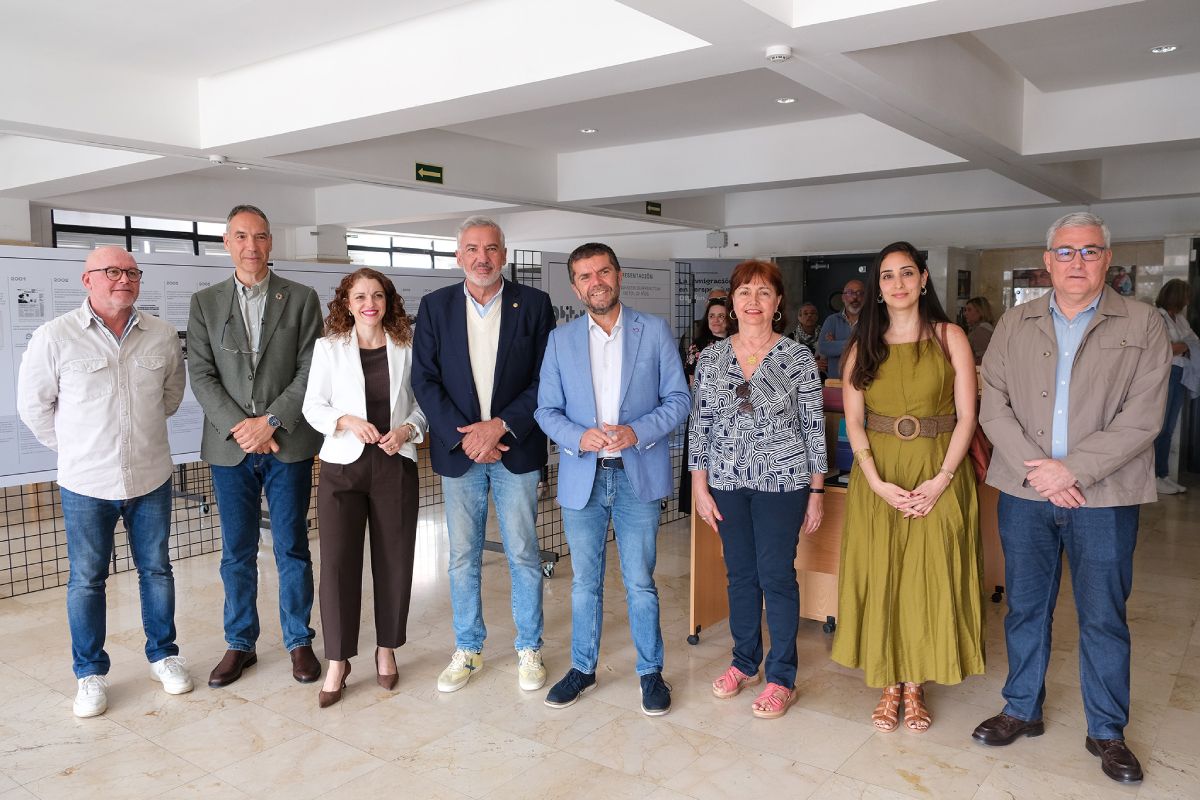
The hall of the Faculty of Humanities at the University of Las Palmas de Gran Canaria on the Obelisk Campus has been chosen as the venue for the second stage of the exhibition commemorating the 25th anniversary of the start of activities at OBITen, The Tenerife Immigration Observatory, established in 2001 through a collaboration agreement between the Tenerife Island Council and the University of La Laguna, has recently been recognized as good practice by the Council of Europe. It will be on display there until the end of May, complemented by a program of guided tours.
The inauguration was attended by the rectors of the University of La Laguna, Francisco J. García Rodríguez, and the University of Las Palmas de Gran Canaria, Lluís Serra-Majem; as well as Vicente Zapata Hernández, professor at the University of La Laguna and academic director of OBITen; and Josefina Domínguez Mujica, professor emerita at the University of Las Palmas de Gran Canaria, who spoke in recognition of her extensive collaboration with the observatory and on behalf of the researchers from Gran Canaria who have participated in this project at various stages. Some of these researchers were present at the event, including Ramón Díaz Hernández, Nasara Cabrera Abu, and Juan Manuel Parreño Castellano.
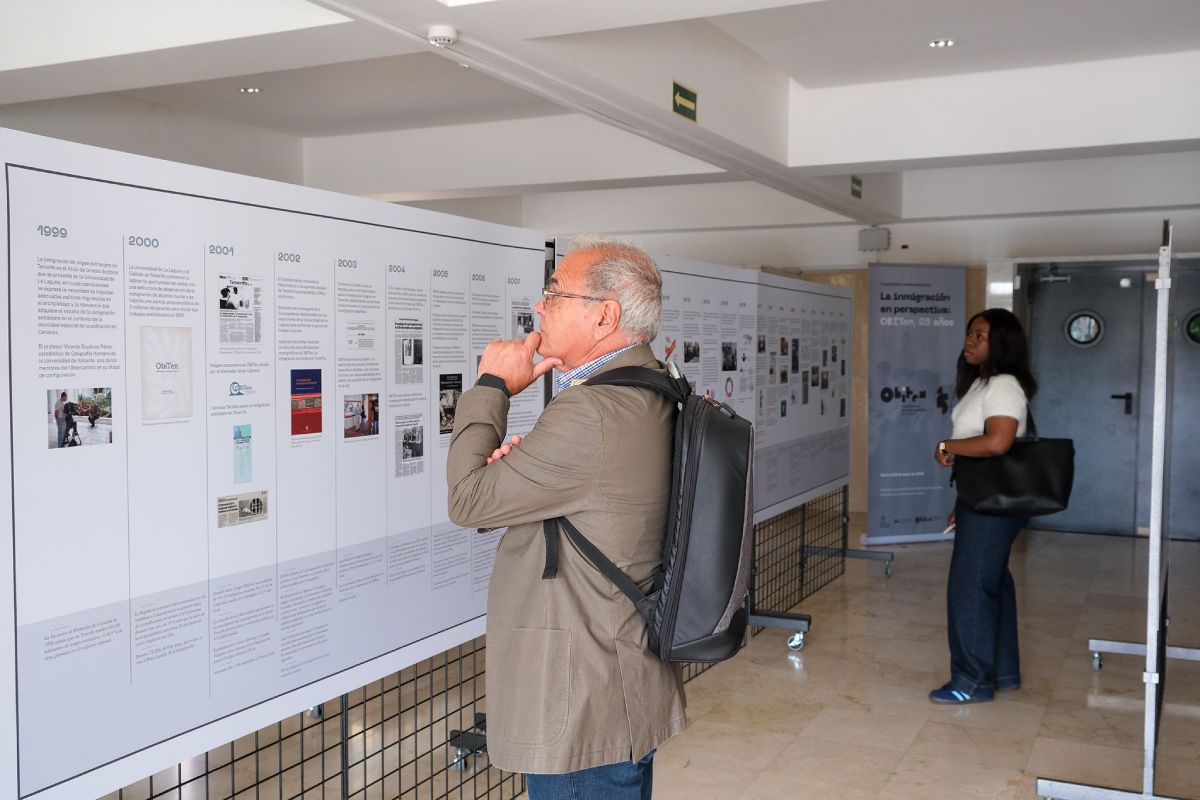 The four speakers highlighted the enormous value of the collaboration between the two universities in the scientific study of migration in the Canary Islands: its causes, dimensions, trajectories, repercussions, and implications for the archipelago and its various islands throughout this century. This collaboration has often been facilitated by OBITen, as the organization has transcended the insular geographical context that initially fostered it, broadening its perspective to gain a much deeper understanding of the migratory processes that shape the region. The presentation showcases the structure created, based on the dimensions of research, knowledge transfer, training, awareness-raising, and intervention.
Both rectors welcomed this new opportunity to learn about the observatory's trajectory and delve into the key aspects of a social phenomenon crucial to the Canary Islands in recent decades: human migration. This migration poses ongoing challenges to a region that occupies a strategic position within the network of international mobility, which, in the case of the archipelago, stands out for its multifaceted nature, also contributing a significant element of diversity to Canarian society. In fact, OBITen has sought to address some of these challenges through its most emblematic initiatives, whether by conducting research or intervening directly in its areas of focus.
In his address, Professor Vicente Zapata emphasized the collaborative nature of OBITen's work, which has brought together many people over many years. He described it as a collective project that has always sought to build bridges and create spaces for collaborative work between the two universities, citing two specific examples: the statement issued by a group of faculty members in October 2006 in the context of the "cayucos crisis," aimed at providing rigorous and informed explanations regarding the intensification of migration by sea; and their joint participation in the parliamentary commission that operated between 2008 and 2010 to prepare a report on the immigration situation in the Canary Islands.
All of this has continued to the present day through the recent signing of a cooperation agreement with the Government of the Canary Islands, which aims to study current population trends, residential mobility, and migration in the archipelago. This was emphasized by Professor Josefina Domínguez, who also highlighted the importance of the collaborative work carried out by academia, which has significantly improved the understanding of Canarian society on a topic that has been and will continue to be crucial. This work has been recognized beyond the archipelago, in forums where it has been praised for its quality and approach to issues of general interest.
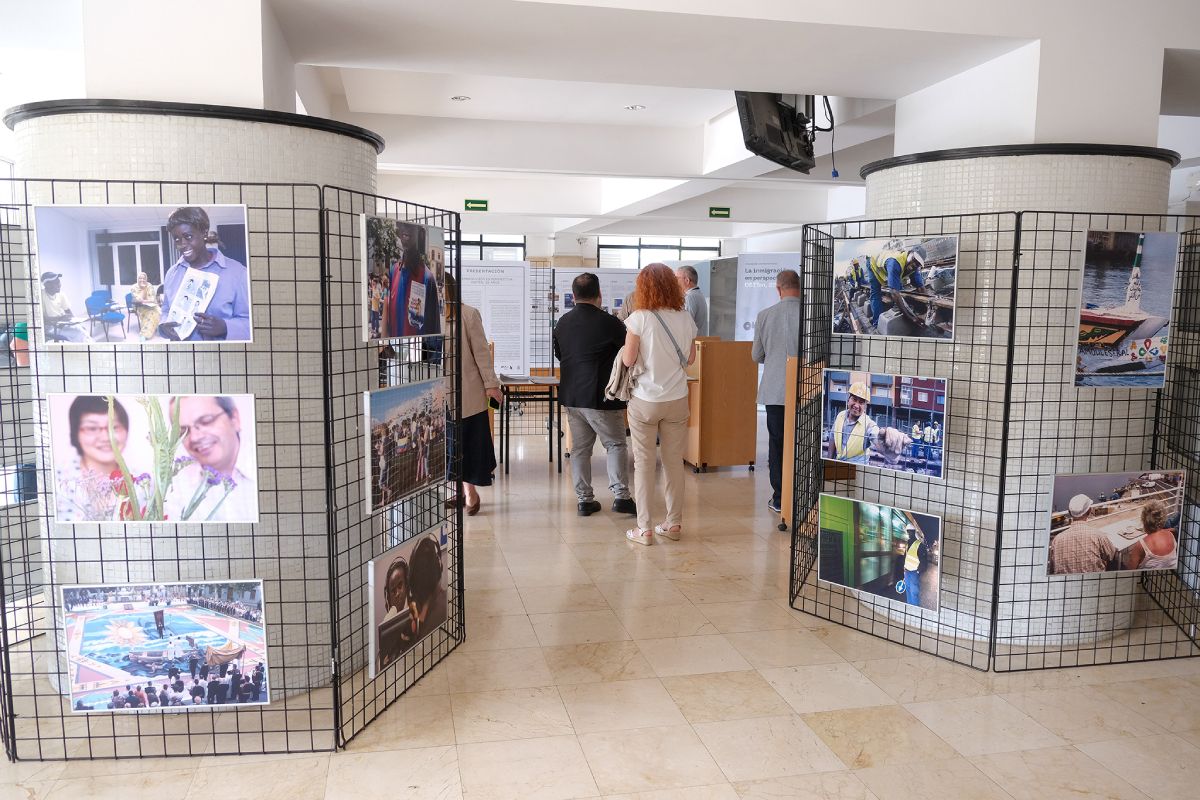 Also present at the opening of the exhibition were the technical director of the observatory, Julio Ramallo Rodríguez; and representatives of the Government of the Canary Islands such as Elisabet Santana Rosales, general director of Social Services and Immigration; and Celso Mendoza Negrín, general director of Diversity, who referred on different occasions to the fact that OBITen has been a source of experience for the development of the Canarias Convive program and the Canary Islands Plan for Immigration and Intercultural Coexistence.
Also in attendance were faculty, representatives of the ULPGC government team and its Social Council, Casa África, CEAR Canarias and the National Police (Provincial Brigade of Immigration and Borders), among other institutions.

 Spanish
 English
 French