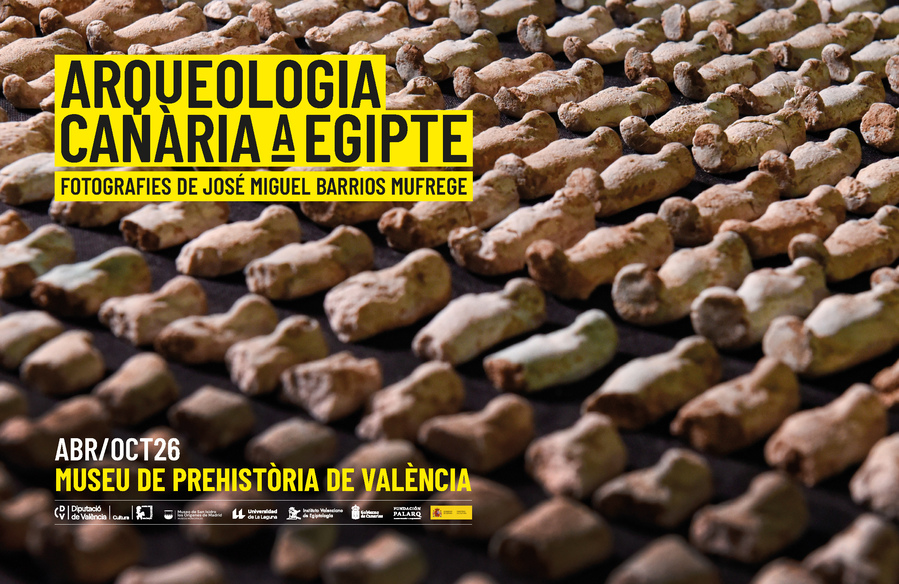
The Museum of Prehistory of Valencia is hosting the photographic exhibition ' until the end of October‘Canarian archaeology in Egypt‘'‘ by photographer José Miguel Barrios, who documents the exploration work of a research team from the University of La Laguna in the necropolis of Assasif Sur, located opposite present-day Luxor, the ancient Waset (Thebes), in Egypt. Project 209, The project, initiated in 2012, was created with the purpose of excavating, documenting, studying and preserving the Theban tomb TT 209, located on the western bank of the Nile, on the northern slope of the wadi Hatasun.
This funerary monument was built as a burial site for the family of Nisemro, a high dignitary of Nubian origin who lived during the 25th Dynasty. Since its inception, the international archaeological mission has been led by Professor of Ancient History Miguel Ángel Molinero Polo and has evolved into a comprehensive study of the archaeological landscape of Wadi Hatasun, a territory that bears witness to a sequence of human occupation dating back thousands of years.
The exhibition showcases the mission's work through the lens of photographer José Miguel Barrios Mufrege, whose images offer visitors a glimpse into the daily life of the excavation, both through the techniques employed and the camaraderie of the team. Objects, people, and landscapes convey the rhythm of the archaeological campaigns and the experience of the multidisciplinary team involved, while also reflecting the rigor and dedication of the archaeological work in Wadi Hatasun.
The exhibition '‘Canarian archaeology in Egypt‘', curated by Miguel Ángel Molinero and Alfonso Martín, from the San Isidro Museum in Madrid, also reflects the scope of the project and its different phases of work from the identification of access points and areas of the funerary complex to the exploration of underground rooms, some still intact, whose findings have made it possible to reconstruct rituals and phases of use over time.
The photographer also reflects in his images some of the unique pieces found by the archaeology team, such as Phoenician amphorae or mummification deposits, which provide information not only about funerary practices and rites, but also about important cultural connections.
In its eleven campaigns, the last one developed this year, the Project 209 It has expanded its scope of study to new areas of the wadi basin, offering a more complete view of the evolution of the territory and life in this Egyptian necropolis. This exhibition is the result of a collaboration between the Directorate General of Cultural Heritage of the Government of the Canary Islands, the University of La Laguna, and the San Isidro Museum.

 Spanish
 English
 French