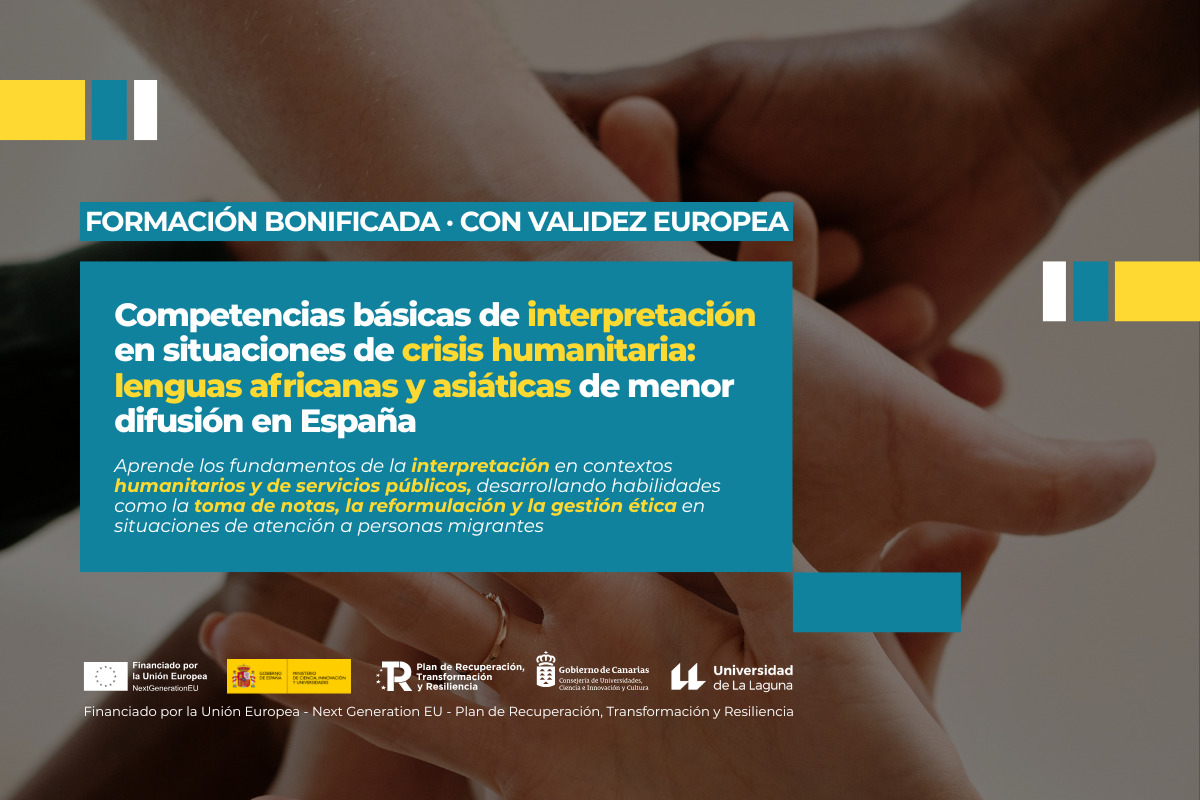
The University of La Laguna, in collaboration with the University of Las Palmas de Gran Canaria, has launched a program of microcredentials Focused on training interpreters in humanitarian aid contexts, the initiative, which combines social responsibility and knowledge transfer in the Canary Islands, a region marked by its strategic position on the well-known 'Atlantic route', contributes to more professional and responsible care in emergency and forced displacement situations.
The program is aimed at ad-hoc interpreters and mediators with an advanced level of Spanish and languages such as Wolof, Bambara, Soninke, Hassaniya, Arabic, Urdu, and Punjabi, among others, thus promoting the integration of linguistic profiles that already play a key role on the ground. The initiative responds to an urgent need: to have trained professionals for liaison interpreting in highly vulnerable contexts such as reception, healthcare, legal assistance, and emergency services, where optimal communication is essential to guarantee effective access to human rights and basic services.
The training includes two complementary modules: “Basic Interpreting Skills in Humanitarian Crisis Situations” and “Interpreting Practice in Crisis Contexts.” It combines online masterclasses taught by professionals from organizations such as UNHCR, ACCEM, the Red Cross, and CEAR, with in-person sessions facilitated by professors from the Master's Program in Conference Interpreting and the Departments of French and English Philology at the University of La Laguna (ULL), the Faculty of Translation and Interpreting at the University of Las Palmas de Gran Canaria (ULPGC), as well as professionals from the humanitarian, legal, police, and healthcare fields specializing in migration contexts.
The training courses have been financed mainly with European NextGenerationEU funds, within the framework of the Microcreds Plan, managed by the Central Government and channeled through the Ministry of Universities, Science and Innovation and Culture of the Government of the Canary Islands.
With this initiative, the universities of the Canary Islands are consolidating their role as active agents in their social environment, promoting training aligned with contemporary humanitarian challenges and contributing to a more inclusive, effective, and humane response in the care of migrants. The interest generated by these training programs and the needs they address demonstrate the importance of continuing this type of initiative, for which funding avenues will be explored in collaboration with public institutions in the Canary Islands.

 Spanish
 English
 French