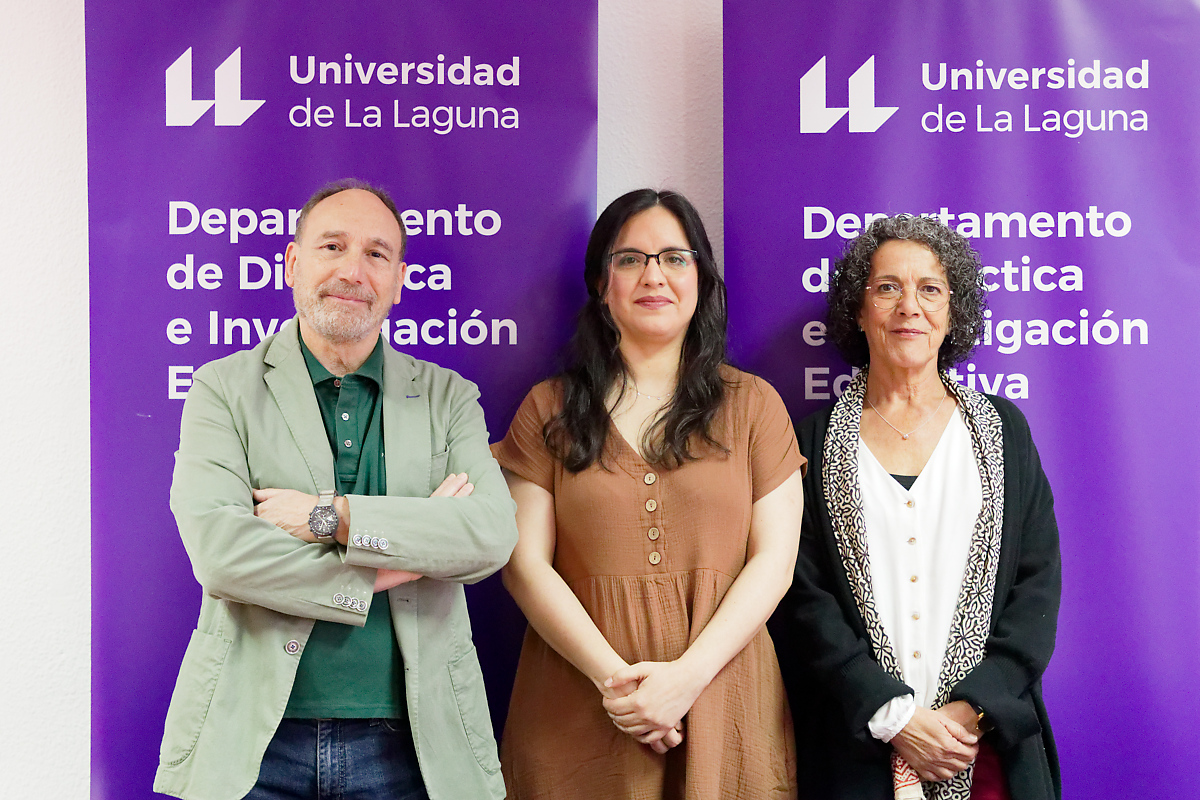
The University of La Laguna recently celebrated, at the Faculty of Education, the defense of a doctoral thesis that analyzes technological practices and the use of digital educational resources (DER) in early childhood within the Canary Islands context, and of which she is the author. Cecilia Verónica Becerra Brito.
Led by the teachers Manuel Area Moreira y Ana Luisa Sanabria Mesa, The thesis studies how children between the ages of 3 and 6 interact with digital technologies in the family and educational spheres, focusing on the socialization and learning processes typical of contemporary digital childhood.
Through four studies conducted in the Canary Islands, the research analyzes the perceptions of families, teachers, and specialists regarding the use of technology and the internet at early ages. The work addresses both the pedagogical possibilities of these tools and the risks associated with overexposure to screens, and raises the need to establish appropriate guidelines for their use at home and in schools.
Among its main conclusions, the thesis points out that the digital ecosystem aimed at children presents significant pedagogical, technological, and design challenges. It also reveals divergent positions between families and teachers regarding usage time, educational purposes, and the benefits of early access to digital devices.
The research also analyzes the impact that the expansion of digital technologies and the widespread use of mobile devices have had on the family and educational dynamics of new generations. According to the author, increasingly early access to screens and digital content has transformed children's play, learning, and socialization, shaping new routines of technology consumption.
Among the aspects addressed, the following stand out: the pedagogical quality of the REDs available for Early Childhood Education, the preparation of families and teachers to accompany these processes, and the influence of the COVID-19 pandemic on the acceleration of educational and domestic digitization.
The thesis also incorporates an analysis of digital platforms and materials used in the Canary Islands, as well as questionnaires, group interviews and discussion spaces with teachers, families and specialists in child development, with the aim of obtaining a broad view of the role that technologies play in contemporary childhood.
According to the researcher, the debate on screen use in childhood cannot be reduced solely to exposure time, but must also consider the quality of the content, adult supervision, and the context in which the digital interaction takes place.
In this sense, the author argues for the need to promote a balanced early digital literacy, capable of harnessing the educational potential of technologies without ignoring possible effects associated with sedentary lifestyles, reduced direct social interaction, or overstimulation resulting from continuous screen use.
The work falls within the lines of research on education and technology developed by the group EDULLAB from the University of La Laguna and is related to projects focused on the analysis of the educational use of ICT and digital materials in childhood.
The evaluation panel, made up of the professors Cristina Alonso Cano, Sonia Byrne y María del Mar Sánchez Vera, The committee highlighted the methodological rigor and scope of the research, emphasizing the complexity of the work on childhood and digital technologies. Furthermore, it praised Cecilia Verónica Becerra Brito's research trajectory and scientific rigor throughout the doctoral process, awarding the dissertation the highest distinction, summa cum laude.
The doctoral study concludes that, in early childhood education, the debate should not focus on "screens yes or no," but rather on how to integrate technology in a pedagogically sound, balanced, and healthy way. The study advocates a model based on high-quality digital resources, shared adult mediation between family and school, and specific training to ensure that technology contributes to learning, creativity, and communication, avoiding merely passive or consumerist use.
As a practical application of the research, the author is developing an educational resource in PDF format aimed at social media content creators, early childhood educators, and families. The material, based on scientific evidence and adapted to accessible language for social media distribution, seeks to bring academic knowledge closer to the public and promote the conscious, healthy, and educational use of technology in childhood.

 Spanish
 English
 French