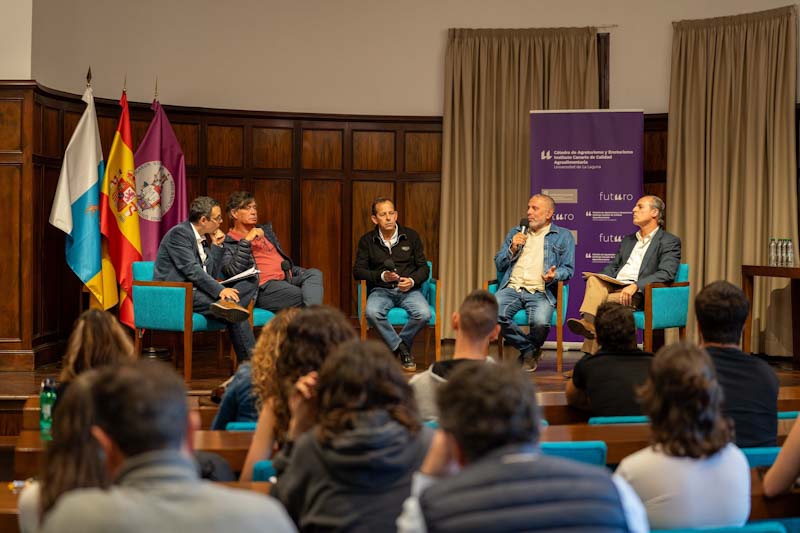
The University of La Laguna hosted the University Seminar “Agri-food Quality Figures of the Canary Islands” last Friday, May 15th, an initiative organized by the Chair of Agritourism and Wine Tourism of the Canary Islands of the Canary Institute of Agri-Food Quality and the University of La Laguna, which brought together specialists from the academic, institutional and business fields to analyze the main challenges and opportunities linked to the future of the Canary Islands agri-food sector.
The meeting, held in the Aula Magna of the Central Building of the Central Campus, was part of the line of specialized university seminars promoted by the Chair, conceived as spaces for reflection, knowledge transfer and connection between university, public administrations, researchers and representatives of the primary sector.
During the institutional opening, Jesús Enrique de las Heras Roger, The director of the Chair of Agritourism and Wine Tourism of the Canary Islands highlighted the importance of these types of meetings to bring the reality of the agri-food sector closer to the academic field and to promote knowledge about the different quality designations that exist in the Canary Islands.
“These seminars allow us to connect the university with the productive sector and convey to students and society the relevance of agri-food quality figures in the Canary Islands, a territory with enormous wealth and productive uniqueness,” he noted.
Also speaking was Luis Arráez Guadalupe, director of the Canary Islands Institute of Agri-Food Quality (ICCA), who emphasized the importance of dissemination and training to strengthen the recognition of local products and quality seals of the archipelago.
Arráez noted that the Canary Islands currently has 17 Protected Designations of Origin and four Protected Geographical Indications, and stressed that "what is not known cannot be protected," emphasizing the need to bring these quality designations closer to consumers, students, and future professionals in the sector.
The day continued with the presentation “Guarantee of origin and quality in the Canary Islands. Legal framework for the competitiveness of the primary sector”, given by Domingo Afonso Martín, head of the Control and Certification Service of the ICCA, who analyzed the role of certifications, designations of origin and geographical indications as strategic tools to strengthen the competitiveness and positioning of Canary Island products in national and international markets.
One of the central moments of the seminar was the round table “Sustainability of the territory and quality figures”, in which Óscar Rodríguez García, manager of the Regulatory Council of the PDO of Wines Valle de Güímar; Vicente Luis Domínguez, President of the Association of Growers “La Papa Bonita” of Icod el Alto; Francisco José Echandi, president of the Association of Tropical Fruit Producers of the Canary Islands; and Domingo Afonso Martín participated.
During the debate, Óscar Rodríguez García defended the role of designations of origin as fundamental tools for guaranteeing the sector's profitability and promoting generational renewal in agriculture. The representative of the Güímar Valley Wine PDO emphasized that the position achieved by Canary Island wines has been possible thanks to the collaborative work between wineries, producers, and regulatory boards, asserting that "profitability and added value are key to attracting young people to the primary sector.".
For his part, Vicente Luis Domínguez warned about the difficulties small producers face in adapting to the administrative requirements associated with quality designations, especially for traditional crops such as heirloom potatoes from the Canary Islands. He also emphasized that the Protected Designation of Origin (PDO) remains an essential tool for guaranteeing product authenticity and traceability against commercial fraud.
Francisco José Echandi pointed out that the recently granted Protected Geographical Indication (PGI) for Canary Islands Avocado represents a strategic opportunity to position Canarian products in international markets that are increasingly focused on differentiated, certified-quality foods. He also emphasized the need to raise consumer awareness of these designations so they can recognize the added value associated with local products.
In his speech, Domingo Afonso Martín stressed the need for quality designations to evolve by incorporating sustainability criteria and adapting to new European regulations, while always maintaining the uniqueness and authenticity of the protected products.
University research
The seminar dedicated a significant part of its program to scientific communications and university research, in a space coordinated by Gabriel Santos García, general coordinator of the Chair of Agrotourism and Wine Tourism of the Canary Islands, aimed at promoting the transfer of knowledge between university and the agri-food sector.
The researcher Rebecca Magdalena Kropp, A researcher from the Department of Animal Biology, Soil Science, and Geology at the University of La Laguna presented a study on functional biodiversity and organic avocado production on farms belonging to Frome Tropicales, COPLACA, located in Güímar. Their research highlighted the importance of incorporating sustainable strategies in tropical crops to improve ecological balance and agricultural productivity.
For their part, Isaac Martín Mendoza, a doctoral candidate in the Regional Development Program at the University of La Laguna, presented the communication “The Lanzarote Designation of Origin: the landscape as the origin of the concentrated model”, focused on how the volcanic landscape and the uniqueness of the territory have become differentiating elements for the international positioning of Lanzarote wines.
In the field of sustainability applied to viticulture, Santiago Manuel Barroso Castillo, Professor from the Department of Business Management and Economic History, presented research on soil diagnosis and life cycle analysis applied to the Tacoronte-Acentejo Designation of Origin, identifying tools to assess environmental impact and move towards more sustainable and efficient production models.
The sensory and oenological dimension was also present in the academic presentations. Kevin Castellano Santiago, a student of the Degree in Nutrition and Dietetics, carried out a systematic review on the organoleptic attributes of wines from the Canary Islands, analyzing the sensory characteristics that influence the perception of quality and differentiation of the product.
Similarly, Jacqueline Rodríguez Domínguez, technician of the Organic Unit of Enology and of the Technical Service of Quality and Agri-food Valorization of the Cabildo of Tenerife, presented a project for the design of a sensory analysis panel for Canarian wines, an initiative aimed at strengthening the processes of technical evaluation and oenological certification in the archipelago.
The academic program concluded with the presentation by Luis Arteaga Mora, a recent graduate in Human Nutrition and Dietetics from the University of La Laguna, who presented a critical analysis of the basic foods of the traditional Canarian diet, highlighting both their nutritional value and their cultural importance within the historical eating habits of the archipelago.

 Spanish
 English
 French