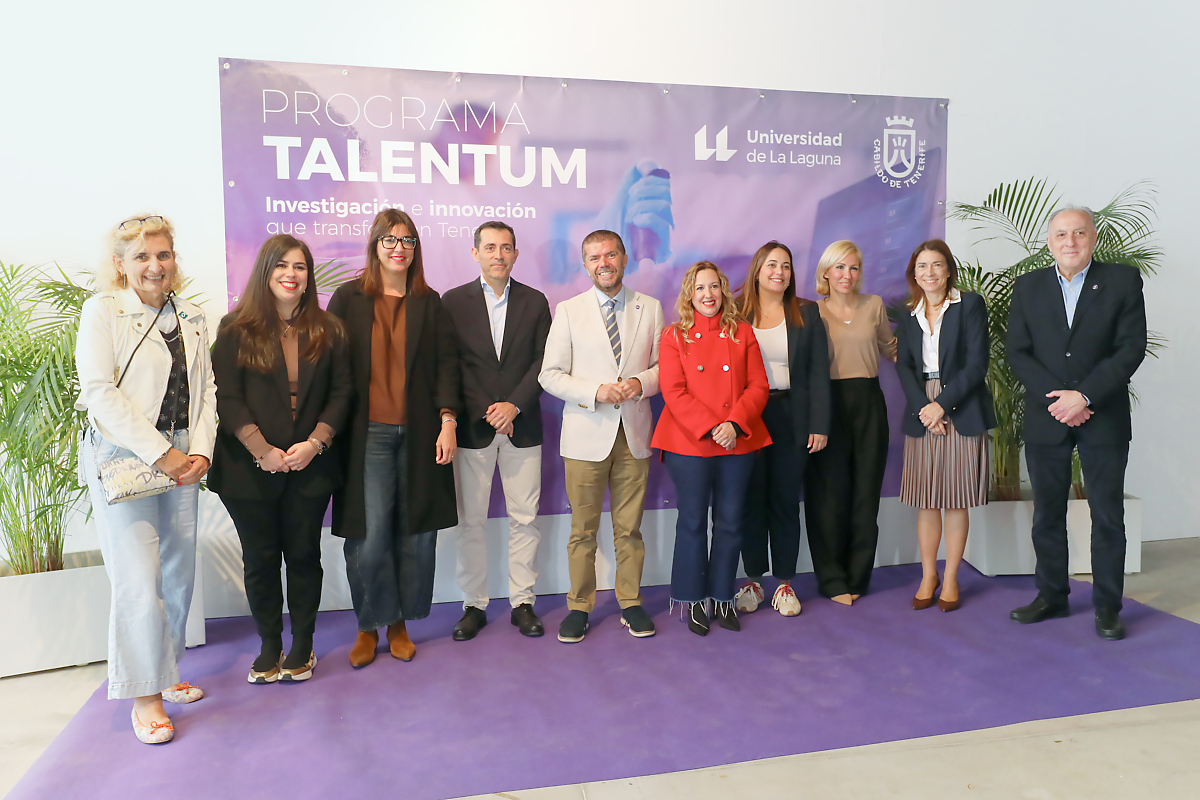
In 2022, the University of La Laguna and the Tenerife Island Council signed an agreement to launch a program of applied research projects. This program included the hiring of postdoctoral staff to carry out the projects, in some cases in collaboration with local businesses. Known as Talentum, the initiative has been running for just over a year and currently has 19 active projects. These projects were presented today, Monday, May 18, at an event held at the Faculty of Fine Arts, which was attended by a broad representation from the community and academia.
The program is divided into two lines of action: Talentum Applied Research (TIA-ULL), designed to develop a project in each of the university's 13 research institutes, from whose staff the principal investigators are drawn, and which involves hiring postdoctoral researchers for the development of each project; and Talentum Transfer, to develop collaborative work with local companies. Together, these represent a contribution of more than one million euros annually from the island council until 2027, the term limit of this initial agreement.
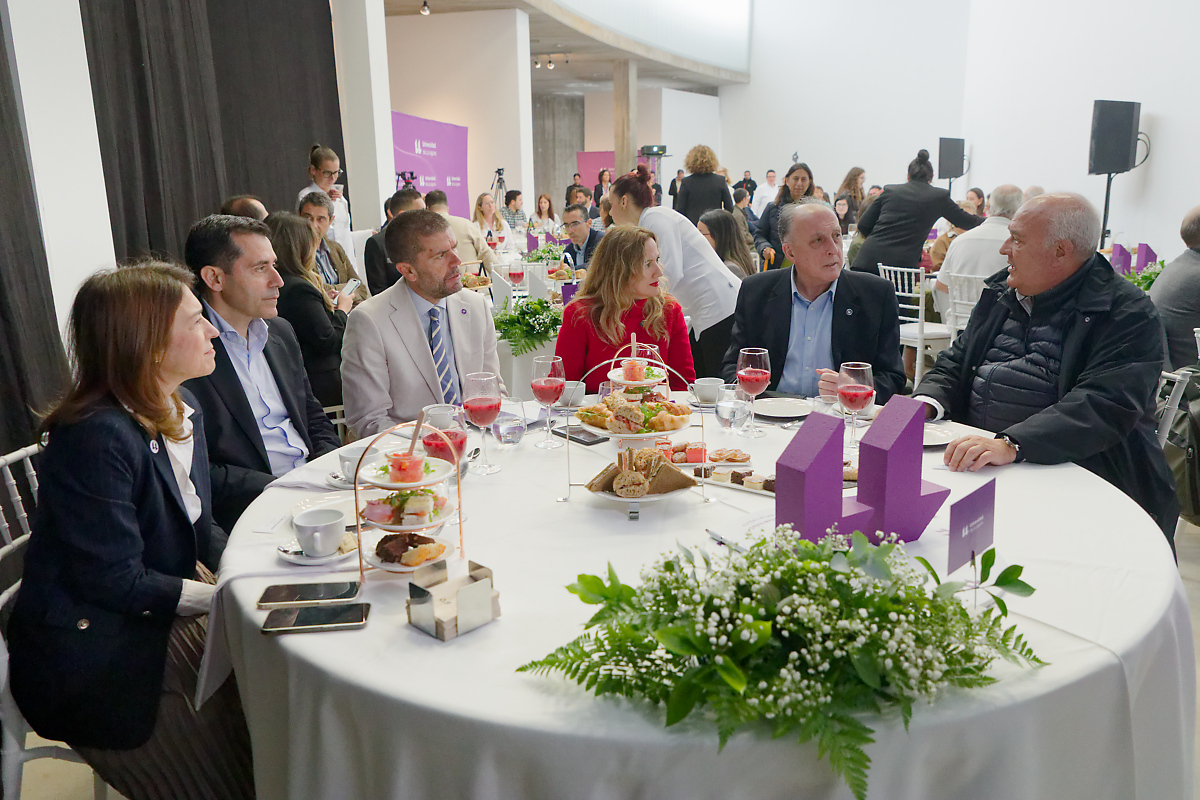 The presentation was attended by the Rector of the University of La Laguna, Francisco J. García; the President of the Island Council of Tenerife, Rosa Dávila; the Vice-Rector for Research and Transfer of the academic institution, Antonio Aparicio; and the Island Councillor for Innovation, Research and Development of the Island Corporation, Juan José Martínez; as well as several participants in the program, who contributed their experience during these first months of work.
The rector began his address by highlighting two facts supported by data: first, that the University of La Laguna is a “strong research institution”—ranked 20th out of 100 in Spain, according to the Shanghai Ranking; and second, that it is underfunded. Currently, negotiations are underway with the Government of the Canary Islands for a program contract that will guarantee greater budgetary stability to generate basic research that can later be applied. In this context, he commended the Tenerife Island Council for prioritizing the knowledge and talent that the University of La Laguna offers to society, given its focus on this area.
García praised initiatives promoted by the city council, such as the Talentum program and the support for industrial PhDs, and stressed that continuity is essential for these measures to succeed: “These types of policies are only valid if we look at the medium and long term, if we are consistent. We can't be in a hurry, because patience is essential for success.” He noted that Talentum is a successor to the previously known Agustín de Betancourt program, which also promoted research and, after almost a decade of work, has now begun to bear fruit in the form of patents and spin-off companies. Therefore, he emphasized the importance of extending these programs so that they can be truly effective.
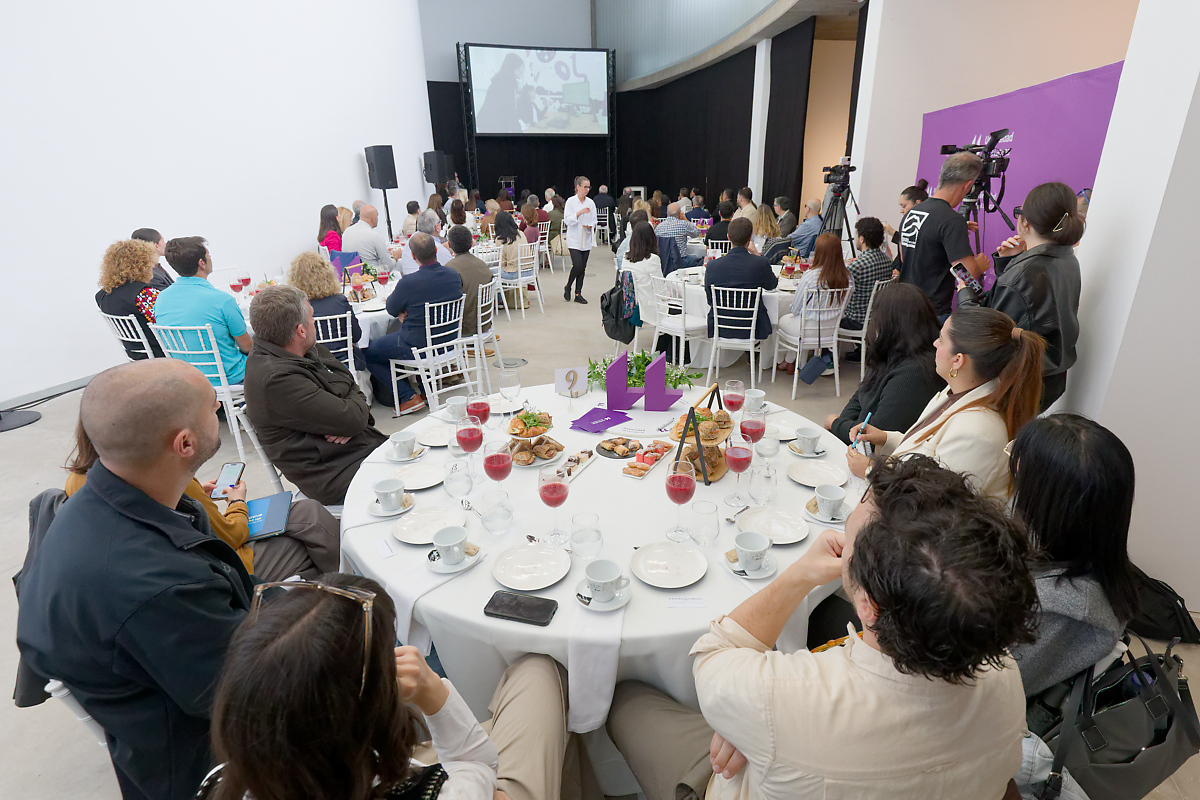
General view of the auditorium of the Faculty of Fine Arts.
Rosa Dávila praised the work carried out by researchers in the companies and institutes where they are developing their projects and declared her “unwavering confidence” in the public university. She recalled that upon assuming the presidency, she created a department specifically dedicated to research, innovation, and development, “something unprecedented in the Island Council,” which, after just two and a half years, “has begun to bear fruit.” This has been possible thanks to an initial process of listening, in which her council was able to understand the concerns of the research staff and learn “what they needed to do their work, to have stability, and to be able to transfer knowledge that gives back to society all that it has contributed to them” during their formative years.
Dávila emphasized the island corporation's commitment to science, noting that the Tenerife Island Council invests more in research than any other institution in Spain. He also pointed out that, in the last two and a half years, the youth unemployment rate in Tenerife has fallen from 361% to 131%: "This means that when we align our efforts with businesses, academia, research centers, and entrepreneurs, there are opportunities and there is a future.".
Presentation of the subprograms
The event consisted of the screening of two videos summarizing the two lines of action of the Talentum program, each followed by remarks from a representative of the research staff and another from the institutions. Thus, after the video dedicated to Talentum Applied Research, Elena Rodríguez, who is developing a project at the Institute, spoke first.
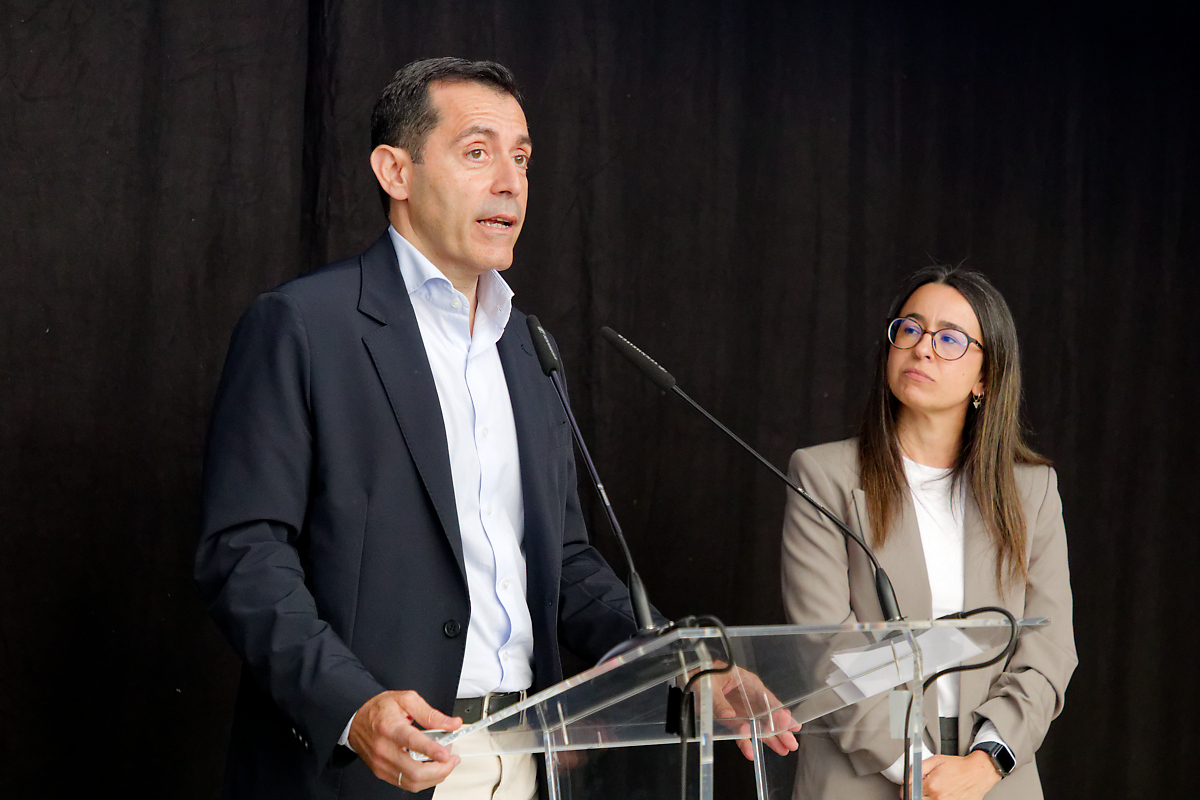
Juan José Martínez, Island Councillor for Innovation, speaking, accompanied by one of the researchers from the program.
The Biomedical Technologies University representative noted that while studying abroad is important for improving one's education, it is equally crucial to have real opportunities to return, settle, and work. "Programs like this demonstrate that we can do excellent science from the island, connected to our environment," he said, "without losing sight of the national and international perspective.".
Following her remarks, Juan José Martínez, the Island Councillor for Innovation, Research and Development of the Tenerife Island Council, defined talent as the main resource the region can currently leverage to develop its economy, which is why the Island Council is promoting initiatives in this area. “Thanks to programs like Talentum, Talentum Plus, and industrial PhDs, by the end of the year there will be 91 young researchers working in Tenerife.” He emphasized the importance of science for achieving economic diversification and reaffirmed the Island Council's support for this group.
For its part, the screening of the video corresponding to Talentum Transferencia was complemented by the words of one of its protagonists, Glorian Mura Escorche, a researcher on a project about kidney diseases developed with the company Biosigma, who recalled that it is not always easy to find a project with real possibilities for transfer, so she praised the existence of a program that facilitates it: "it not only promotes research, but also helps to make visible that in the islands quality research is done, with a lot of talent and potential.".
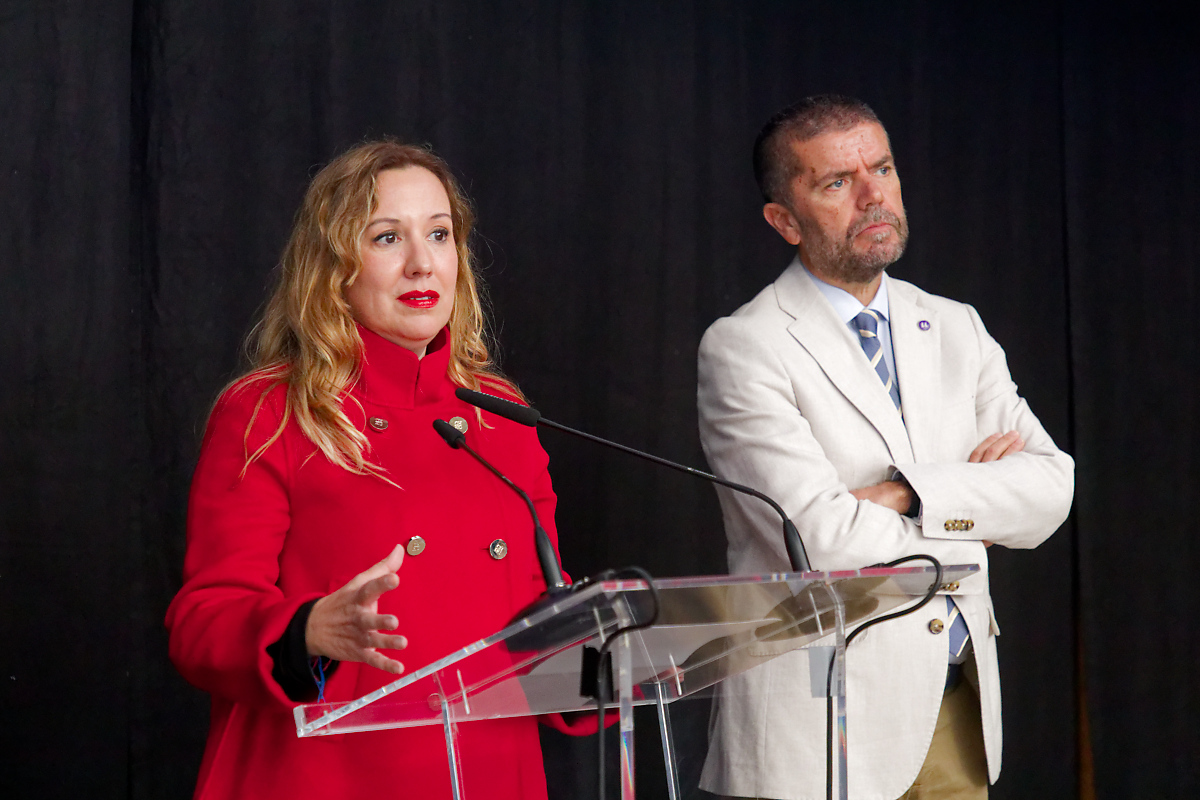
The president of the Cabildo and the rector of the ULL.
The next speaker was the Vice-Rector for Research and Transfer, Antonio Aparicio, who reflected that, for science to advance, "researchers must be allowed to work; they shouldn't be told what to do, because they already know, as they are the professionals." Therefore, the role of institutions is to provide them with the support they need to work, "enhancing avenues, creating added value, and fostering possibilities.".
Two former beneficiaries of the now-defunct Agustín de Betancourt program also participated in the event, representing two success stories of research support policies because both have created spin-off companies based on their research: Juan Luis Ramos Suárez, from the company Biogas Canary Islands, and Carlos Morán Rodríguez, creator of Fomarché. Grant McNaughton-Smith also spoke on behalf of
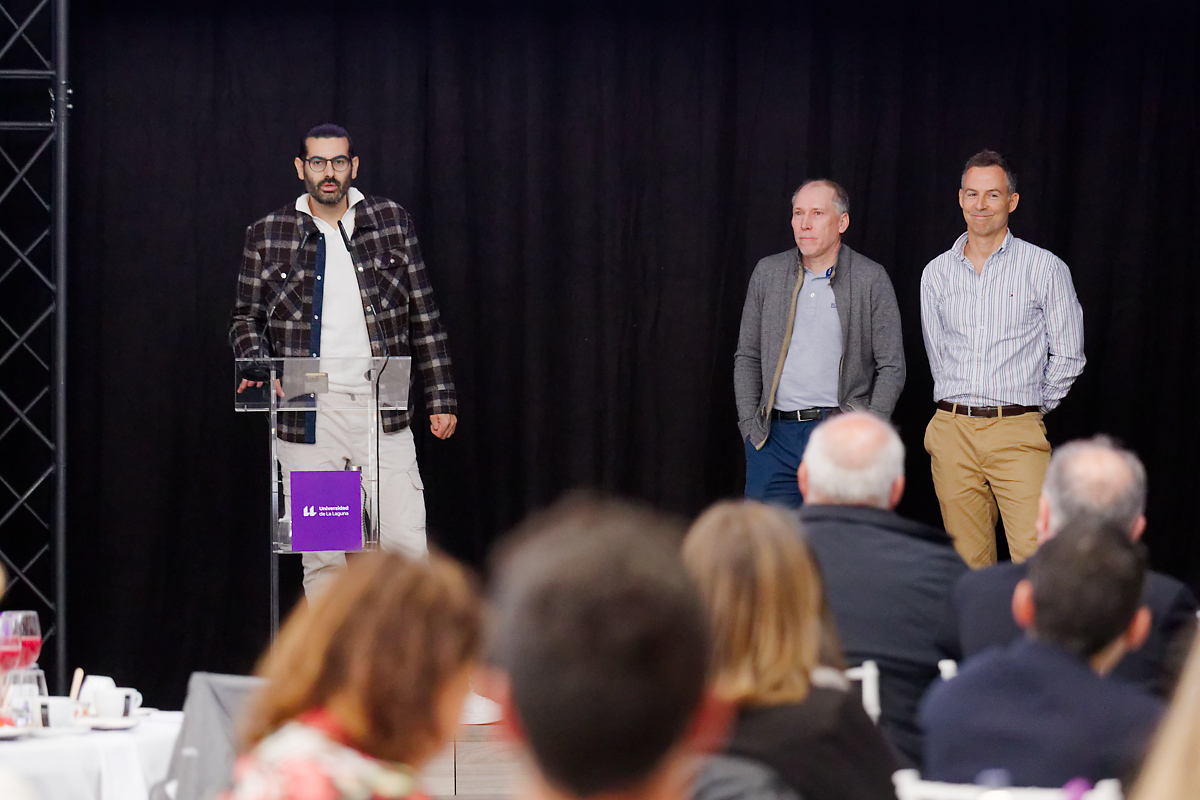
Representatives from three companies participating in Talentum, at the event.
these processes.
The event was led by the director of the secretariat of University Institutes and Publications, Roberto González Zalacaín, and the director of the Knowledge Transfer Office (OTC), Rebeca Baz Dávila, and was structured as a working breakfast to encourage interaction among the participants.
Talentum Applied Research Projects (TIA-ULL)
| Project | Responsible Institute | Principal Investigators |
| QUIBIONAT.Design and synthesis of new selective degraders of estrogen receptors | Antonio González Institute of Bio-Organic Medicine | Ana Estévez Braun.
|
| i-rVerde. Economic analysis of the green industry based on the intelligent and sustainable management of organic waste | University Institute for Regional Development | José Andrés Moreno Pérez; Juan José Díaz Hernández. |
| miRNAs as regulators of IL-13-mediated SARS-CoV-2 infection | University Institute of Tropical Diseases and Public Health of the Canary Islands | Aída Elizabeth Córdoba Lanús; Jacob Lorenzo Morales. |
| Carbonstellar. Carbon nanostructures in the interstellar medium | University Institute of Advanced Studies in Atomic, Molecular and Photonic Physics | Javier Hernández Rojas |
| GENDERVISION-AI. Gender-focused research using AI and Big Data | University Institute for Women's Studies | Carina Soledad González González; Jezabel Molina Gil |
| New narratives of the Atlantic island imaginaries (15th-18th centuries) | University Institute of Medieval and Renaissance Studies | Cristian Díaz Rodríguez |
| RepAzul. Impacts and opportunities of the blue economy in the Canary Islands | University Institute of Social Research and Tourism | José Jaime Pascual Fernández; Raquel de la Cruz Modino |
| Emerging pollutants and smart technologies in tourism | University Institute of Business | Marta Arbelo Pérez; Antonio Arbelo Alvarez |
| Digitization of the Spanish of the Canary Islands (16th–21st centuries) | Andrés Bello University Institute of Linguistics | Marcial Morera Pérez; José Juan Batista Rodríguez |
| ATALAYA – Coding theory and algebraic techniques for cryptography and data storage | University Institute of Mathematics and Applications | Irene Márquez Corbella; Ignacio García Marco |
| Greenfuels. Green hydrogen and e-fuels production technologies | Institute of Materials and Nanotechnology | Elena María Pastor Tejera; José Luis Rodríguez Marrero |
| NeuroMod. Inhibitory neurotransmission in schizophrenia and depression with TMS-EEG | University Institute of Neuroscience | Wenceslao Peñate Castro; Manuel de Vega Rodríguez. |
| Intrarenal ischemia and diabetic nephropathy (IIR) | Institute of Biomedical Technologies | Esteban Porrini |
Talentum Transfer Program Projects (TT-ULL)
| Project | Researcher | Partner company |
| INHIPANC. Glutamine uptake and metabolism inhibitors for the treatment of pancreatic ductal adenocarcinoma | Raquel Diana Rivero | CEAMED |
| INAMEER. Innovation in aquaculture nutrition: alternatives for improving the larval development of emerging species | Alejandro Escáñez Pérez | CIMA SL. |
| BIOARTECAN. Innovative strategies for the sustainable extraction of bioactive compounds from Artemisia canaria. | Hakim Faraji | Biotech Tricopharming Research |
| 3D-MICRO-IFC. Obtaining 3D information from biological samples using quantitative phase-contrast microscopy | Laura García Expósito | Wooptix |
| CRIBARENAL. Cellular platform for preclinical screening of molecules with therapeutic potential in hereditary kidney diseases | Glorian Mura Escorche | Biosigma |
| HCLIPCAN. HsClpP activators as anticancer drugs for resistant tumors | Otilia Violeta Stoica | CEAMED |

 Spanish
 English
 French