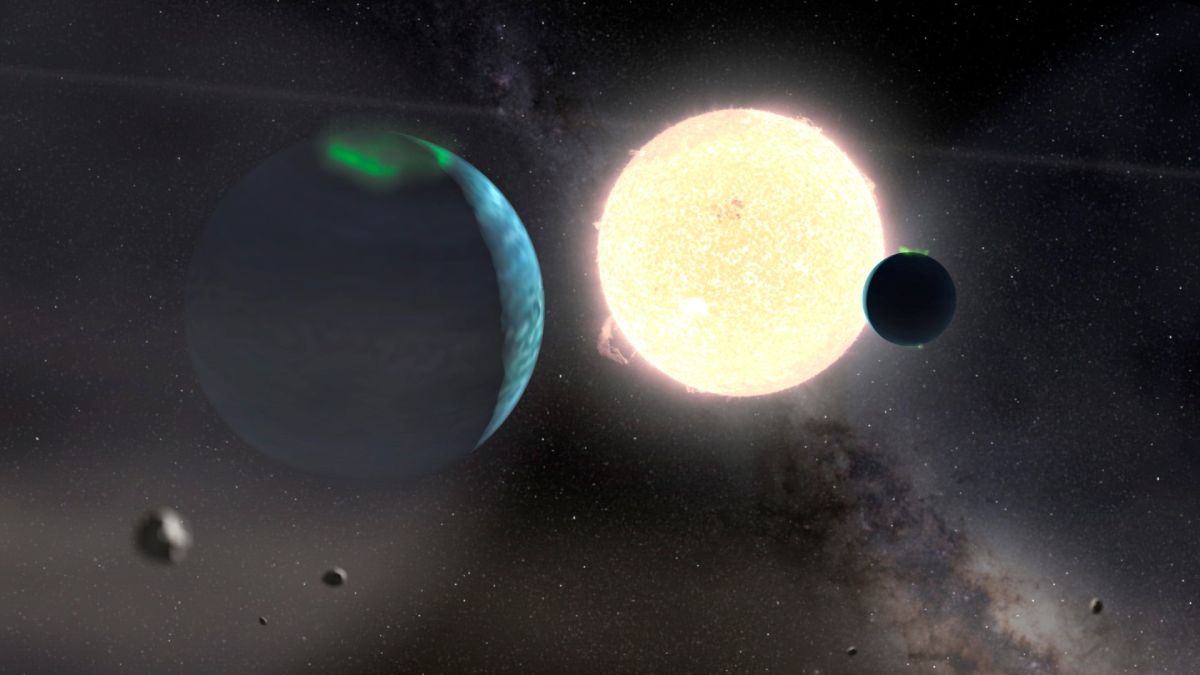
An international collaboration of astronomers led by the University of La Laguna (ULL) and the Canary Islands Institute of Astrophysics (IAC) has identified two enigmatic, enormous yet lightweight planets orbiting HD 114082. This star, just 15 million years old, is much younger than the Sun (4.6 billion years old), rotates 15 times faster, has a mass 28% greater, is a thousand degrees hotter, and almost four times more luminous. Its planets receive nearly 200 times more light and heat than Jupiter. The study, which required separating the faint planetary signal from the stellar signal, offers clues about how exoplanets form and helps to contextualize the solar system.
Carlos del Burgo Díaz, Beatriz Galindo, a distinguished researcher at the University of La Laguna, who works at both this university and the IAC, and who led the study published today in Astrophysical Journal Letters, describes the discovery: “We have identified a strange pair of giant exoplanets. They stand out among the youngest detected as they pass in front of their star because they take the longest to complete an orbit. The inner planet, 20%, is closer to its star than Earth is to the Sun and is the size of Jupiter. The outer planet is at the same orbital distance as Earth and has a radius 36% larger than Jupiter's and an average density more than 7.5 times less than that of water, so it would float on it.”.
Alejandro Suárez Mascareño, with dual affiliation to ULL/IAC, co-author of the article, adds: “Planets move in almost circular orbits in the same plane, and can be in or near a resonance [which implies that their orbital periods have a simple whole number ratio].”.
The study includes data taken with the TESS (Transiting Exoplanet Survey Satellite) and CHEOPS (CHaracterising ExOplanet Satellite) space telescopes, and other data acquired with ground-based facilities such as NGTS (Next-Generation Transit Survey; Chile), ASTEP+ (Antarctic Search for Transiting ExoPlanets telescope; Antarctica), and the Las Cumbres Observatory (LCO). From this data, light curves of the star were generated; that is, graphs of its intensity versus time.
These images show four non-consecutive dips in light from HD 114082 b, the inner planet. Each dip, or transit, occurs because, from our perspective, the planet passes in front of the star and blocks a small portion of its light. This allowed us to determine the orbital period of this planet with an accuracy of one minute. For the outer planet, HD 114082 c, we estimated a period of 314 days (within the 9% margin of error) from a transit confirmed by two instruments and additional measurements.
The gravitational attraction between the two planets manifests as a tug-of-war, which delays or advances the transit of the companion. This effect, which is more intense the closer these giants are to a resonance, can be measured even if their masses are relatively small. Carlos del Burgo adds: “Following this discovery, we can expect the exoplanet community to join the hunt for a second transit of the outer planet so that its period can be measured accurately. Once this goal is achieved, refining the masses of the two planets will require measuring the times of several transits of each. This method could reveal other members of the system.”
How and where were these planets formed?
These giants formed within the protoplanetary disk, rich in gas and dust, that surrounded the star. First, they accumulated material until they formed a solid core. When they reached a certain mass, an accelerated accretion process of gas began, and the internal heat caused their envelope to expand. Theory suggests that two planets close to formation tend to reach similar masses.
The measured mass of the outer planet is less than 24% that of Jupiter or 4.4 times the mass of Neptune. The planets of HD 114082 could have formed in situ, Or perhaps they were in a distant, cold region and migrated to their current orbits, where they receive more light and heat. Carlos del Burgo explains: “These giants must have influenced the orbits of the asteroids and comets [remnants of planetary formation] closest to the star, arranging them in a belt located in the same plane as the planetary orbits.”.
Jonathan Marshall (ASIAA), co-author of the article, adds: “This plane is inclined with respect to that of the outer ring formed by grains of icy dust and debris, probably primordial, which is located on the periphery of the system, at a distance 25% greater than the orbit of Neptune.”.
The international collaboration led by the University of La Laguna (ULL) and the Institute of Astrophysics of Cantabria (IAC) involved 38 scientists. Efforts were coordinated to achieve data integration and consistent processing. The results obtained place the HD 114082 planetary system in the spotlight of the exoplanet community. In the coming years, observations can be made with facilities like those used in this study and others such as the James Webb Space Telescope. These will allow for a more detailed characterization of this unique system, from determining the masses of the planets to revealing the chemical composition of their atmospheres and other mysteries yet to be solved.
Article: C. del Burgo, et al., 2026, ApJL, 1003, L15, The longest-period young transiting exoplanets — A duo of puffy giants inside a debris disc. DOI: https://doi.org/10.3847/2041-8213/ae63bd

 Spanish
 English
 French