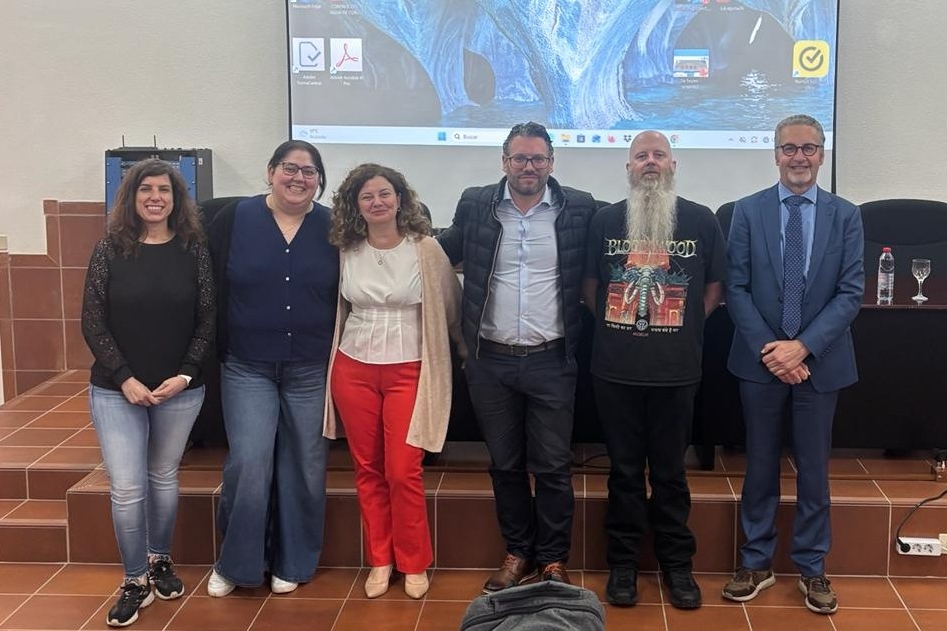
The Lecture Hall of the Chemistry Section of the University of La Laguna hosted this Monday, May 18th, the workshop Surfaces & Biomaterials. This international meeting was organized within the framework of the ZINCROS research project, an initiative funded by the Government of the Canary Islands and co-financed by the European Regional Development Fund, in which participants gathered Experts from research centers in Belgium, Germany and Spain to discuss the latest advances in hybrid materials, nanotechnology and biomedical applications.
The day began with a welcome address by the organizers, Miriam Rodríguez González and Alejandro González Orive, professors in the Physical Chemistry department. They also presented the objectives of the ZINCROS project and the main results achieved to date. Throughout the morning, the program featured presentations by leading figures in international and national research, who discussed the synthesis of new materials and their applications in areas such as biomedicine and environmental analysis.
The block of presentations included a presentation by Professor Steven De Feyter, from KU Leuven University (Belgium), who addressed surface synthesis of covalent organic frameworks (COFs) monitored using scanning tunneling microscopy under ambient conditions. Meanwhile, Professor Adrian Keller, from the University of Paderborn (Germany), focused his presentation on the use of DNA nanostructures known as DNA origami for pathogen detection and the controlled release of antimicrobial drugs.
The University of La Laguna was represented by Professor Verónica Pino, who gave a presentation on metal-organic framework (MOF) devices for (bio)analysis, and Dr. Paul Soto, who delved into the development of smart hybrid materials. Dr. Cristina Martín, a researcher at the University of Castilla-La Mancha, also shared her findings on the photophysics of emerging materials for biomedical applications.
With the celebration of this workshop, the academic institution not only consolidates the international collaboration networks of the ZINCROS project, but also reaffirms its position in the research of advanced materials and nanotechnology.

 Spanish
 English
 French