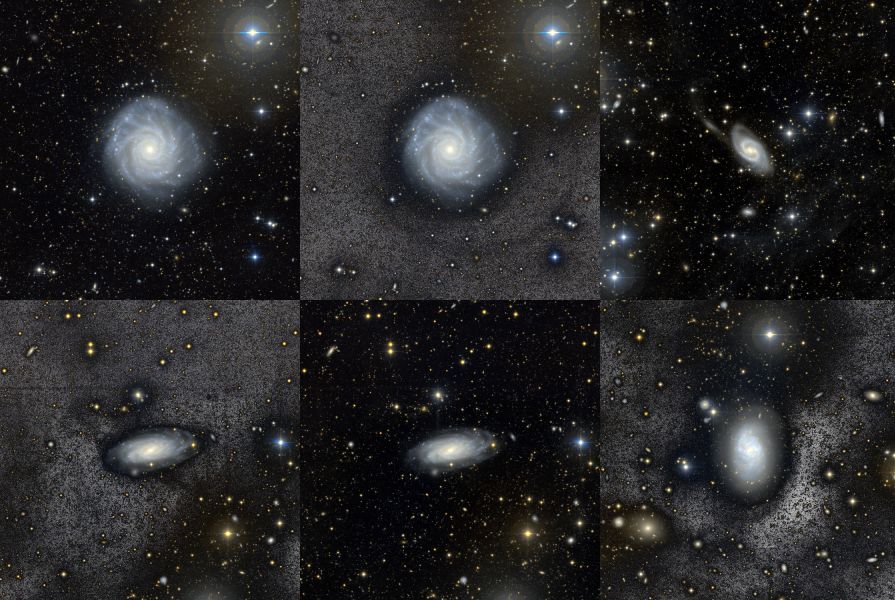
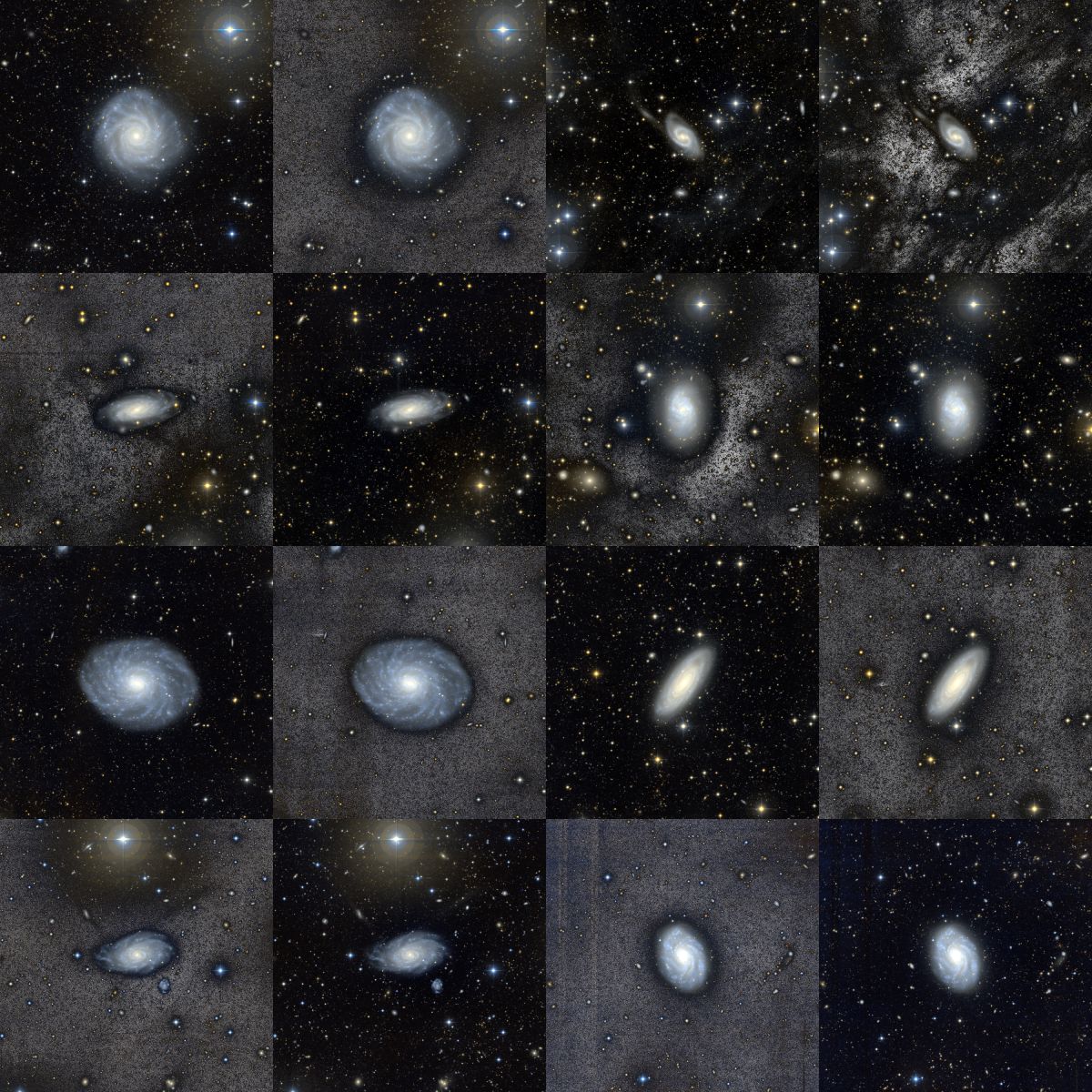
Deep images of eight Milky Way-like galaxies from the BEARD project, observed with the Wide Field Camera on the Isaac Newton Telescope at the Roque de los Muchachos Observatory. From left to right and top to bottom: NGC3938, NGC2543, NGC1090, NGC1087, NGC3486, NGC7606, NGC3614, and NGC3810. © Javier Román and Carlos Marrero de la Rosa.
The international BEARD project, led by the Canary Islands Institute of Astrophysics (IAC) and the University of La Laguna, has used data from several telescopes at the Roque de los Muchachos Observatory and computer simulations to explain how galaxies analogous to the Milky Way have managed to overcome the most violent stages in the history of the Universe.
The current model of the evolution of the Universe predicts a period dominated by major galaxy mergers about ten billion years ago. “These are violent interactions, during which weak structures, such as the thin disks of spiral galaxies, are expected to be destroyed,” he says. Jairo Méndez Abreu, astrophysicist at the IAC and the University of La Laguna and principal investigator of the project BEARD. “Galaxies often have, along with disks, other thick components that provide them with stability and help them survive. This is the case with bulges, which are the luminous spheroids present in the center of spiral galaxies,” the researcher continues.
However, some galaxies are pure disks, lacking stabilizing structures that helped them survive the harshest stages of cosmic history. This is the case with our home galaxy, the Milky Way. “How is it possible that our galaxy, and others like it, have survived to this day despite not having large bulges at their centers? This is one of the fundamental questions that the BEARD project seeks to answer by analyzing galaxies analogous to the Milky Way, both real and computer-simulated,” he continues. Adriana de Lorenzo-Cáceres Rodríguez, also an astrophysicist at the IAC and the university and co-principal investigator of BEARD.
The BEARD project, from the English “Bulgeless Evolution And the Rise of Discs”Evolution of bulge-less galaxies and the birth of disks“ is an international effort involving 35 researchers from 13 institutions in 6 different countries (Spain, Italy, the Netherlands, the United Kingdom, Mexico, and Chile). The International Scientific Committee granted BEARD over 600 hours of observing time on several telescopes at the Roque de los Muchachos Observatory (ORM) on the island of La Palma to study 54 Milky Way-analogous galaxies. The team also includes experts in numerical simulations to study these objects from a theoretical perspective. In 2026, the first results were published in three scientific articles in the journal Astronomy & Astrophysics.
Carlos Marrero de la Rosa, a predoctoral student at the IAC and lead author of first of the articles, has analyzed deep images taken with the Isaac Newton Telescope at the ORM: “We have applied a novel analysis technique to reveal the faintest and outermost parts of Milky Way-like galaxies, precisely defining their extent and finding small but significant differences compared to bulged galaxies. Our conclusion is that these differences can be explained by special configurations of the merger processes that bulged galaxies have undergone, an aspect that we have explored in detail at BEARD.”.
“Through numerical simulations, we have discovered that bulge-less galaxies, like our Milky Way, can survive during the major merger phase of the Universe through two channels. On the one hand, there is a small probability that some galaxies will not interact with others despite the high frequency of these violent events. On the other hand, we have discovered that there is a special interaction configuration in which pure disks are not destroyed,” explains Yetli Rosas Guevara, a researcher at the University of Córdoba (UCO) and lead author of the study. of the second of the three recently published scientific articles. “In this second channel, the galaxies must merge in a synchronized dance, rotating in the same direction and approaching each other in the same plane, like a couple twirling on the same floor,” the researcher continues.
“Galaxies are often accompanied by a system of smaller satellite galaxies, remnants of past interaction processes,” says Salvador Cardona-Barrero, a researcher at the academic institution and the IAC and lead author of the third article BEARD scientist. “Galaxies analogous to the Milky Way exhibit a different distribution of satellites than other galaxies, more concentrated and aligned, consistent with a history of quiet and orderly mergers. This result agrees with the two explanations that BEARD offers for the cosmic survival of the Milky Way.”
Thus, BEARD has succeeded in explaining the existence of galaxies like the Milky Way within the currently accepted model of the Universe, and continues to study other aspects of the lives of these objects. To this end, the team has created the largest and only catalog of Milky Way-like galaxies available to date. All observational data and analytical products are being made available to the international scientific community through a public archive hosted on the project website, where educational materials can also be found. Of particular note in this area is the five-part comic book series "The Battle of the Galaxies," created in collaboration with astrophysicist, educator, and artist Luis G. Leiva. This series aims to introduce secondary school students to current knowledge about spiral galaxies in general, and our Milky Way in particular.
The BEARD project has been partially funded by the State Research Agency of the Ministry of Science and Innovation through the CoBEARD Knowledge Generation Project (PID2021-128131NB-I00), as well as the European Regional Development Fund (ERDF) “A way of making Europe”.

 Spanish
 English
 French