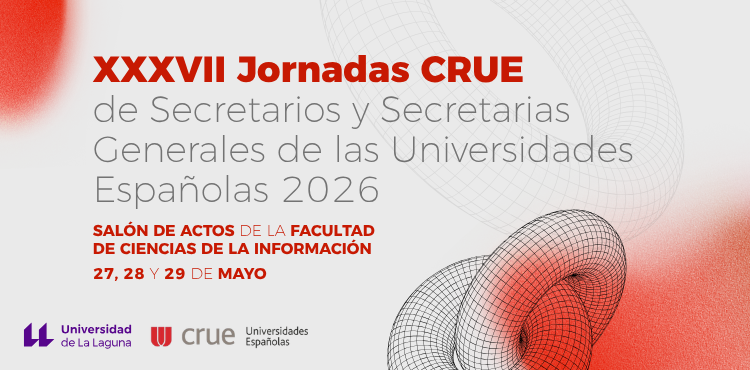
The University of La Laguna will host, starting tomorrow, May 28, the XXXVII Conference of Secretaries General of Spanish Universities, The meeting, attended by some 60 people, including registered participants and speakers, from approximately 35 public and private academic institutions across the country, will address some of the legal challenges facing academic centers. These include adapting their statutes to the Law on the Organization of the University System (LOSU), which has been in effect for three years, the impact of artificial intelligence on academic and administrative matters, and the implementation of new digital degree certificates, among other issues.
The meeting will be held in the Assembly Hall of the Faculty of Political, Social and Communication Sciences (Pyramid Building) and its inauguration will be tomorrow, Thursday the 28th at 10:00 a.m., with the participation of the rector of the University of La Laguna, Francisco J. García Rodríguez; the rector of the University of Oviedo and president of Crue-General Secretariats, Ignacio Villaverde Menéndez; and the rector of the University of Santiago de Compostela, Antonio López Díaz.
The Secretary General of the University of La Laguna, Juan Antonio García García, explains that this is a good opportunity to address crucial issues for higher education in a more direct and coordinated manner. He also highlights the renewed involvement of the Tenerife institution in the governing bodies of the CRUE (Conference of Rectors of Spanish Universities) after years of absence, as Rector Francisco García has chaired the Faculty Sectoral Committee for a few weeks now, and Juan Antonio García himself has been a member of the General Secretaries Sectoral Committee for about six months.
He program The sessions are structured around round tables that address specific topics. Regarding digital certificates for official qualifications, Juan Antonio García explains that from 2027 onwards, official degrees will no longer be issued on paper and, from that moment on, each citizen will have a “European Identity Wallet” at their disposal.European Identity WalletThis is where your personal information, including academic information, will be stored, and you will decide which entities can access that information. For example, a company or public administration that you wish to consult regarding your academic qualifications.
For universities, this measure will mean a reduction in internal bureaucracy, as they will no longer have to issue degrees or academic certificates on paper, but the process presents a technological challenge. Initially, this measure will affect new degrees issued from the year of its implementation onward, starting with those corresponding to micro-credentials. In the future, the system will be studied for how to incorporate previously issued degrees in physical format.
Another issue highlighted by the Secretary General of the University of La Laguna is the adaptation of university statutes to the Organic Law on Universities (LOSU), "which is taking longer than the legislator anticipated," as García acknowledges. A dozen Spanish universities have already completed the process, and La Laguna has finalized a draft of its adapted statutes, which it intends to present to the University Senate in June. If approved, it will only require approval from the Regional Government to complete this regulatory update.
Artificial intelligence is posing a challenge to all sectors, and academia is no exception. Therefore, one of the roundtables addresses the ethical use of this technology, which, as García García points out, has delicate implications in areas such as data protection, as well as the potential danger of falling into cultural, gender, and other biases.
The sessions are highly technical, as they address administrative matters such as the process of affiliating and disaffiliating external centers with universities. The affiliation procedure is very clear and regulated, and is quite common in Spanish universities—for example, the University of La Laguna has an affiliated Nursing center and two Tourism centers. However, the procedure to follow when terminating this affiliation is to be terminated is not clear, and this will also be discussed at this meeting.
The Conference of Rectors of Spanish Universities (CRUE[Name of the organization] is a non-profit association created in 1994 that represents all academic institutions, promoting cooperation between them and public administrations, as well as relations with foreign universities and social partners. It is organized into sectoral sections, one of which is [name of the section]. General Secretariats, which, in turn, is divided into six working networks: university coexistence, archives, service inspection, legal offices, protocol, and data protection.

 Spanish
 English
 French