
The Governing Council of the University of La Laguna approved today, June 3, in plenary session the creation of three new technology-based companies that originate within the educational institution, with the aim of transferring the scientific advances generated in the academic institution to the productive sector.
Thus, spin-offs are the most relevant key element in knowledge transfer, explained the Vice-Rector for Research and Transfer, Antonio Aparicio Juan, at this morning's meeting of the governing body. These three new structures join the six already created at the university, and the Vice-Rector added that there are five more initiatives of this type that could materialize in the coming months.
Aparicio Juan explained that these structures transform research results into initiatives with socioeconomic impact, stemming from years of research by teams at the University of La Laguna. Once the product is fully developed, business plans are established for each company, and its creation is approved.
These three companies are being established in accordance with the new regulations on this matter and, at least initially, will be located within the university itself. For their creation, it is essential that their purpose be the exploitation of knowledge generated at the university, and in the case of these three, the institution itself will hold a 51% stake in the share capital of each.
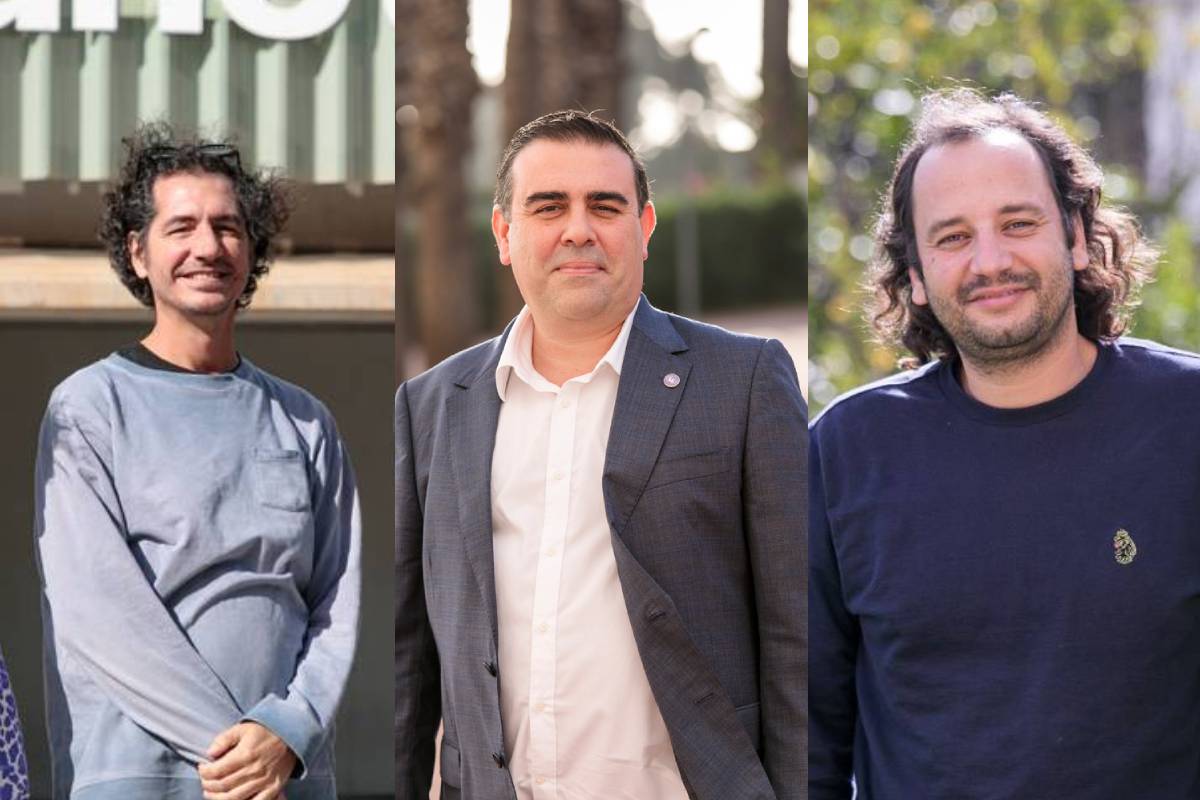
Gonzalo García (i), Jorge Méndez and Jonay Toledo (d), proponents of the three companies.
The first spin-off is Tenet LightKey, promoted by Jorge Méndez Ramos, a professor in the Department of Physics. It will be dedicated to developing anti-counterfeiting technologies to protect all types of documents, technological products, certificates, etc. For this purpose, it uses luminescent inks based on rare earth elements, an initiative that has received the Canary Islands Innovation Award.
The second company agreed upon today is called Robotserv, and in this case, it is being promoted by Jonay Tomás Toledo Carrillo, a professor in the Department of Computer and Systems Engineering. It is a company that will develop mobile robots to perform repetitive tasks in non-automated environments, such as, he said, the agricultural sector.
Zona 1 is the name of the third company, or spin-off, sponsored by Gonzalo García Silvestro, a tenured professor in the Department of Chemistry. This entity is dedicated to the development of nanostructured mechanical coatings that inhibit the absorption of certain molecules, which is one of the main methods for preventing metal oxidation. The innovation is based on a patent that has also been extended to several Asian countries, and it anticipates significant growth in industries where these types of products are essential.
Furthermore, the Governing Council also agreed in today's plenary session to the proposal to create two institutional chairs in the field of medicine, one in Functional Imaging and Neurocomputing IMETISA – University of La Laguna, and another in Telemedicine, Artificial Intelligence and Clinical and Teaching Innovation in Medicine and Surgery IMETISA-

Antonio Aparicio, Vice-Rector for Research and Transfer.
University of La Laguna, both with a strong focus on healthcare and research.
Today's session revealed two appointments: Noa Real García, assistant professor, as director of the Student Support Secretariat, within the Vice-Rectorate for Students, and Paula Fernández, as director of Social Projection, in the Vice-Rectorate for Culture and University Extension.
The Governing Council also addressed a specific amendment to the Academic Organization Regulations, aiming to clarify the situation of the remote campuses (Tourism in Adeje and Nursing in La Palma). The goal is to implement full in-person instruction gradually, year by year in the case of La Palma, and completely starting next academic year in Adeje. This would eliminate the mirrored classes in both degree programs and would also require hiring more specialized faculty for these campuses.
The session also agreed to modify the number of places offered in the double degree program in Nautical Studies, Maritime Transport, and Marine Technologies, so that students from these two original degrees can transfer to the double degree program if they wish and meet the academic requirements. Finally, the governing body also approved the multi-year expenditure for electricity supply to all buildings of the University of La Laguna, which must now be ratified by the Social Council.

 Spanish
 English
 French