
A study conducted by Jonathan Delgado, researcher at the Department of Developmental and Educational Psychology of the University of La Laguna, and Moses Betancort, A member of the Department of Clinical Psychology, Psychobiology, and Methodology has demonstrated that acoustic voice analysis combined with machine learning techniques can become an effective, non-invasive, and low-cost tool to aid in the classification of multiple sclerosis (MS). The work, published in the scientific journal Multiple Sclerosis and Related Disorders, It was developed in collaboration with researchers Tatiana Romero from the European University of the Canary Islands and Miguel Ángel Hernández from the University Hospital of Our Lady of La Candelaria.
The research stems from the clinical premise that voice changes are common in people with multiple sclerosis, even in the early stages of the disease. Thanks to new voice analysis technologies and the use of artificial intelligence, the team developed a model capable of detecting these subtle vocal alterations that often go unnoticed.
The study involved 300 participants, 200 of whom had a confirmed diagnosis of multiple sclerosis, while 100 were neurologically healthy controls. Each participant made a simple vocal recording, sustaining the sound of the vowel "a" for four seconds. From these samples, the researchers extracted fifteen acoustic parameters related to voice stability, noise, and variability.
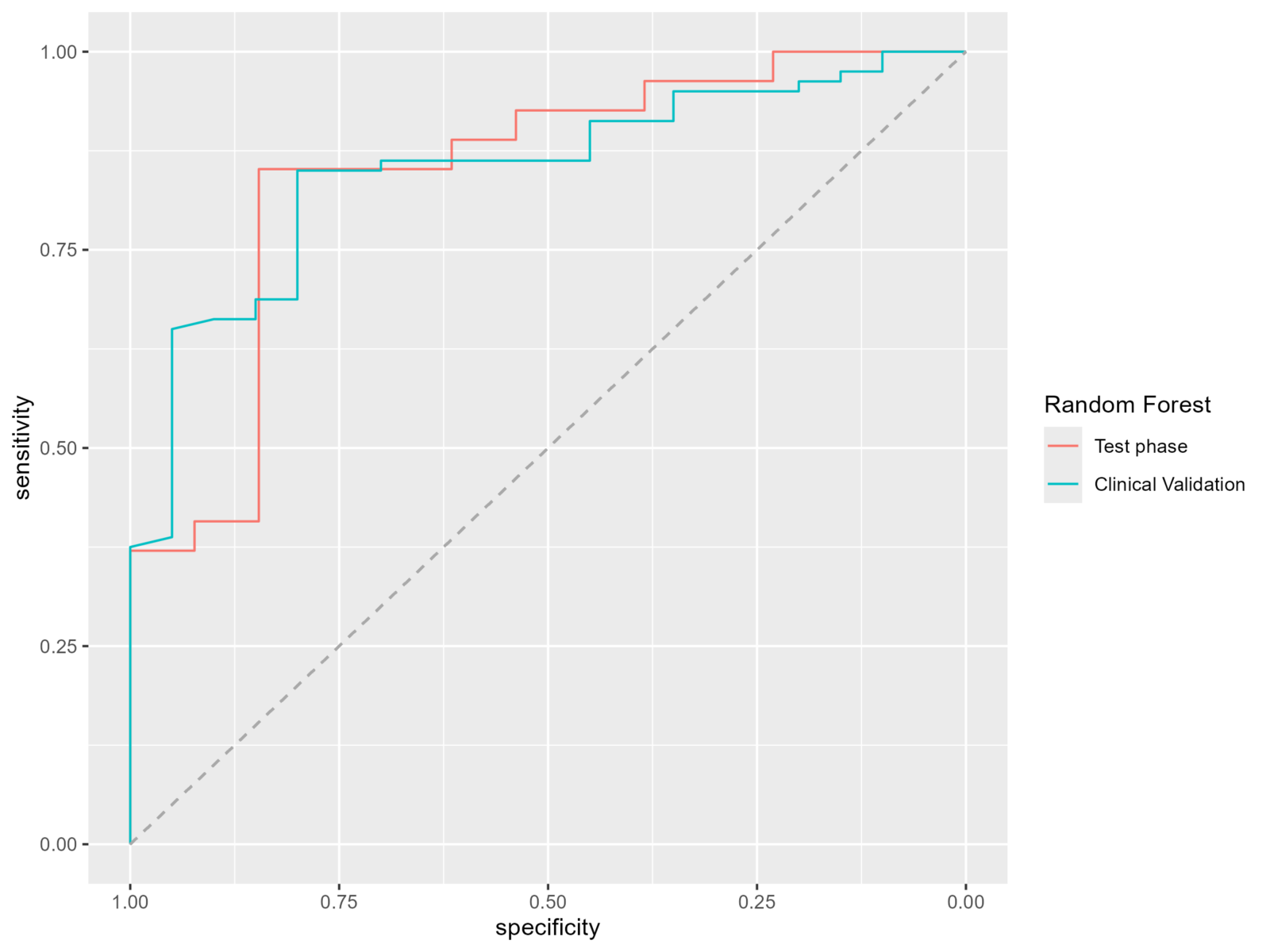
Graph of the ROC curves of the Random Fores model, in the training/internal test phase (red) and validation in an independent cohort of participants (blue).
During the study, several artificial intelligence systems were used to analyze all the information obtained from the voices. The researchers indicate that, among all the models tested, the one that offered the best results was Random Forest, which was able to differentiate with remarkable accuracy between people with multiple sclerosis and those who were healthy.
The research also identified the vocal variables with the greatest impact on automatic classification. These include high-frequency voice noise, spectral slope, and fundamental pitch variability—parameters associated with neuromuscular alterations characteristic of the disease.
One of the most significant findings of the study is that these vocal biomarkers appear to remain relatively independent of factors such as age, disease duration, or the degree of physical disability as measured by the EDSS (Expanded Disability Status Scale). This suggests that the detected vocal alterations could act as status biomarkers, present from the early stages of the disease and relatively stable throughout its progression.
However, acoustic voice analysis was found to be insufficiently accurate for classifying the clinical severity of multiple sclerosis. Although some parameters showed changes in patients with advanced disability, the model failed to reliably differentiate between mild, moderate, and severe stages of the disease.
The researchers in this study emphasize that this approach could have significant future applications as a clinical support tool, especially due to its speed, cost-effectiveness, and non-invasive nature. Furthermore, they highlight that voice analysis could facilitate remote monitoring strategies using digital devices, contributing to earlier and more accessible detection of neurological disorders.

 Spanish
 English
 French