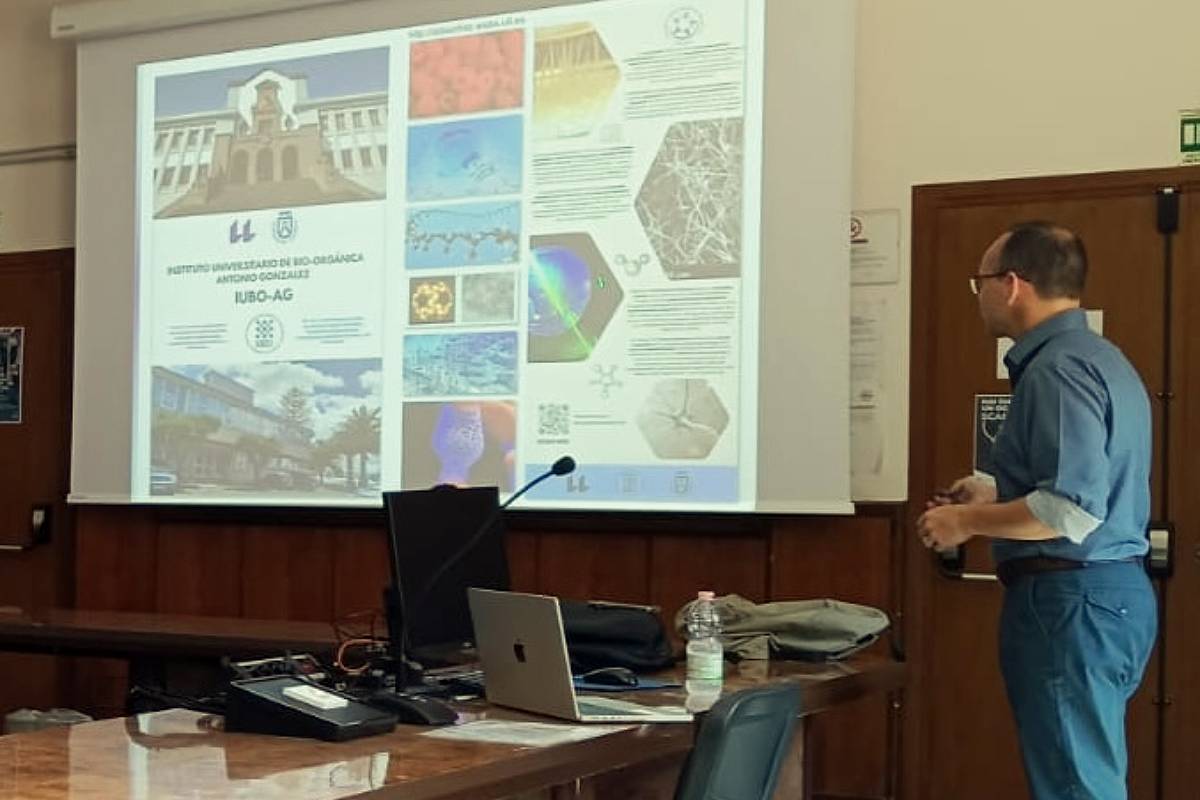
David Díaz Díaz, Professor of Organic Chemistry at the University of La Laguna, Secretary of the Antonio González University Institute of Bio-Organic Chemistry and Director of the research group AFM-NANO, continues to consolidate the international projection of the Canary Islands academic institution through new scientific collaborations with leading Italian universities.
In recent weeks, the researcher has given invited lectures at the Università degli Studi di Roma Tor Vergata and in the historic Università degli Studi di Roma “La Sapienza”, one of the most prestigious academic institutions in Europe —founded in 1303 and currently boasting over 140,000 students, positioning itself as one of the most influential universities on the continent in numerous fields of knowledge—.
During his presentations, Díaz showcased some of the advances developed by the AFM-NANO group in the design and application of soft functional materials for strategic areas such as catalysis, energy, biomedicine and sustainable technologies, opening new opportunities for scientific cooperation and academic mobility with the Italian researchers and students who attended.
For Díaz, the visit also takes on special significance due to the historical and scientific context of La Sapienza, an institution closely linked to some of the most important figures in Italian and European chemistry. Among them is Stanislao Cannizzaro, considered one of the great pioneers of modern chemistry and a key figure in the recovery and dissemination of Avogadro's hypothesis, fundamental to the establishment of atomic and molecular weights. His legacy remains very much alive at the Roman university, where the main building of the Department of Chemistry now bears his name.
Along with Cannizzaro, other historical figures such as Emanuele Paternò di Sessa or Giacomo Ciamician made a decisive contribution to the development of modern Italian and European chemistry, consolidating La Sapienza as a scientific enclave of enormous international relevance.
These international invitations also reflect the recognition achieved by Professor Díaz's scientific career and that of the AFM-NANO group. In recent years, the researcher has received, among other national and international awards, the Institutional Research and Internationalization Awards from the University of La Laguna, in addition to regularly appearing in the well-known ranking compiled by Stanford University that lists the world's most influential scientists.
Far from being isolated collaborations, the relationship with various Italian universities will continue to strengthen in the coming months. Professor Díaz will return to Italy at the end of the year to participate in new invited scientific activities, with the aim of fostering collaboration agreements, joint projects, and research exchange programs between institutions. With initiatives of this kind, the University of La Laguna continues to expand its international presence and strengthen its role in leading scientific networks.

 Spanish
 English
 French