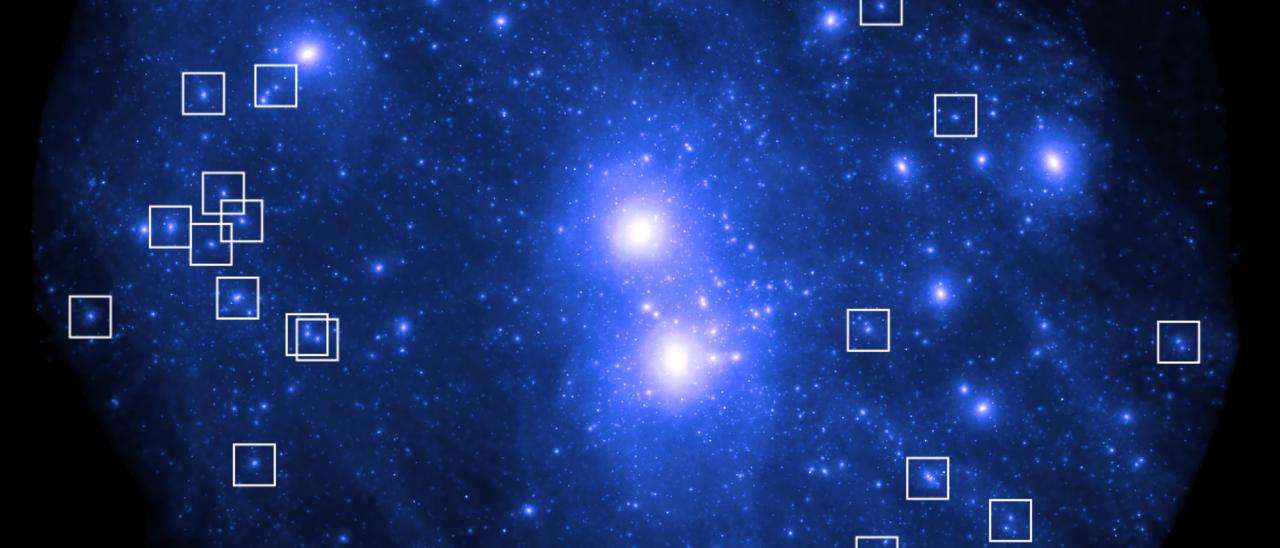
The Canary Islands Institute of Astrophysics and the University of La Laguna are leading an international study on dark galaxies. ULL doctoral candidate Guacimara García Bethencourt, along with her thesis supervisors, is participating in the research. Arianna Di Cintio y Sébastien Comerón, both professors in the Department of Astrophysics at the University of La Laguna and researchers at the IAC, present in Astronomy & Astrophysics A pioneering study on one of the most intriguing objects in current astrophysics: dark galaxies, systems rich in gas and dark matter, but unable to form stars and therefore invisible to traditional telescopes.
The work comes at a highly topical time. In recent weeks, both NASA and ESA have announced the discovery of the first observational candidates, including the Cloud-9 object, Confirmed with the Hubble telescope. These detections have placed dark galaxies at the center of the cosmological debate.
In this context, the new study is at the forefront of the field of galaxy formation and evolution by using state-of-the-art cosmological simulations such as HESTIA (IP N. Libeskind, AIP) and NIVARIA-LG (IP A. Di Cintio, IAC-ULL) to unravel how these “phantom” objects originate and evolve.
«"The results show that these galaxies arise in dark matter halos with specific properties, in which the gas never reaches the densities necessary to trigger star formation," explains García Bethencourt.
Furthermore, the team provides key predictions for their detection: up to eight dark galaxies could be observable in the Milky Way's immediate vicinity through neutral hydrogen emission, opening the door to their detection in future surveys.
This work not only reinforces one of the fundamental predictions of the Lambda-Cold Dark Matter (LCDM) cosmological model, the standard theoretical framework that describes the origin, evolution, and fate of the universe, but also offers a concrete guide to discovering a population of galaxies that, until now, has remained hidden. "The universe could be full of invisible galaxies... and we are closer than ever to finding them," the researcher concludes.
| This research has received funding from the Spanish Ministry of Science and Innovation (MICINN), within the framework of the "Research Consolidation" program, grant agreement CNS2023-144669, (IP A. Di Cintio), and the 2024 call for "Knowledge Generation Projects", grant agreement PID2024-160009NA-I00, (IP A. Di Cintio). |

 Spanish
 English
 French