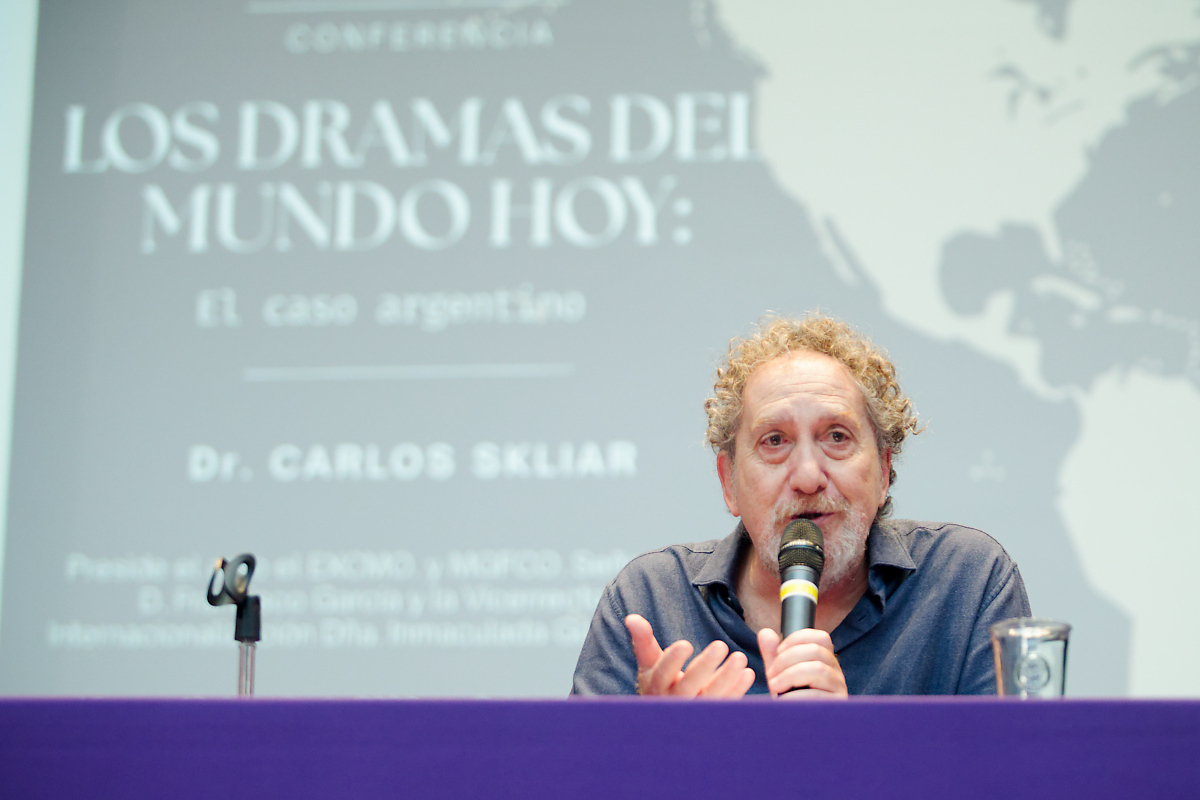
The Argentine writer Carlos Skliar has returned to the University of La Laguna, thanks to the research group in Critical Pedagogy led by Mª Lourdes González Luis. The expert in pedagogy and philosophy has participated in several seminars during his stay at this academic center and today, Friday the 19th, he gave a presentation at the Faculty of Education about the different dramas that plague the world and, especially, his country.
“We live in a world that tends towards dispossession. There are as many worlds as there are experiences, microworlds that indicate forms of habitability and tenure,” he noted, and all of this is embedded in a macroworld “that belongs to no one but has very specific owners,” he added.
The educator spoke about the world's policies of care and neglect, which have historically been intertwined in different ways. "Today, neglect has been so pervasive that the question of care itself has become indeterminate." In his view, the tragedy is composed of highly visible elements, which doesn't preclude a certain subtlety, he said. "This is a world that dispossesses, that creates subjective conditions for being. It's a world that makes time and place inhospitable, but at the same time demands immense adaptability. In the end, everything is left to how one is born, as if that absolutely defines everything that comes after.".
The senior researcher at the Latin American Institute for Social Research (FLACSO/CONICET) outlined the trends emerging in contemporary societies, including loneliness as an illness or isolation, exhaustion, deterritorialization, and the dissuasion of certain actions while simultaneously compelling others. This chaotic set of elements, according to the speaker, defines today's world, combined with a strong emphasis on self-affirmation. "This world dictates that each person chooses their own path, contradicting the very existence of education understood as a social construct geared toward the public and the common good.".
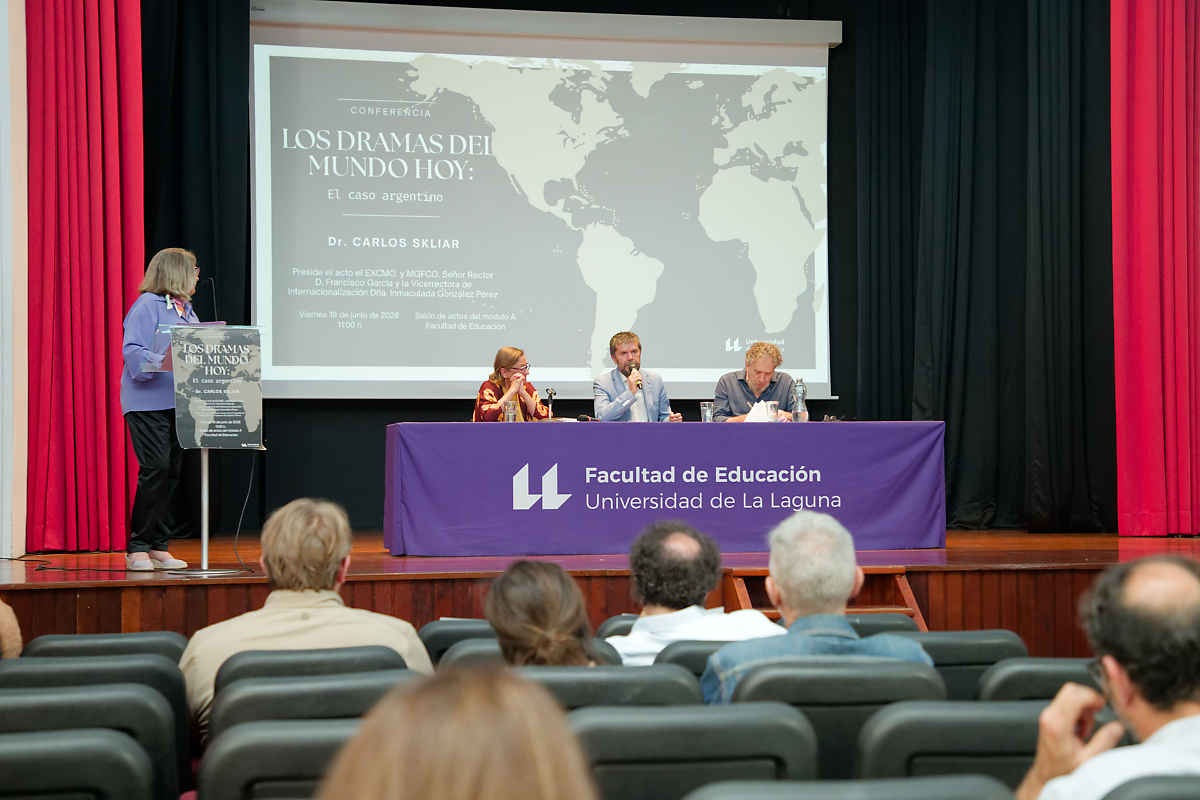
A moment from the presentation.
The arrival of fascism
Carlos Skliar was particularly critical of the situation in his country. Argentina is in the hands of a “libertarian government” that has been in power for two and a half years. “It has allowed an unprecedented form of fascism,” he stated, questioning the need to address his nation's chronic economic problems by imposing fascism, and whether there wasn't a more constructive alternative.
The country's enormous external debt, surpassing any historical record, is compounded by a vast public debt, with poverty rates affecting over 60% of the population. "Around twenty businesses close every day, and consumption has plummeted to unprecedented levels. Debt is suffocating families with unpayable loans, and numerous social and cultural programs have been discontinued, while ministries related to health, culture, and education have been eliminated to create a single Ministry of Human Capital.".
Added to all this is the implementation of the Educational Freedom Law, which 'Chileanizes' education through the purchase of educational vouchers so that those who can afford it can decide the direction of educational centers and the content that their sons and daughters will learn.
“The country has been handed over as a multinational territory for the extraction of valuable raw materials,” he described. However, this is a radicalized and destructive form of capitalism, “which ultimately distracts attention from a supposed culture war, in which we have all been drawn, while people starve to death.”.

 Spanish
 English
 French