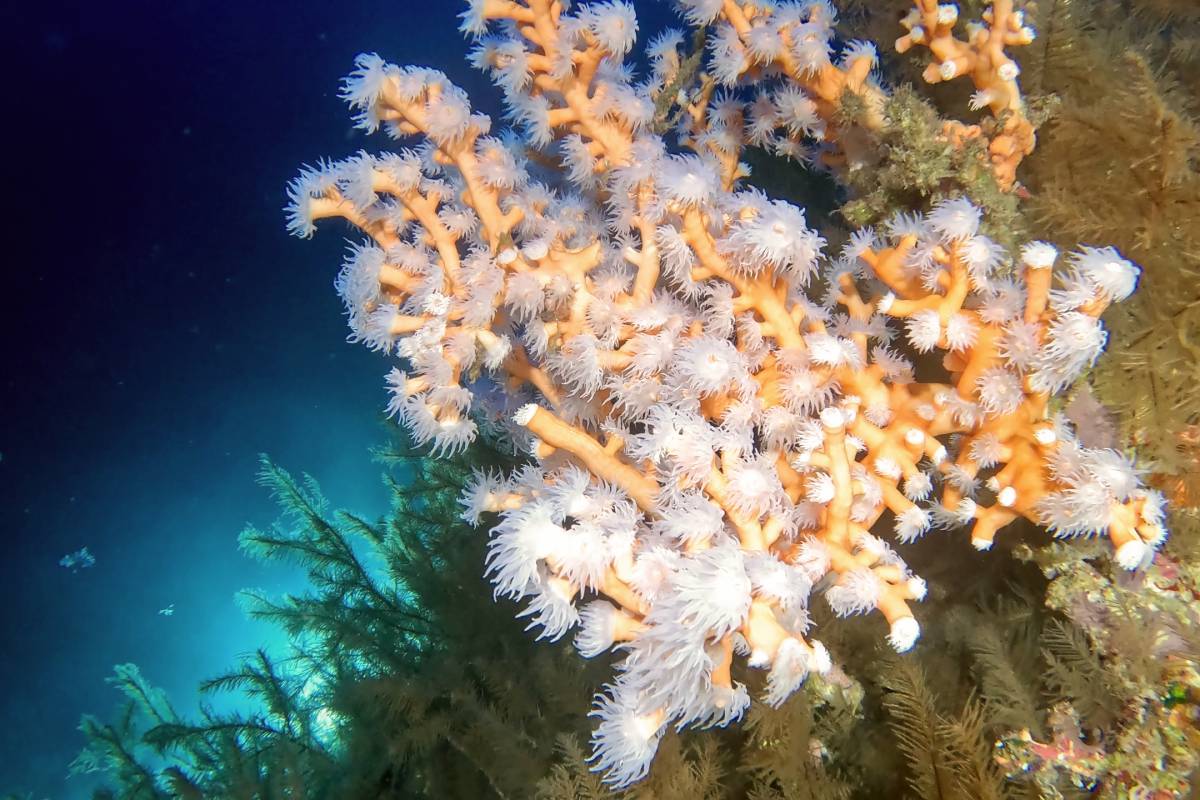
The mesophotic coral communities of the Canary Islands constitute one of the archipelago's least-known marine ecosystems. Located between 50 and 150 meters deep, these coral and sponge formations serve as a refuge for numerous marine species and harbor a high level of biodiversity. However, the extent to which activities such as artisanal fishing may affect their conservation remains unknown. To address this question, the University of La Laguna has launched the project “Study and Mitigation of the Impact of Artisanal Fishing on Mesophotic Coral Ecosystems in the Canary Islands (CORALART).”.
This initiative is a collaborative effort with the Biodiversity Foundation of the Ministry for Ecological Transition and the Demographic Challenge, through the Pleamar program, and is co-financed by the European Union through the European Maritime, Fisheries and Aquaculture Fund (EMFF). With a total budget of €390,313, it will study these ecosystems on El Hierro, Tenerife, and La Graciosa through collaboration between scientists and the fishing sector.
“The main objective of this project is to scientifically understand the impact of artisanal fishing on these ecosystems, since currently there is no quantified data on whether there is a real impact, in addition to basic aspects about the biology and reproduction of these deep-sea corals,” he explains. Adriana Rodríguez Hernández, Professor and researcher in the Zoology department at the University of La Laguna and leader of the project. These communities, which include vulnerable species such as Savalia savaglia, Dendrophyllia ramea and gorgonians of the genus Paramuricea sp, They are located in marine reserves and Special Conservation Areas (SCA).
Through a methodology that combines monitoring in situ, Through the recovery of specimens, laboratory studies, and training activities with fishermen, the project seeks to reduce the direct impact on these habitats, while strengthening the co-responsibility of the fishing sector in their conservation, promoting more sustainable practices adapted to the local context.
The first phase will consist of monitoring mesophotic communities through technical diving expeditions to depths of approximately 100 meters. These dives will allow for a direct assessment of the conservation status of the ecosystems and the quantification of the potential effects of fishing activity on the corals. “This will allow us to include damage that is not always visible in recovered specimens,” explains the researcher.
The next phase will focus on collaboration with the fishing sector. To this end, the research team will provide participating vessels with a kit specifically designed to preserve corals accidentally caught in fishing gear. “This kit will include containers adapted to maintain the corals' environmental conditions, and once ashore, the fishermen will be able to transfer the specimens to aquariums installed at the fishermen's associations, equipped with appropriate temperatures and low lighting levels,” the researcher explains. In this way, the corals will remain in good condition until the research team travels to collect them and transport them to the laboratories at the University of La Laguna.
Once in these laboratories, researchers will analyze the recovery capacity of the affected corals, studying aspects such as their growth, biology, reproduction, and response to different environmental disturbances. These studies will determine whether the species are capable of regenerating after suffering damage and expand scientific knowledge about these still poorly understood marine communities, in which the identification of new species is not ruled out.
Outreach will also play a key role in CORALART. The project will include the production of a freely accessible documentary showcasing the various phases of the research and introducing the public to the richness of mesophotic communities. In addition, workshops and outreach materials will be developed for the fishing industry, educational institutions, and the general public. “The goal is to raise awareness of these ecosystems and promote their conservation through collaboration between fishers and researchers,” emphasizes Rodríguez Hernández.
Within this initiative, the Fishermen's Guilds of La Graciosa, La Tiñosa, San Roque and Isla Baja, La Restinga, Garachico and Los Cristianos act as collaborating entities, in addition to the collaboration of the General Directorate of Fisheries of the Government of the Canary Islands and the General Directorate of Natural Spaces and Biodiversity of the Government of the Canary Islands.

 Spanish
 English
 French