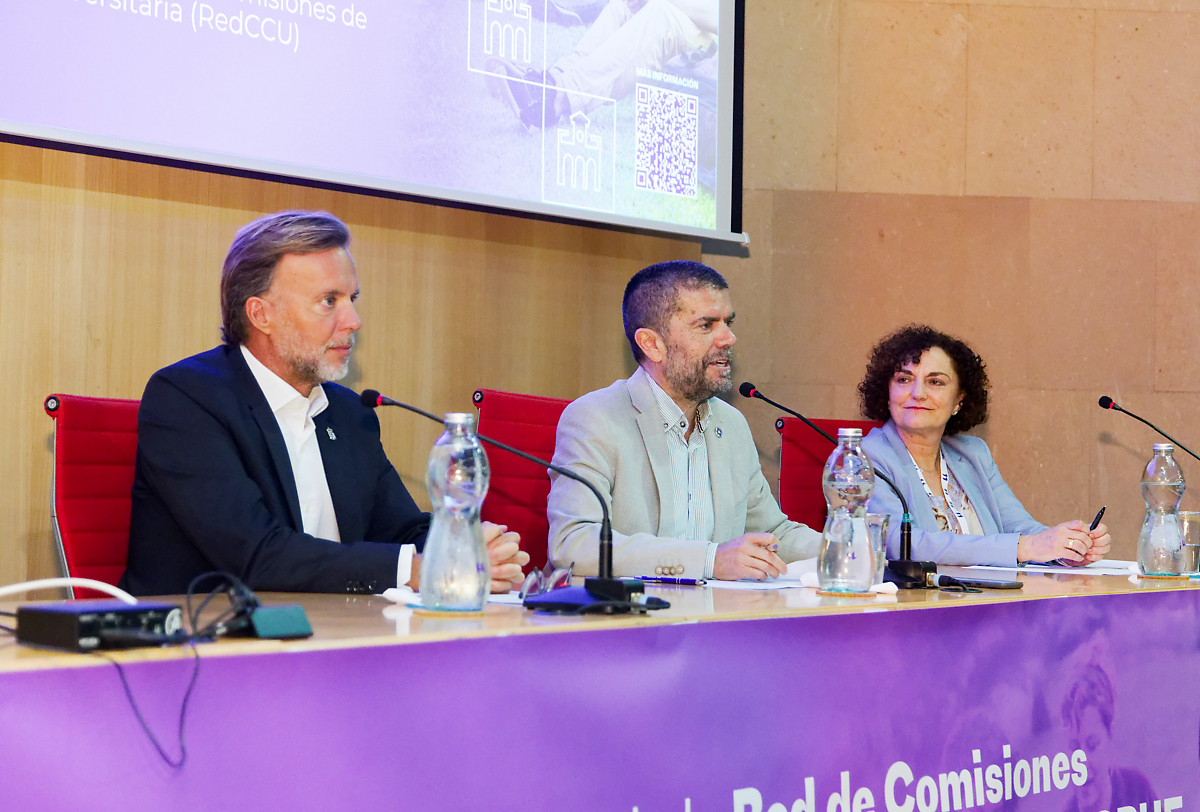
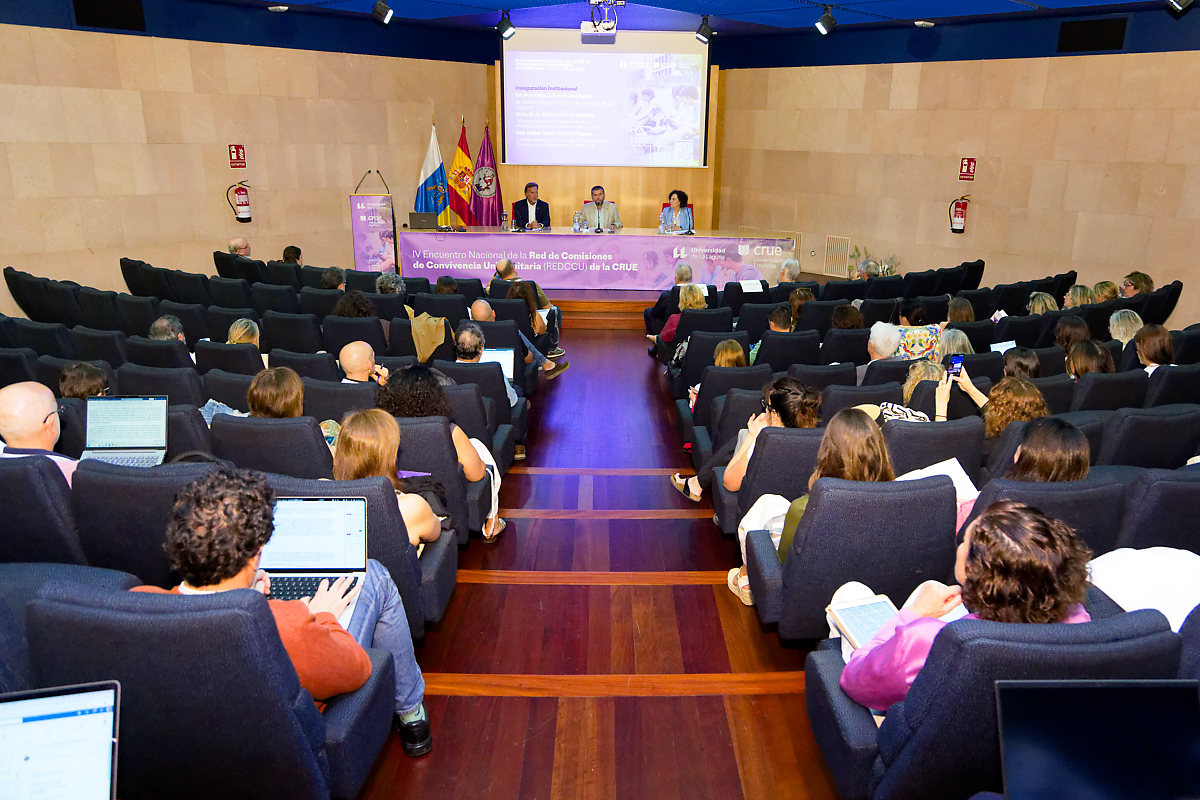
The Law 3/2022 The University Coexistence Law established a new regulatory framework through which national academic institutions are driving a profound change in their organizational culture, placing coexistence at the heart of academic life and promoting conflict resolution, mediation, and, above all, prevention. After four years in effect, those responsible for this area from 43 centers throughout Spain met at the University of La Laguna to participate in the fourth edition of the national meeting of the CRUE Network of Coexistence Commissions, which was inaugurated today, Thursday, June 25, and will continue until tomorrow.
The Blas Cabrera Felipe Auditorium of the Faculty of Sciences is the venue for this meeting, whose inauguration was presided over by the rector of the University of La Laguna, Francisco García Rodríguez, who, first of all, highlighted the work of CRUE Spanish Universities “as a space for reflection, exchange of experiences and advocacy before the administrations for the defense of universities, especially public ones”.
Regarding the topic of the meeting, he noted that the new law represents a milestone because it creates a framework for resolving conflicts through dialogue and mediation as key services. At that point, he highlighted the pioneering work of the Mediation and Counseling Unit for Coexistence (UNIMAC) of the University of La Laguna, created in 2010 and whose head, Manuel Rosales, is coordinator of the organizing committee of the meeting.
The rector reflected that the university is a space where, historically, differing opinions have coexisted and dissent has been exercised harmoniously. This makes the academic institution a perfect laboratory for exploring these approaches to ensure coexistence and mediate conflicts, and for extrapolating them to an increasingly polarized society.
The Deputy Minister of Universities and Research of the Canary Islands Government, Ciro Gutiérrez Ascanio, also praised the university as an ideal space for fostering an institutional culture of coexistence. He noted that academia brings together people with very different interests, backgrounds, and opinions, and that this diversity has been one of its strengths, as it promotes the respectful exchange of ideas and establishes conditions that allow all debate to take place freely.
He also alluded to the complexity of today's fast-paced society, in which messages are amplified at an unprecedented speed. In his opinion, society cannot progress without a suitable framework for coexistence, and in this respect, the university is fundamental because it will produce not only the professionals of the future, but also its leaders and citizens. Therefore, it is essential to instill values such as respect and coexistence during the formative years.
Isabel Ortiz Rodríguez, coordinator of the Network of University Coexistence Commissions, also spoke at the opening ceremony. She recalled that these conferences began to be organized when the law came into force, and their first three editions—held in Madrid, Oviedo and Almería—tried to respond to the uncertainty created by the new legislation.
This new meeting in La Laguna marks a new stage for these forums, as progress has already been made in implementing the regulations and establishing the corresponding bodies. Now is the time to share experiences, success stories, and also mistakes from which to learn. “It is now time to delve deeper, reflect, and put into action” to move towards “fairer and more inclusive” universities.
 Assessment of the new law
The first speaker was the Secretary General of the University of La Laguna, Juan Antonio García García, who offered a critical assessment of Law 3/2022, “a good attempt to improve university life” compared to the regulations in force until then, a Francoist decree from 1954. “We have gained in that this system has been adapted to constitutional principles. In this respect, it is clear that the law represents a significant improvement in terms of establishing coexistence committees and incorporating certain values of mediation, ensuring that sanctions or disciplinary action is the last resort. I believe it has created a climate of improved university life.”.
Thus, he explains that a previous regulatory framework, in which the government authority had the power to authorize certain actions in universities, has been superseded, and therefore the approach “was purely repressive and had become outdated.” Despite this, its reform was not addressed until 2022.
As with all legislation, García believes there are some areas for improvement. “The law, as required by the Constitution, must define all behaviors that are subject to sanctions, and I think it falls short in its definition.” He believes that some offenses are missing, others need updating, and still others need to be adapted to the new reality of information and communication technologies, because “the university environment is no longer limited to classrooms; it encompasses electronic environments, social networks, and all of this requires some updating of the types of infractions.”.
Regarding the positive aspects, the Secretary General cites the commitment to mediation; the promotion of preventative measures; and the coexistence committees as equal spaces for faculty, teaching and research staff, and students, which reinforce the idea that the university community lives together in difference and diversity. The University of La Laguna already has a coexistence code and a student discipline code, and the Coexistence Committee mandated by law has been established, joining the existing UNIMAC committee. Emphasis should also be placed on training that equips individuals and units, such as deans' offices and student delegations, with the tools to detect and address potential conflicts and act preventively, even before they arise.

 Spanish
 English
 French