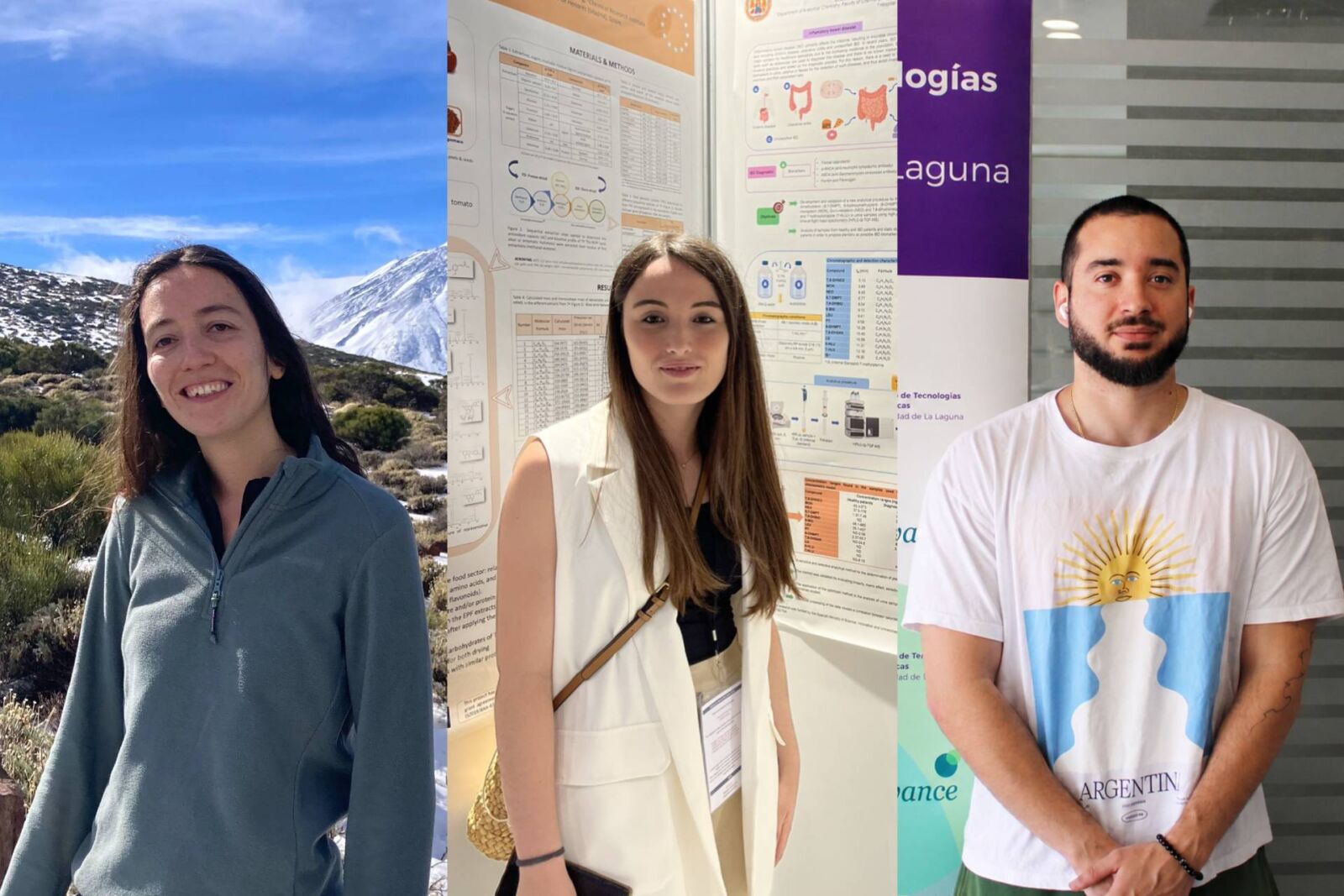
The Juan de la Cierva Aid These grants have become one of the main instruments for boosting the careers of young researchers in Spain. Promoted by the Ministry of Science, Innovation and Universities through the State Research Agency, they facilitate the integration of early-career researchers into R&D centers throughout Spain to reinforce and consolidate the experience acquired during their first years of postdoctoral training. Thanks to this program, the University of La Laguna will soon host three young scientists conducting research in the areas of Biosciences and Biotechnology, Physical Sciences, and Environmental Sciences and Technologies.
Luis Romero, a postdoctoral researcher from the University of Texas Health Houston, McGovern Medical School (USA), will join the research group. Molecular Bases of Human Channelopathies (MOLCAN), led by the professor Teresa Giráldez at the University Institute of Biomedical Technologies.
With a distinguished career in the field of ion channel biophysics, Romero's research focuses on the function of transmembrane proteins known as BKs. These proteins are present in almost all physiological systems of the body, playing a fundamental role in the functioning of the nervous, gastrointestinal, cardiovascular, reproductive, endocrine, and lymphatic systems.
BK channels are capable of playing diverse roles in various systems, partly due to the mechanisms that introduce calcium into the cell and other auxiliary proteins that precisely modulate this activity. Among the objectives that Luis Romero García will pursue at the University of La Laguna (ULL) is the study of how these channels spatially and functionally couple to intracellular calcium sources, as well as the factors that regulate this interaction. According to the researcher, this work aims to deepen our understanding of the function of these transmembrane BK proteins.
The collaboration established with the research group Pathophysiology of mineralocorticoids, led by the professor Diego Álvarez de la Rosa, This allowed her to see the growth opportunities at ULL and options for addressing scientific questions with innovative approaches. “For those of us starting a career beyond a doctorate, it is extremely important that your mentors provide support and give you the freedom to ask questions and try to answer them,” she emphasizes.
Microplastics monitoring
Researcher Claudia Giménez will join the research group Applied Analytical Chemistry Research Group, under the supervision of the professor Javier Hernández. Her research will focus on the study of microplastics and associated chemical pollutants, with the aim of developing new analytical strategies that allow for their more precise detection and characterization. Giménez notes that her objective is to design advanced analytical methodologies to identify and quantify plastic particles and the chemical compounds they carry or release.
To this end, state-of-the-art instrumental techniques, such as chromatography, mass spectrometry and various spectroscopic tools, will be used, combined with innovative sample preparation and data analysis procedures, in order to detect and characterize microplastics and other contaminants in water, sediments, soils, biological tissues and physiological fluids.
Furthermore, advanced statistical methods will be applied to identify the types of polymers, evaluate their size and morphology, and simultaneously determine the presence of plastic additives and other organic contaminants. This work will also contribute to the standardization of analytical methodologies that still lack global consensus. Claudia Giménez will analyze the bioavailability and potential toxic effects of these contaminants in model organisms, their transfer along the food chain, and ultimately, human exposure.
The researcher explains that she chose the University of La Laguna (ULL) because of its renowned prestige in the field of Analytical Chemistry and, in particular, because of the scientific excellence of the research group, whose international track record perfectly aligns with her research interests. She highlights the opportunity to join a highly specialized and multidisciplinary environment with cutting-edge scientific instrumentation and to strengthen her international profile.
Evolution of dwarf galaxies
For their part, Ana Contreras de Santos will carry out his research work in the group of Astrophysics and Theoretical Cosmology, coordinated by Arianna Di Cintio. His research focuses on the study of galaxy formation and evolution, with special attention to dwarf galaxies, within the framework of the standard cosmological cold dark matter (LCDM) model.
To achieve this, he uses cosmological simulations that allow him to reproduce the joint evolution of dark matter, gas, and stars, as well as to study how different physical processes give rise to the observed properties of galaxies. His work focuses on the production and analysis of high-resolution simulations of dwarf galaxies located in environments similar to the Local Group, to which the Milky Way belongs.
Based on these simulations, the researcher analyzes how different physical processes and ingredients incorporated into numerical models affect the star formation history and structural evolution of these systems. The goal of this line of research is to better understand the mechanisms that govern the evolution of low-mass galaxies and their role in resolving the small-scale stresses of the LCDM model, thus contributing to a better understanding of dark matter.
“I chose the University of La Laguna because since last year I've been working in the research group I'll be joining with this contract, where I've had the opportunity to specialize in the study of dwarf galaxies using cosmological simulations,” the researcher explains. Although she had previously worked with numerical simulations, this line of research has allowed her to delve into a field that is especially relevant today, driven by the observational advances of recent years. “This is an excellent opportunity to continue my training and contribute to the development of cutting-edge research projects.”.

 Spanish
 English
 French