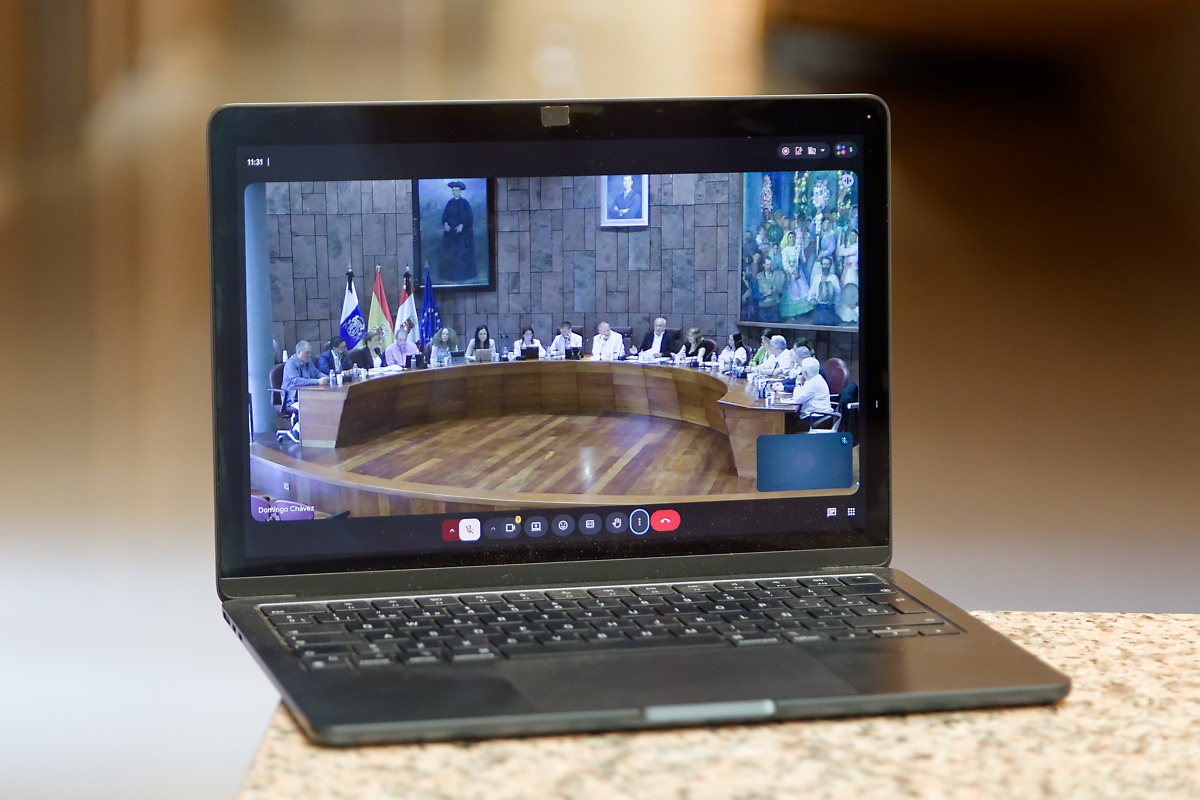
He Social Council The University of La Laguna, in its regional vocation, has moved today, June 29, to the island of La Gomera, from where it held its plenary session, presided at first by the island president, Casimiro Curbelo.
Curbelo highlighted the excellent relationship he maintains with the academic center, with which he shares two cultural chairs, and expressed his pleasure at this visit to an island, he said, affected by double insularity. For his part, the rector, Francisco García, added the existence of a research project on diabetes and its prevalence in the island's population, as well as mentioning the La Gomera Campus, with academic activity almost year-round, and the micro-credentials program. Meanwhile, the president of the Social Council, Francisco Almeida, thanked the island for the warm welcome extended to this collegiate body.
Among the issues discussed on the agenda, information was provided on the status of the regulations governing the sectoral conference of social councils of the Canary Islands universities, currently in process, and the final approval by delegation of the permanent commission, when the time comes.
Today's plenary session also addressed the text of the regulations governing the organization and operation of the collegiate body, for which partial amendments were debated and voted on separately, addressing technical issues.
In other news, the governing body approved the creation of three new spin-offs from the University of La Laguna, which have already received the approval of the Governing Council. The first of these is Tenet LightKey, which will be dedicated to developing anti-counterfeiting technologies to protect all types of documents, technological products, certificates, etc. It uses luminescent inks based on rare earth elements, an initiative that has received the Canary Islands Innovation Award.
The second company approved today is Robotserv, which aims to develop mobile robots to perform repetitive tasks in non-automated environments, such as the agricultural sector. The third and final company, Zona 1, will focus on generating nanostructured mechanical coatings that inhibit the absorption of certain molecules, a key method for preventing metal oxidation. The Social Council welcomed the launch of these three new knowledge-intensive companies, all originating from within the university and stemming from the scientific knowledge generated there.
Dual training
The Vice-Rector for Teaching, José Manuel Fraga, presented to the collegiate body the Interuniversity Dual Certificate of Specific Training in Agents of Digital Transformation of Public Services, jointly with the University of Las Palmas de Gran Canaria and their respective foundations, and in which the majority of the time the students will be working while taking this training.
This is a blended learning program, combining synchronous and asynchronous sessions. The coordinator for this academic center is Professor Daniel López. An enrollment of 50 students is expected, divided into 25 from each province. The program, which will begin next academic year, aims to develop a professional profile with advanced skills in digitization, data analysis, and process automation—an initiative highly valued by the Social Council.
Finally, the governing body gave its approval to the multi-year expenditure and the start of the multi-year contracting procedure for the supply of high-voltage electricity to all buildings of the University of La Laguna, incorporating alternative sources into the file and with the goal, in the not too distant future, of self-consumption.
The Social Council meeting concluded with a minute of silence in remembrance of the countless victims of the catastrophe that is currently devastating Venezuela.

 Spanish
 English
 French