
He Second Congress on the Demographic Challenge of the Canary Islands Promoted by the regional government, it hosted the public exhibition of Aridane Project, promoted by the University of La Laguna through its General Foundation, together with the Cabildo of La Palma and the co-financing of the “la Caixa” Foundation within the framework of its program “Social action in the rural area”, where it shares activity with 63 other territories throughout the Spanish State, focused on its aspect of community revitalization of the territory.
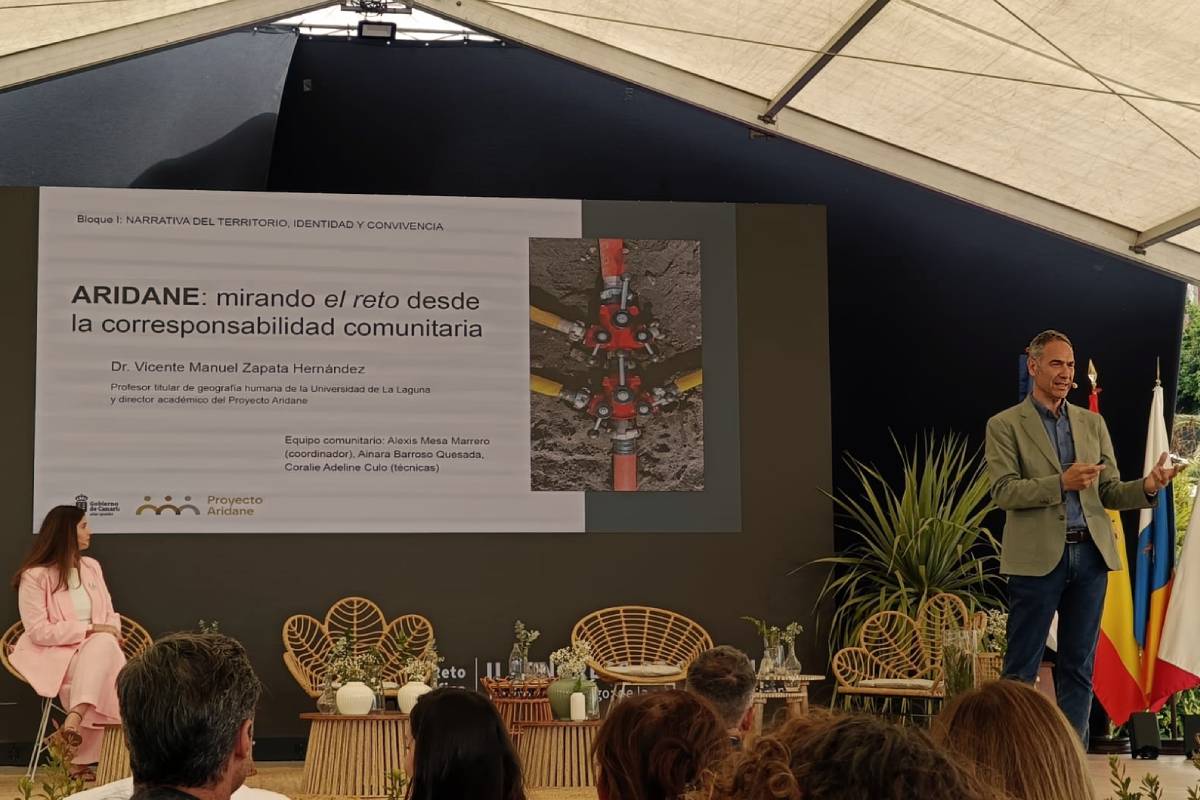
The Aridane Project was one of the initiatives presented at this event held in the municipality of Breña Alta. It was featured in the first session, which focused on territorial narrative, identity, and coexistence, under the theme "Aridane: facing the challenge through community co-responsibility." The presentation highlighted the originality of this initiative, which aims to define and develop, through participatory processes, a public policy to address the demographic challenge facing the Aridane Valley and contribute to its social and territorial cohesion.
The presentation was given by the professor of Human Geography. Vicente Zapata, Zapata, director of this project, which also involves the three municipalities of the Aridane Valley and the La Palma Biosphere Reserve Foundation, as well as the Canary Islands Government itself, reiterated the objectives of the Aridane project and argued for its implementation in the eastern region of La Palma, “given that several years have passed since the Tajogaite eruption and the Valley must address new challenges, such as those related to its geodemographic process.”.
 This process is certainly complex, highlighting issues such as the challenging generational transition following a negative natural balance since 2011 (more deaths than births), the growing aging of the population (the population over 64 years old is already double that of those under 15) or its increasing cultural diversification due to immigration, a phenomenon that is contributing to addressing, in part, the progressive sociodemographic weakening of the region.
Aridane's presentation served to introduce his work to a wider audience, as it is currently under development following a community listening process, some of whose findings were shared. In this regard, the main concerns of the Valley's residents are currently linked to housing availability, the economy and job market, education and access to vocational training on the island, their relationship with public administrations, and the availability of more leisure and cultural options.
In this same block, the selected communication on intercultural coexistence in its relation to the demographic challenge, linked to the program, was presented. Canarias Convive, which is also promoted by the University of La Laguna together with the Government of the Canary Islands.
And in the section on the territorial model for the Canary Islands of the 15 minutes, another intervention was given on the community dimension in employment through the project Neighborhoods for Employment: Stronger Together, which is being held in conjunction with the Tenerife Island Council. The participation of the University of La Laguna in the Congress has been significant, as demonstrated by the fact that both its opening and closing presentations were given by two economics specialists from the academic institution., Serafín Corral Quintana y Ana González Pérez, respectively.

 Spanish
 English
 French