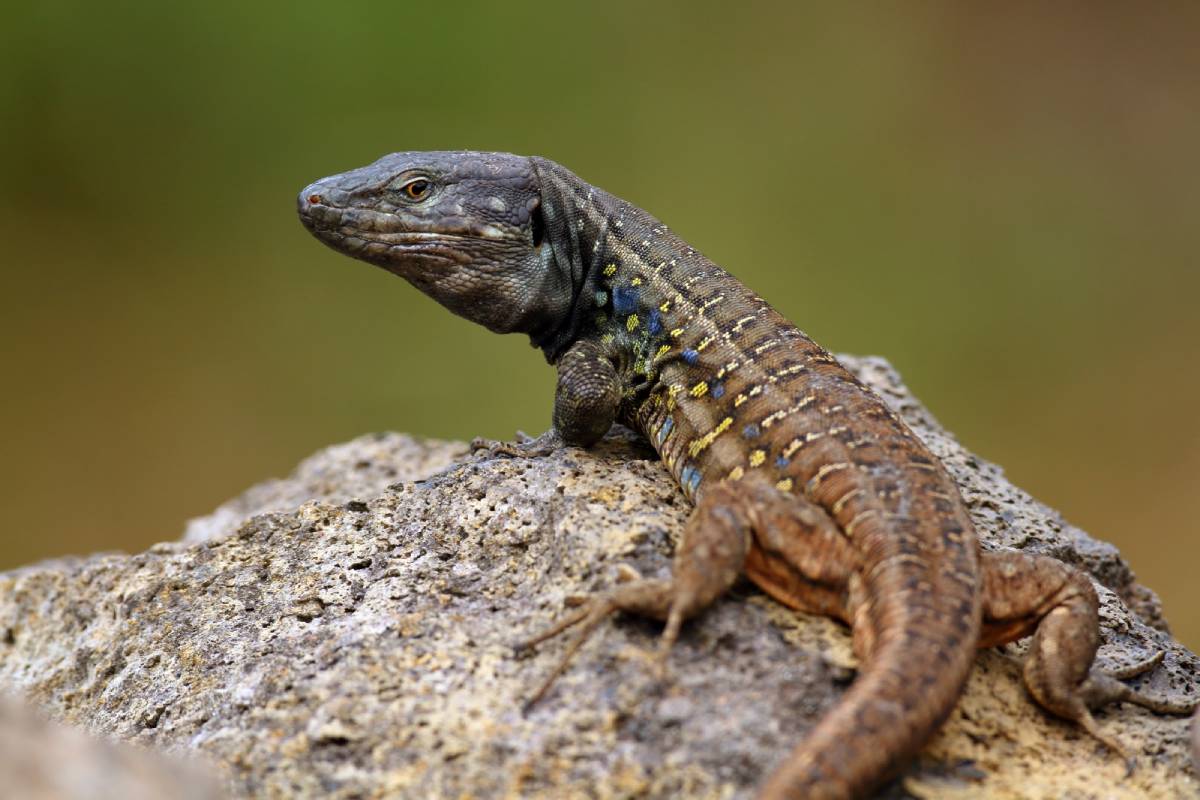
The cat colonies, Felis catus, are reducing the populations and body size of the black lizard, Gallotia galloti, on the island of Tenerife. This is confirmed by a study that analyzed more than 200 lizards in the vicinity of 22 cat colonies. The study, published today in the journal Biology Letters, It highlights the effects that feline colonies have on other species, as they have found that the feeding stations are altering the ecological dynamics of lizards, rodents, and birds.
The study, by researchers from the National Museum of Natural Sciences (MNCN-CSIC), the University of La Laguna and the Ornithology and Natural History Group of the Canary Islands (GOHNIC), compares lizard populations in areas close to feline colonies with control areas far from them that share a similar habitat.
The results demonstrate the direct and indirect impact of cats on these endemic reptiles, a key component of island ecosystems as seed dispersers and prey in the food chains of native predators. “We have detected the presence of up to 14 lizards in the remains of prey found in a single cat colony. However, the effect of the colonies is not limited to predation. Our data show that they also influence the structure of lizard populations and even the size that individual specimens reach,” explains MNCN researcher Airam Rodríguez.
To analyze these changes, the authors selected a representative sample of these colonies distributed across the island of Tenerife and applied an experimental design that compared areas near and far from feeding sites in pairs. The team used pitfall traps to take detailed morphological measurements of the captured lizards, which were then returned to their natural habitat.
In the control areas, an average of 3 more lizards (120% more) were captured than in the vicinity of the feline colonies. Furthermore, the lizards were not only less abundant but also smaller in the areas with a higher cat population. However, contrary to their initial hypotheses, the authors detected significant differences in the scaled mass index; that is, despite being smaller, they had a greater relative body weight, suggesting that the lizards had greater availability of food resources in the vicinity of the colonies.
By analyzing stable nitrogen and carbon isotopes of cat food and lizard excrement, the authors confirmed that lizards frequently consume food placed in cat feeders.
“The changes associated with abundance and size may be due to the selective pressure exerted by cats, while the increase in weight is due to alterations in resource availability, since they can now access cat food,” Rodríguez points out. “This decrease in size could be explained by the fact that, according to the remains of preyed lizards we have found in the colonies, cats prefer to hunt the larger specimens,” he continues.
Changes in the ecosystem and protection of native species
The feeding stations in the colonies are artificial feeding points that attract not only felines and lizards, but also other species, including rats, hedgehogs, chickens, doves, and pigeons. Artificial feeding contributes to the proliferation of these species, altering ecological dynamics, since they are mostly exotic species that cause a wide range of impacts on native species and ecosystems.
The Canary Islands form an exceptionally biodiverse habitat where numerous endemic species survive that cannot be found anywhere else in the world. As is the case on other islands, the introduction of non-native species such as the domestic cat threatens the survival of a large number of particularly vulnerable endemic species, such as lizards and seabirds.
“It is documented that the domestic cat is one of the invasive species that generates the greatest pressure and impact on native species, especially on islands,” he explains. Juan Carlos Rando, co-author and professor in the Department of Animal Biology, Soil Science and Geology at the University of La Laguna.
“This work highlights the need for integrated management policies that take into account the protection of native fauna in the vicinity of cat colonies. Our data demonstrate the need to consider the ecological effects of the cat population beyond animal welfare,” concludes Beneharo Rodríguez (GOHNIC), co-author of the study.

 Spanish
 English
 French