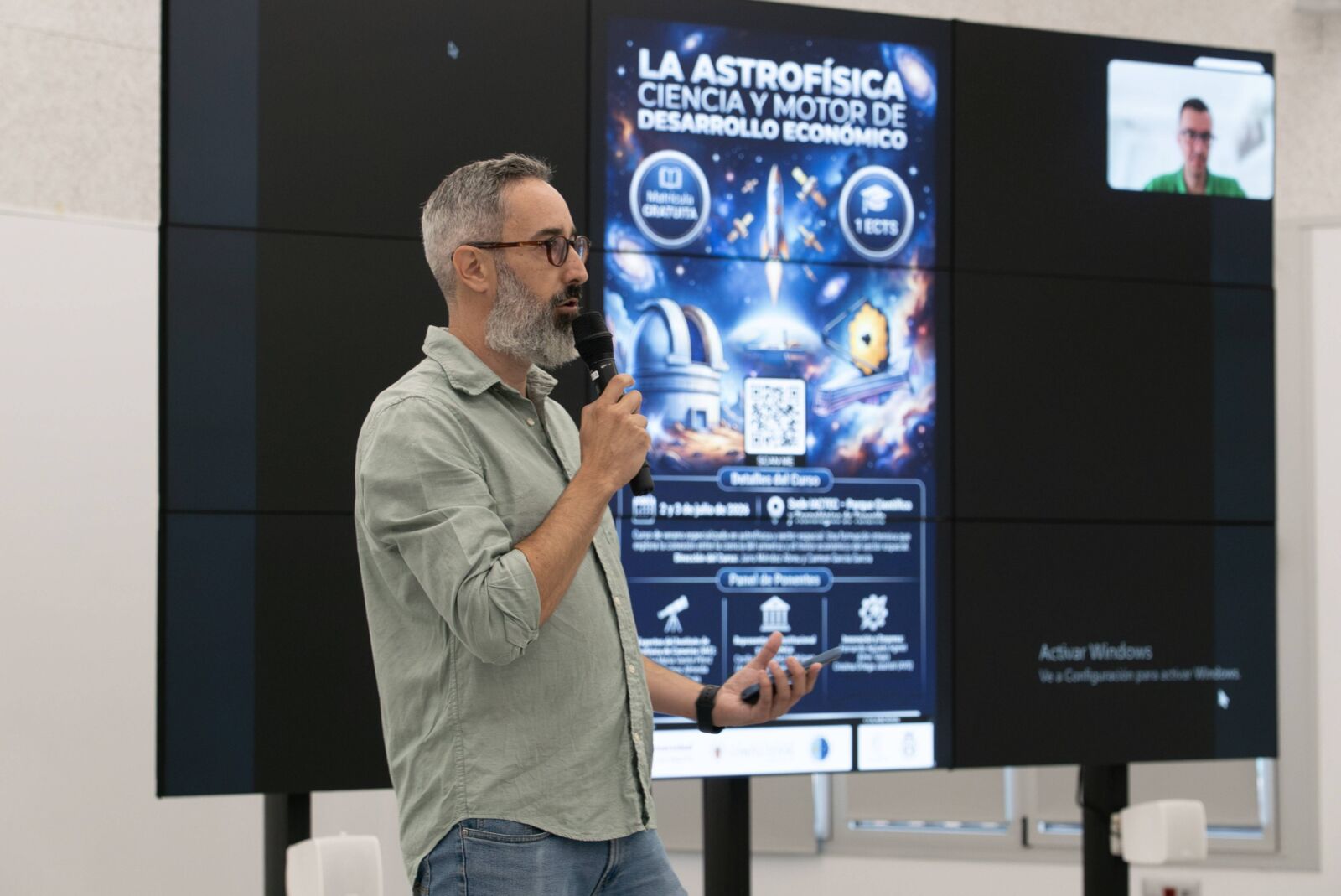
The course "Astrophysics as a Science and Driver of Economic Development" will be held at the IACTEC building in the Las Mantecas Technology Park (La Laguna) on July 2nd and 3rd. This initiative, part of the Complutense University of Madrid's Summer Courses in San Lorenzo de El Escorial, is being organized for the first time jointly with the University of La Laguna and the Canary Islands Institute of Astrophysics, with the collaboration of the Tenerife Island Council and the CELESTE project.
The course, which is free to enroll in and open to anyone interested, is led by Jairo Méndez Abreu, researcher at the IAC and permanent staff professor at the University of La Laguna, together with Carmen García García, head of the Local Development Area of the Robledo de Chavela City Council.
This first collaboration with the Complutense University of Madrid will allow the public to learn about some of the most relevant advances in modern astrophysics and show how astronomical research drives technological development, innovation and the creation of new economic opportunities, especially in a territory like the Canary Islands, an international benchmark in universe observation and with a growing projection in the space sector.
Throughout the two days, the program It will offer a current view of the knowledge of the universe, from the study of the sun, stars and galaxies to the search for life on other planets, highlighting the fundamental role played by large ground and space observatories and the development of cutting-edge scientific instrumentation.
The course will also dedicate a significant portion of its program to the socioeconomic impact of astrophysics and the space sector. The sessions will address the opportunities these fields offer for generating highly skilled employment, promoting technology transfer, and consolidating a knowledge-based economy, both in Spain and the Canary Islands.
The Canary Islands Institute of Astrophysics will have a prominent role in the academic program. Among the speakers are Cristina Ramos Almeida, Jorge García Rojas, Savita Mathur, José Alberto Rubiño Martín, and Rafael Rebolo, who will share the latest advances in areas such as galaxy evolution, stellar physics, planetary nebulae, cosmology, and scientific and technological opportunities related to the space sector.
The course will be inaugurated by Juan José Martínez Díaz, Councilor for Innovation, Research and Development of the Tenerife Island Council; Valentín Martínez Pillet, Director of the IAC; and Abel López Díez, Director of the University Extension Secretariat of the University of La Laguna.
The program will also include the participation of representatives from the Spanish Space Agency, the University of Vigo, the company AVS and the University of La Laguna, who will analyze the growth of the Spanish space industry, the new professional profiles demanded by the sector and the opportunities that the Canary Islands offer for the development of space-related activities.
The closing ceremony will include a round table discussion on the challenges and opportunities of astrophysics as an engine of economic development, in which representatives from research, universities and institutions linked to the space sector will participate.

 Spanish
 English
 French