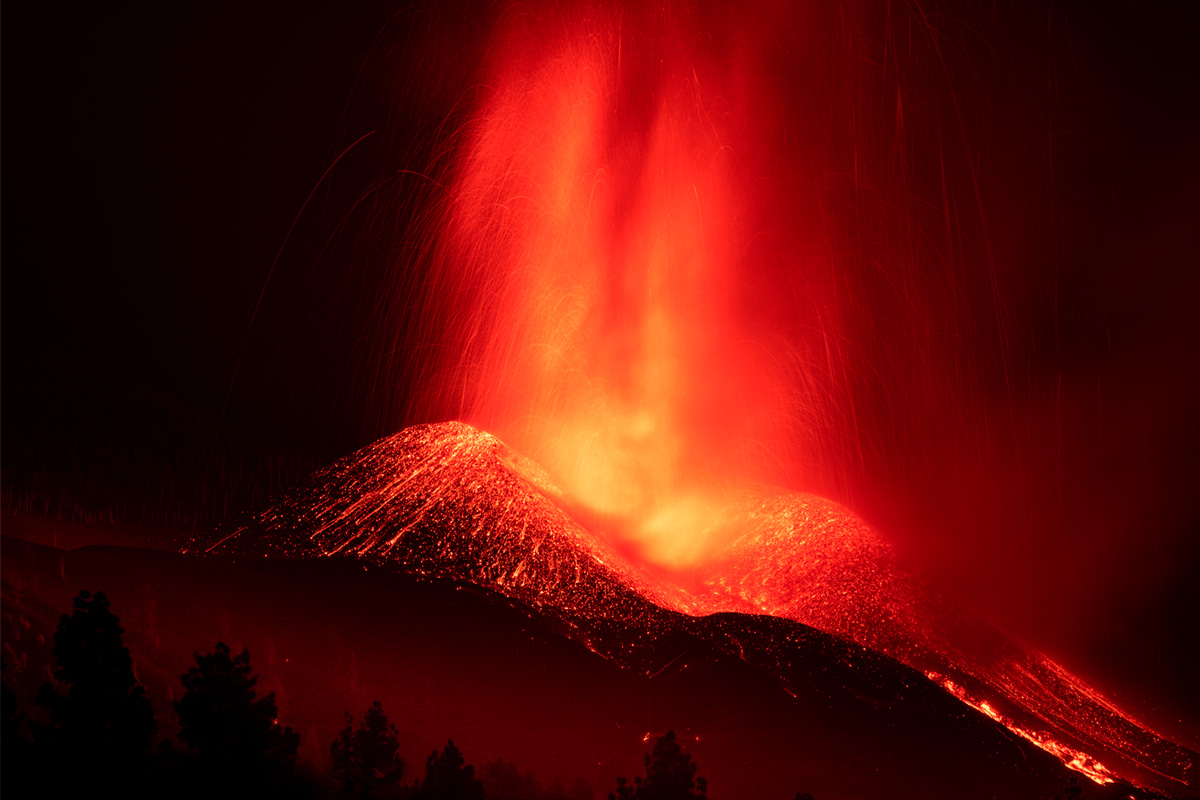
The magazine Journal of Hazardous Materials The journal published in its latest issue a study authored by researchers from the University of La Laguna and the Institute of Technology and Renewable Energies (ITER) which concludes that, while the eruption of Tajogaite volcano on La Palma caused a significant increase in radon gas concentrations in nearby areas, the estimated radiation did not pose a serious risk to public health. The emissions, influenced by degassing and meteorological factors, were higher than background levels, and the study therefore highlights the importance of monitoring this gas in volcanic risk assessments.
The lead author of the work is Pedro Salazar Carballo, from the Laboratory of Medical Physics and Environmental Radioactivity of the University of La Laguna (FIMERALL-SEGAI), with the participation of other collaborating researchers from the same laboratory — María López Pérez and José Luis Rodríguez Marrero— in addition to Mª Candelaria Martín Luis, from the Department of Animal Biology, Soil Science and Geology; and José M. Lorenzo Salazar, from ITER.
Radon is a naturally occurring, invisible, and odorless radioactive element that emanates from the subsoil due to the decay of uranium present in rocks. In volcanic environments, monitoring it is critical, as it is the second leading cause of lung cancer worldwide and tends to concentrate in enclosed spaces.
The study reveals that the eruption of Tajogaite released massive amounts of this gas, with a daily emission rate of about 30 million becquerels per square meter, a figure that exceeds by 160 times that of other active volcanoes in periods of calm and is up to six orders of magnitude greater than the emissions recorded in natural soils around the world.
This anomaly is explained by the opening of new fractures and the increased permeability of the ground, which facilitated the vertical ascent of gas from the depths to the surface. The research details that the distribution of radon in the Aridane Valley followed a decreasing pattern as the distance from the eruptive center increased.
In the areas closest to the volcano, approximately a quarter of the indoor measurements exceeded the reference level of 300 becquerels per cubic meter established by public health regulations. However, this phenomenon was not solely due to geological activity. The study emphasizes that meteorological factors played a decisive role in the accumulation of the gas.
Periods of weak winds and the presence of low-lying thermal inversion layers acted as a physical barrier, preventing the dispersion of radon and forcing its concentration near the ground and inside homes. Therefore, despite the estimated emission figures for the Tajogaite volcano, the overall impact on the health of the island's residents is reassuring.
The estimated dose of ionizing radiation for the population of the Aridane Valley during the three months the process lasted was 0.3 millisieverts, a value well below radiological risk thresholds. Extrapolated to a full year, the exposure would be equivalent to 1.2 millisieverts, representing barely half the average annual dose that any person receives from natural and artificial sources under normal conditions.
However, this study warns of specific risks at localized points very close to the eruptive center, where individual doses could have been significantly higher under prolonged exposure scenarios.
These findings underscore the need to integrate systematic radon monitoring into volcanic risk assessment protocols, not only to protect the respiratory health of residents, but also as a predictive tool to understand the dynamics of active magmatic systems and their interaction with local meteorological conditions, which modulate gas dispersion and determine the final dosimetry received by the population through surface accumulation processes.

 Spanish
 English
 French