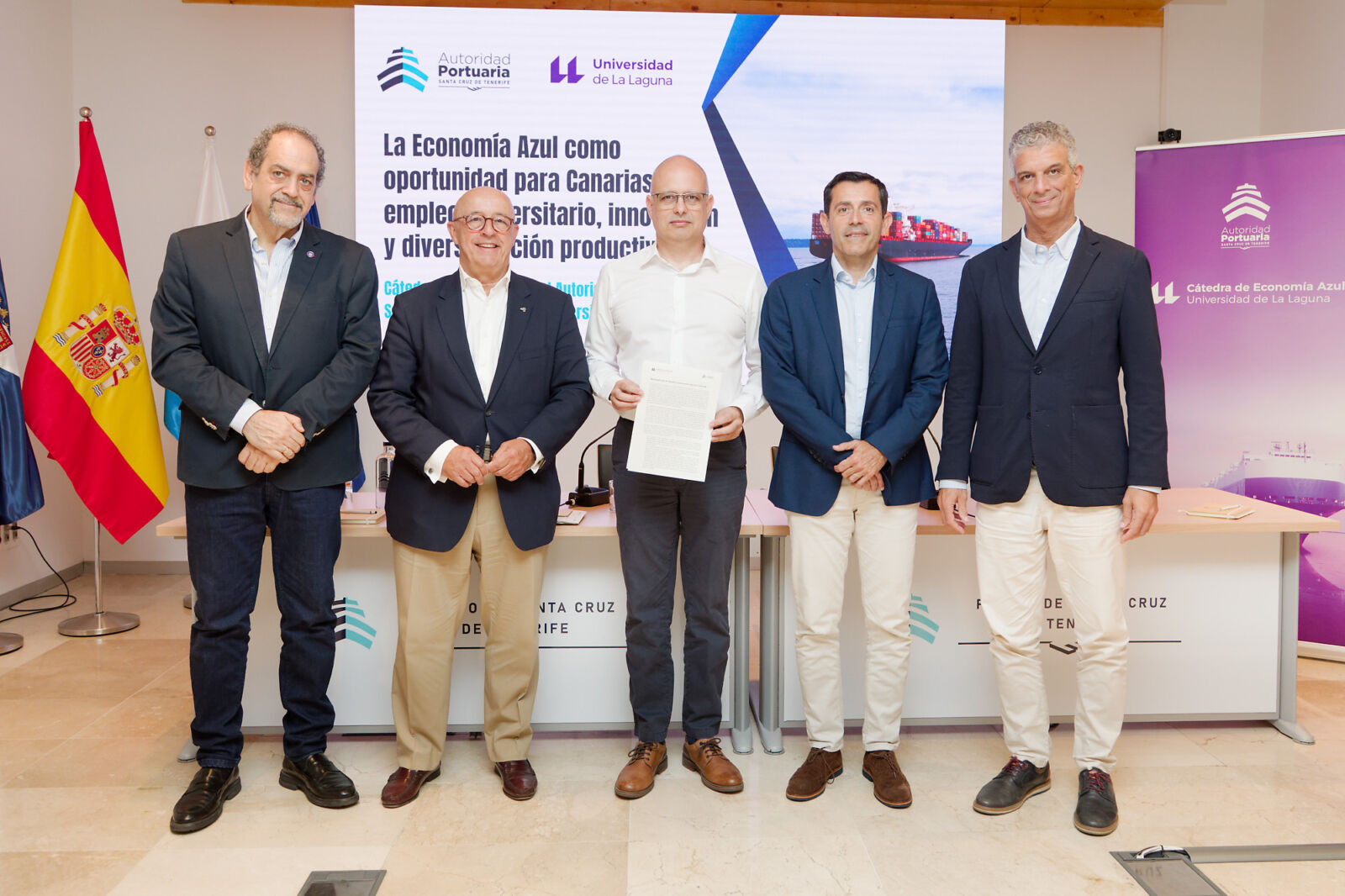
The development of the Blue Economy in the Canary Islands will increasingly require multidisciplinary professionals with skills in areas such as digitalization, sustainability, and adaptation to new technological and regulatory environments. To achieve this, a stronger connection between the business and educational sectors through more practical and flexible training programs is essential, a condition that the University of La Laguna and companies in the sector are already working towards.
This is the main conclusion of the manifesto prepared within the framework of the conference "The blue economy as an opportunity for the Canary Islands: university employment, innovation and productive diversification", held in the port of Tenerife and attended by business representatives, public administrations, universities and research centers with the aim of identifying, precisely, those opportunities for qualified employment for graduates and higher degree holders from the Archipelago.
For Pedro Suárez, president of the Port Authority of Santa Cruz de Tenerife, this initiative represents "the starting gun to materialize the opportunities offered by Ports of Tenerife for all those who are in training and who have not yet determined their professional future," highlighting the importance of these future professionals integrating into the Canary Islands business fabric and not having to leave to develop their professional skills outside the Canary Islands.
The need to promote specific training initiatives that respond to the real needs of companies in the sector is an aspect on which José Manuel García Fraga, Vice-Rector of Teaching at the University of La Laguna, and Carlos Mora, Professor of the Department of Agricultural and Environmental Engineering and director of the Chair, for which, they indicated, "it is required that society itself, companies and the public administration indicate what they need in order to respond to the future labor demands of the sector.".
In this context, the Island Councillor for Innovation, Research and Development, Juan José Martínez, emphasized that training needs will have to advance in robotics, artificial intelligence, and certain engineering specialties. “These are opportunities for the talent of our young people and promising employment opportunities for Tenerife and the Canary Islands.».
Blue Economy in the Canary Islands
The importance of these findings is particularly relevant in the current context of the blue economy in the Canary Islands. According to the report "Quantification of the Blue Economy in the Canary Islands," published last May by the Canary Islands Institute of Statistics, this sector generated a gross value added of €1.69 billion in 2024, equivalent to 2.9% of the Canary Islands' Gross Domestic Product, in addition to 21,187 jobs, with maritime transport and port activities playing a particularly significant role.
This growth, however, is conditioned by challenges such as the digitization of processes, cybersecurity, the transition to more sustainable and decarbonized production models, adaptation to new regulatory frameworks, and the incorporation of innovation as a driver of competitiveness.

 Spanish
 English
 French