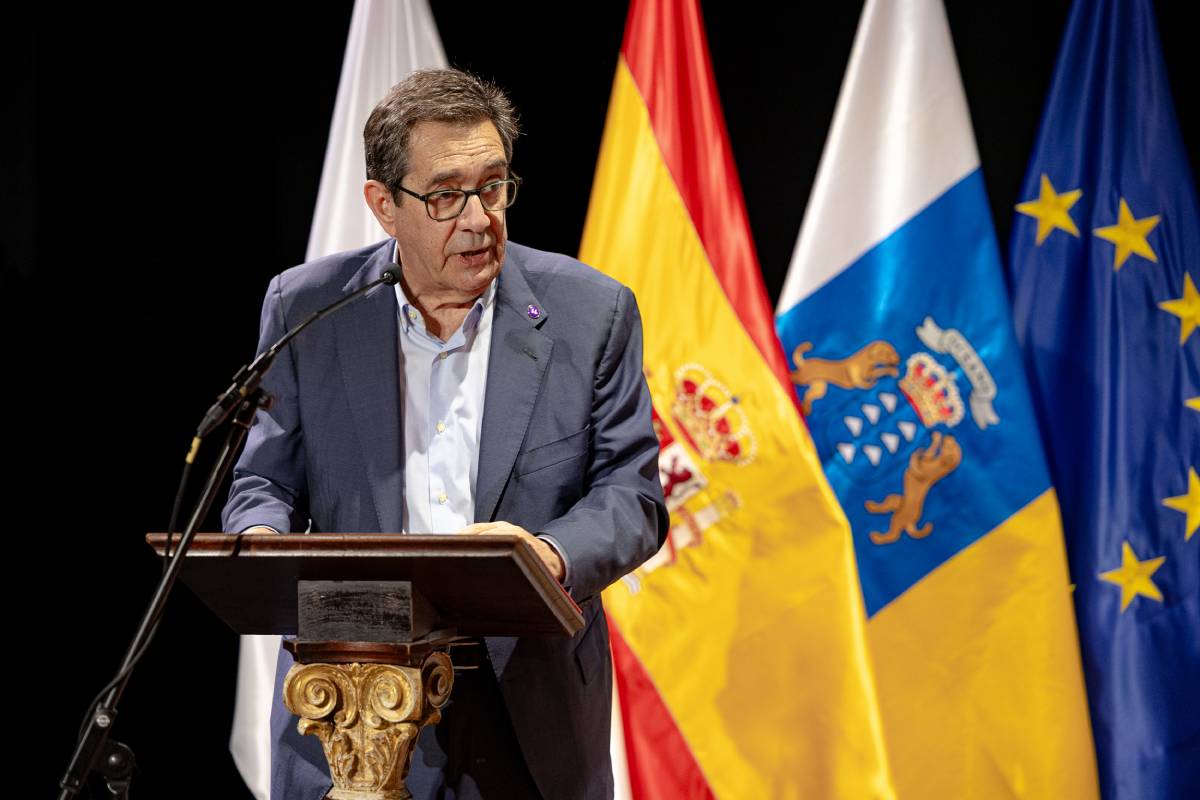
Mathematician and former rector of the University of La Laguna, Antonio Martinón Cejas, was the opening speaker at the thirty-third edition of the Adeje Summer University today, Friday, July 3rd, with his presentation entitled “Reflections of a Canary Islander on the World of Tomorrow.” Much of his talk focused on the development of Artificial Intelligence and its implications, not only technological but also political. Faced with the temptation for certain millionaire technologists to use it to control society, the speaker defended the value of humanism and advocated for institutions and individuals to do everything in their power to defend democracy from this threat.
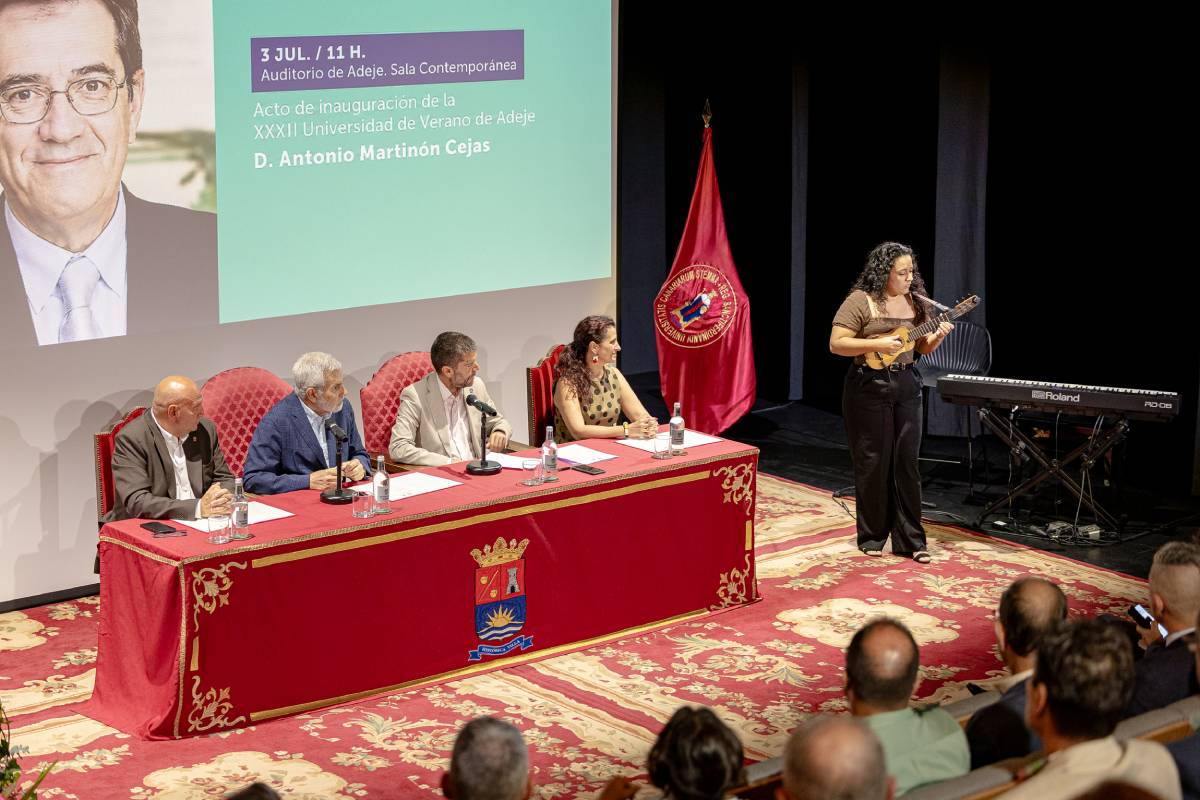
Prior to this conference, the Adeje Summer University was inaugurated in an event attended by the rector of the University of La Laguna, Francisco García Rodríguez; the mayor of Adeje, José Miguel Rodríguez Fraga; the vice-rector of Culture and University Extension, Isabel León Pérez; and the councilor of the Area of Culture, Sports and Education, Adolfo Alonso Ferrera.
The ceremony also featured performances by musicians from the municipality: the timple player Alba Chávez, the duo Voz y Alma (Daniela Díaz Santana and Pablo Bello Muñoz) and the choir of the Municipal School of Music of Adeje.
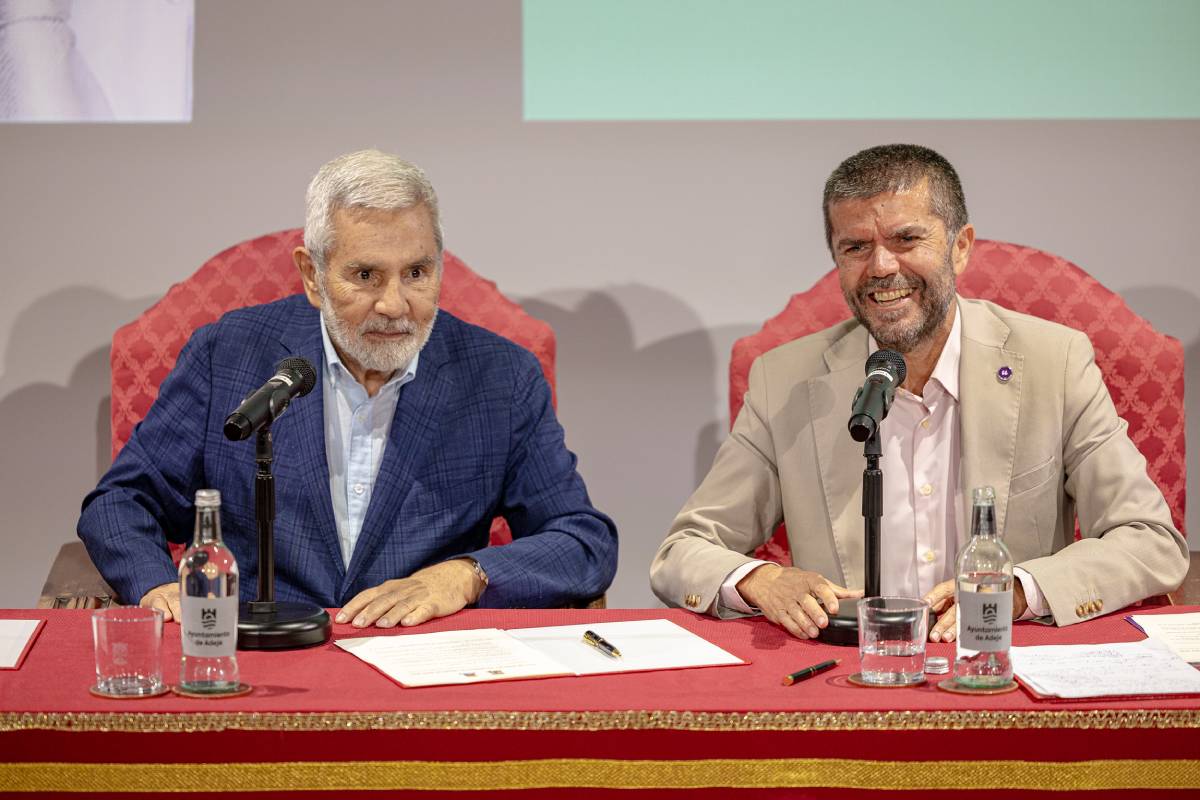
The mayor of Adeje and the rector of the ULL.
The first to speak was the mayor, who described the Summer University as a “serious and well-established” service to the community that has endured while some summer training programs in other towns have disappeared. “Perhaps our continued vitality can be explained by the fact that these courses serve a young society undergoing significant transformation.” Rodríguez Fraga also referred to the strengthening of the Southern Campus, which next year will offer almost entirely in-person instruction.
The rector, for his part, highlighted the success of this year's program, noting that with nearly 500 people already registered and registration still open, it represents the highest attendance figures in the last decade, ensuring that no courses or workshops have been canceled. García believes the key to the courses' continued success in Adeje lies in their ability to adapt their format to the evolving sociological context. He also expressed the institution's commitment to strengthening the South Campus with activities beyond the Tourism Degree already offered.
A look to the future
The title of Antonio Martinón's presentation alludes to the "world of tomorrow," in homage to the work of two authors who have been important to him: Stefan Zweig, who wrote "The World of Yesterday," and Ryszard Kapuściński, author of "The World Today." In this referential exchange, the former rector of the University of La Laguna has been tasked with looking toward the future. At the beginning of his presentation, he warned that, due to time constraints, he would have to leave out issues that are also important to him, such as the situation of women, and that his talk would raise reflections and questions, rather than provide answers.
The speaker argued that there is an “unjustified” pessimism about the future. While acknowledging that problems persist, he pointed out that objective data indicates progress over the last few decades in areas such as inequality and extreme poverty. He believes it is dangerous to succumb to the defeatism of believing the planet is beyond repair, as this leads people to disengage from the situation. “The world can be fixed and resolved,” he asserted.
Following the agricultural and industrial revolutions, which brought about profound changes—both positive and negative—for society, a similarly disruptive technological revolution arrived some 60 years ago. In this revolution, the combination of advancements in computing and communications has led to the greatest discovery of recent times: Artificial Intelligence. “It’s a very new field that many of us are eagerly anticipating and interested in because it opens up avenues of benefits for everyone, but also enormous risks. And we don’t know how it will evolve because it’s still in its infancy.”.
Martinón referred on several occasions to the recent encyclical of Pope Leo XIV“Magnificent humanity”Religious connotations aside, he recommended it as “a very valuable document from the point of view of social observation.” In it, the pontiff emphasizes that AI “is not neutral,” since it “takes on the face of those who conceive it, finance it, control it, and regulate it.”.
And who exactly are these people? Martinón mentioned the case of two of them: Dario Amodei, founder of the company Anthropic, responsible for the Claude AI; and Peter Thiel, co-founder of Palantir, a company that is putting this technology at the service of armed conflicts such as those in Ukraine and Gaza with disturbing results.
 Regarding the first point, Martinón emphasizes that, despite being responsible for an AI, he has warned that it is such a powerful tool that it could bring great benefits, but also pose a great danger to humans, so we must remain vigilant: “The fact that previous technologies have not destroyed society is no guarantee that AI will follow the same path,” Amodei warns.
As for Thiel, Martinón characterized him as a “reactionary libertarian” whose actions have made clear his intention to try to shape the world according to his needs, alluding to “an epic about technological advancement” that takes precedence over the well-being of people.
Within this context, AI is being developed, which, among other dangers, will lead to the destruction of many jobs, as well as the creation of new ones. This will have economic impacts, since people need to work to earn the money that allows them to survive, but it will also have other kinds of social consequences: “Work is the way most of us socialize with other humans; it is an essential part of life and of women's liberation.”.
Just as atomic energy fueled a Cold War between the US and the now-defunct USSR, the advent of AI has triggered another Cold War, this time a digital one, again between the US and, now, China, in which the EU plays a very minor role given its technological shortcomings in this field. In this conflict, the danger lies in people being treated as data, cogs in a machine, or commodities. “The concern is that human beings will cease to be human and become mere assets.”.
Therefore, Martinón joins those who believe that AI needs to be regulated so that it serves people and, therefore, “cannot be in the hands of technologists who decide the future of humanity and threaten governments because of their contempt for human rights and democracy.“ Despite everything, the speaker believes that people can still contribute to reversing the situation, because by combining individual efforts it is possible to achieve great changes and thus protect democracy, which is ”the only sphere where freedom can exist.“.

 Spanish
 English
 French