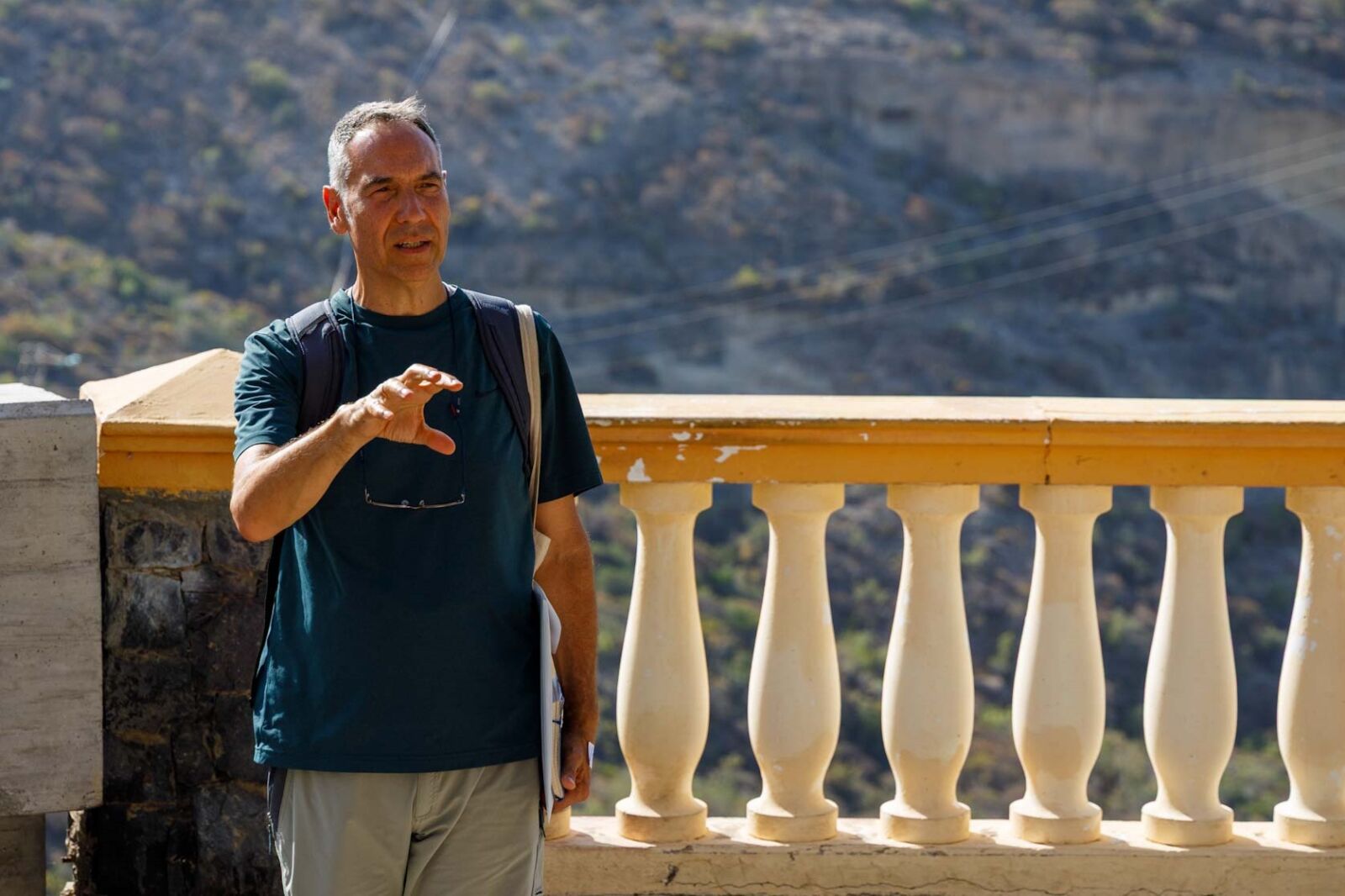
The professor in the area of Human Geography at the University of La Laguna Vicente Zapata Hernández has coordinated today, Monday, July 6, the workshop of the Adeje Summer University“Hiking and heritage interpretation: what the paths tell us”, during which the students were able to take an educational route through the corridor that runs from the historic center of Adeje to La Enramada Beach, which, according to the coordinator of this initiative, “is one of the most important in the Canary Islands because it offers a fragment of the geography, history, economy, culture, art, institutions, and how the Canary Islands have developed throughout their history.”.
The trail is important because of the significance of Adeje itself, Zapata points out. “And from the perspective of what it offers, I think it’s an incredible interpretive corridor, because you could develop dozens of routes here depending on the theme, changing landmarks, changing topics, changing the logic of the route. Yesterday, Sunday, I walked it starting from both ends, and when we went downhill, we saw some things, and when we came back up, we saw others. It offers a lot of possibilities, and that’s why I think it’s one of the most valuable heritage resources that the Canary Islands have.”.
This workshop has combined Three fundamental elements: trails with heritage value; hiking as a mobilizing activity that allows us to utilize these resources; and heritage interpretation, understood as a strategy that aids in understanding what the environment offers so we can observe it critically and, from there, make a better judgment about things. “It even allows us to be more critical; that is, hiking will put us right in the middle of it, and interpretation will help us better understand what we see,” Zapata explained at the start of the tour.
In contrast to the hiking of the past, which was more purely descriptive, “this interpretive model seeks to go beyond mere information, proposing a series of dynamics and activities, sharing materials, creating new meanings, and generating a critical view of what we see, so that the person not only retains information about a date or event, but incorporates it into their present. Therefore, this new model of interpretive hiking is not so much about constantly explaining, but about stopping at a series of points where activities will take place and we will interact.”.
Water as a common thread
For example, on this route along the Adeje-La Enramada corridor, Zapata has used water as a central theme, a key element for this region and for Tenerife in general. It is the element that has linked the ten stops along this walking route. “It is a critical resource in this area, which explains practically everything we are going to see.”.
In addition to gaining in-depth knowledge of the territory covered, the workshop also has the secondary objective of empowering participants to design their own heritage interpretation activities. To achieve this, the workshop also covered the tools used, how to design a route, and what stages it should include, among other aspects.
The route included ten stops, starting from the new Plaza del Casco, next to Casa Fuerte, and passing through, among other points, the Plaza de España, to appreciate the monumental complex; the Plaza del Llano, as the entrance to Adeje; the lower part of the town's historic center, to appreciate aspects of agricultural activity such as, for example, the use of water generated in that area or coming from other places; a passage to the beginning of the Camino de la Encarnación; and, finally, several stops until reaching the La Enramada area, ending in El Veril.
As previously explained, activities were carried out at each stop, not only to generate knowledge but also to raise awareness about the importance of the landscape heritage and its fragility. For example, the workshop participants cleaned a small section in the Tosca Colorado area to raise awareness about the condition of the path. “That area isn't in particularly bad shape, but we're going to try to do an activity where we all share responsibility for cleaning it,” Zapata explained.

 Spanish
 English
 French