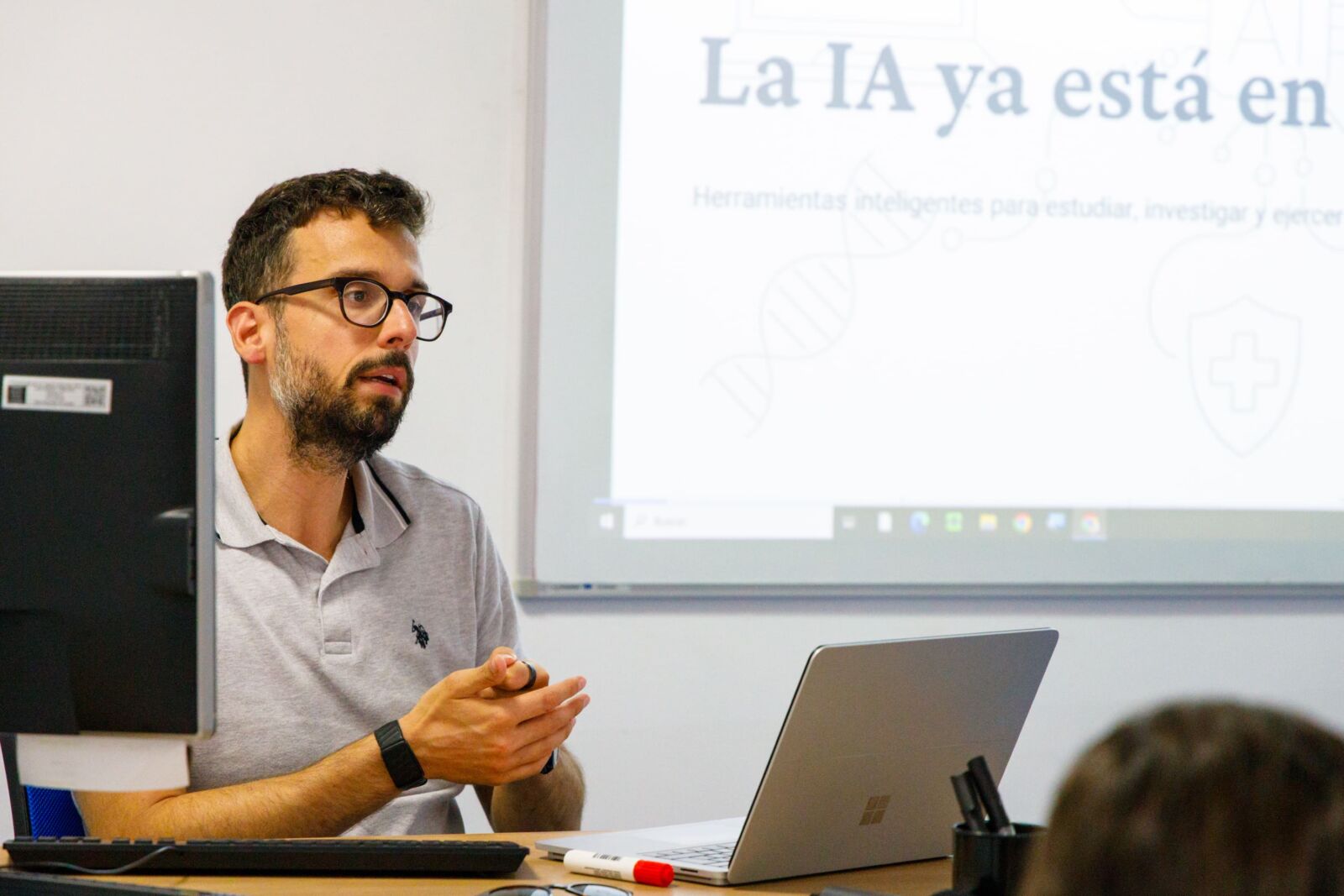
Artificial Intelligence (AI) has permeated all areas of society, including healthcare. While its use requires caution, in the opinion of José Faustino Afonso Domínguez, a primary care physician specializing in sports medicine, the adoption of this technology by healthcare professionals will be advantageous: “We will have to adapt because, ultimately, ChatGPT, Gemini, and Claude already know more than I do. And it's true: they have all the information on a topic because they connect to the network and are able to look everything up in seconds. So, I have to pivot towards a more human-centered approach to medicine: having a tool that allows me to look my patients in the eye more and gives me more time to empathize with them is, for me, a success.”.
Afonso has been one of the teachers of the Adeje Summer University course “AI and Health: intelligent tools to study, research and practice better”, directed by Francisco Javier Amador Morera, From the Department of Economics, Accounting and Finance at the University of La Laguna. Sergio Berjón García, a family physician in primary care, also participated as a lecturer.
Regarding the danger that AI could eliminate jobs, Faustino Afonso points out that it is a real concern and, in fact, jobs are already being lost in some sectors. However, he also believes it is a tool that should not be underestimated: “Anything that improves and achieves better results for our patients and enhances their health is welcome.” On the other hand, specifically in the healthcare sector, the specialist does not believe that roles such as doctors, nurses, and physiotherapists will be replaced in the medium to long term, given their manual component, especially the latter two.
Another area of healthcare where AI can be extremely useful is research. According to the specialist's estimates, it can save up to 501,000,000 hours of time. "One example where it makes a world of difference is in literature searches. Conducting a state-of-the-art review of a research topic can take months because you have to find everything that exists on the subject. AI does it in five minutes, and you already have all the literature available for you to review. That's months of work saved.".
However, proper training is necessary to understand these tools and, above all, to be aware of their limitations, which they do have. “It’s not an oracle, nor is it infallible, neither. It’s a model that predicts the next word, that’s what it does. And it needs a human to do its job properly. And we also have to be able to recognize when it’s hallucinating. Because it does hallucinate, quite a lot,” he warns.
Afonso advocates for user responsibility, since AI is often being used without the necessary knowledge. “Knowing how to use it, it’s an incredibly powerful tool; not knowing how, it can be dangerous,” especially in areas like healthcare.
The main mistake he identifies is that many people use it as if it were a kind of Google where a person provides the answer, leading them to give its responses absolute credibility. “And that’s not the case at all. How you interact with it, how you ask the AI questions, how you configure it, and that radically changes the way it gives you feedback, matters a great deal.”.
This training course was designed as a hands-on workshop, using the most widely used AI platforms—Chat GPT, Gemini, and Claude—to explore different scenarios and even examining the differences in behavior between their free and paid versions. The course was based on the latest revisions these platforms have undergone regarding health guidelines and placed particular emphasis on providing students with the tools to ask effective questions, or, in the terms of this technology, to formulate a good question. prompt specifically in health-related professions.
Thus, during the first day of the course, training was offered to create projects that allow for the automation of that prompting and thus avoid having to repeat it every time it is necessary, which is a nuisance because sometimes it can be made up of very long texts.
The course also covers the use of tools like Notebook LM to create a closed system that responds only to files previously uploaded by the user, thus preventing external links from contaminating the results. It also includes automating tasks such as sending emails and generating summaries, infographics, images, and other materials needed for patients.

 Spanish
 English
 French