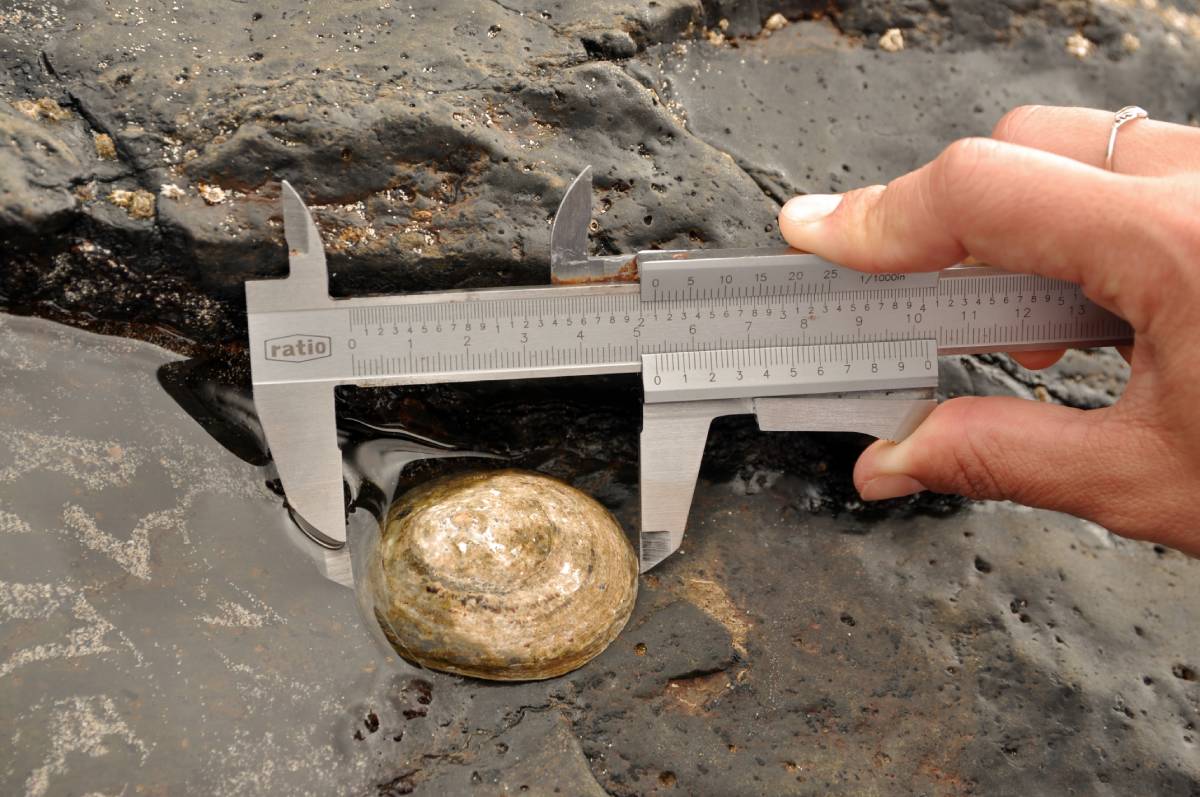
A study led by the University of La Laguna reveals that the Majorera limpet (Patella candeiThe scallop (Cyclops scallop), an endemic species found only on Fuerteventura and the Savage Islands (Madeira), has practically disappeared from the entire coast of Fuerteventura and the islet of Lobos. Currently, only a single relict population survives in southern Fuerteventura, on the Jandía peninsula, raising alarms about the imminent danger of extinction for this mollusk in the Canary archipelago.
The investigation has been published in the journal Aquatic Conservation: Marine and Freshwater Ecosystems by the Marine Community Ecology and Conservation research group (ECOMAR) of the University of La Laguna. The work is part of the doctoral thesis of Marina Aliende Hernández, under the direction of the researchers José Carlos Hernández y Beatriz Alfonso, and has had the collaboration of honorary professor Jorge Núñez, who carried out the first sampling of this species in 1994.
An insufficient recovery plan
The Majorera limpet is an emblematic species of the Canary Islands that inhabits intertidal zones. Exposed to the air during low tide, it becomes extremely susceptible to shellfish harvesting pressure, its main threat. The most striking aspect of the results is that, despite the implementation of a recovery plan in 2015 (Decree 161/2015, BOC 136) that established priority conservation areas and a total ban on its harvesting, this study demonstrates, through a historical comparison with data published in recent decades, that its status has not improved.
This situation highlights the urgent need to focus attention and develop new strategies to protect this species. In this regard, the study emphasizes that the Jandía area, where the Majorera limpet still persists, is characterized by strong waves throughout the year, a physical factor that could be hindering illegal shellfish harvesting by limiting access to the coast.
The climate change factor
To investigate the environmental causes affecting the species, the scientific team evaluated oceanographic variables along the coast of Fuerteventura, exploring the relationship between rising air and sea temperatures and the mollusk's decline. Although the authors note that specific heat stress experiments are needed to reach a definitive conclusion, the analyzed climatological data suggest that the warming trend of recent decades may also have negatively impacted the species' alarming situation.
Limpets are especially vulnerable when their abundance declines drastically. As externally fertilized organisms, they depend on the presence of a large number of mature individuals in close proximity to ensure reproductive success and population prosperity. Therefore, the study concludes that future conservation efforts should focus on exploring the laboratory cultivation of specimens from Fuerteventura and their subsequent reintroduction into the wild, prioritizing areas with oceanographic conditions similar to those of the Jandía Peninsula, the last refuge of the Fuerteventura limpet.

 Spanish
 English
 French