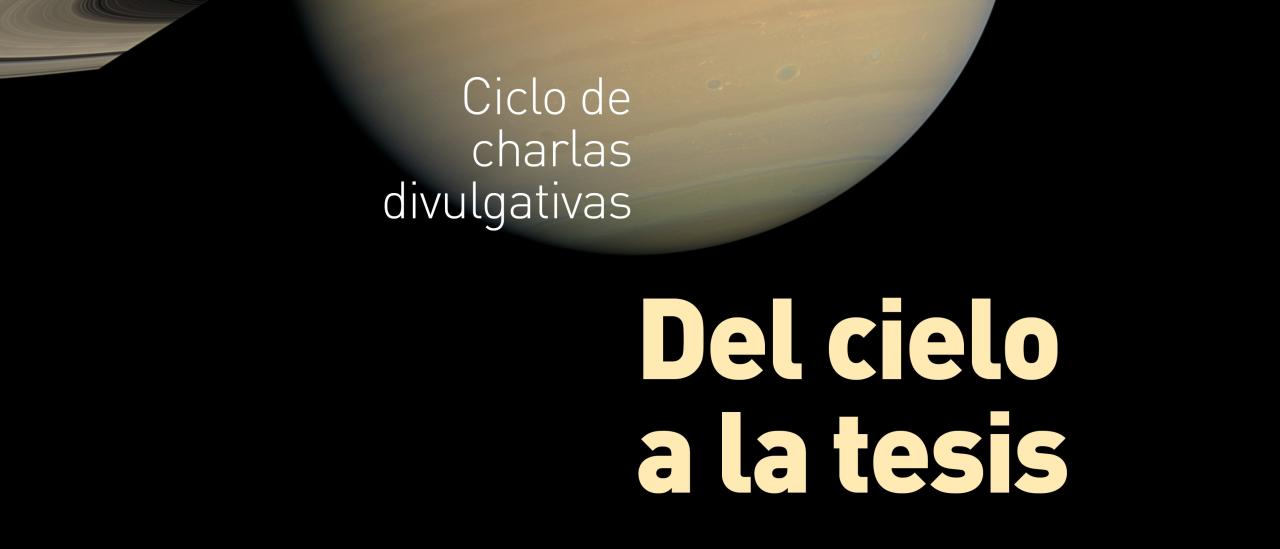
The series of outreach talks 'From the Sky to the Thesis', promoted by the predoctoral students of the Institute of Astrophysics of the Canary Islands and the University of La Laguna to bring astrophysical research closer to the public, will hold a new session next Thursday, July 23 at 5:00 p.m. in the Museum of Science and the Cosmos, of the Autonomous Organization of Museums and Centers of the Cabildo of Tenerife.
This edition will be special, as it coincides with the first anniversary of the initiative, whose first session was held on July 24, 2025. In just one year, 'From the Sky to the Thesis' has established itself as a meeting place for the predoctoral research community and the public, presenting some of the latest advances in astrophysics in a rigorous yet accessible way. As usual, the day will consist of two 30-minute public talks, with free admission until capacity is reached.
A super-Earth in a nearby planetary system
Is it possible to find worlds similar to our own around other stars? The answer lies in observing with enormous precision the slight "wobble" that stars experience due to the gravitational pull of their planets. However, when those stars are red dwarfs, the task becomes more complicated, since their intense activity can obscure or mimic the signals of exoplanets.
In his talk, Atanas Stefanov will present the discovery of a super-Earth located in the habitable zone of the GJ 3998 planetary system, just 59 light-years from Earth. Thanks to the analysis of observations obtained with the HARPS-N spectrograph, it was possible to confirm two previously known planets and identify a third, GJ 3998 d, with a minimum mass about six times that of Earth and stellar illumination very similar to that received by our planet.
The presentation will explain how astronomers distinguish the signals produced by planets from those generated by the star's activity, and why this new world is one of the few known exoplanets that receives an amount of energy comparable to that of Earth.
Atanás Stefanov is a predoctoral researcher at the Instituto de Astrofísica de Canarias (IAC), where he is developing his doctoral thesis focused on the detection of rocky exoplanets around cool dwarf stars. After graduating from University College London in 2023, he joined the IAC thanks to a La Caixa INPhINIT grant. His research combines the analysis of observational data with the development of computational tools for the detection and characterization of new planetary systems.
Discovering the shape of stars with Cherenkov telescopes
When we look at the night sky, stars appear as simple points of light. But is it possible to know their shape or even measure their size? Solving this challenge has been one of the great quests of observational astronomy.
In the second talk of the afternoon, Fernando Frías García-Lago will show how a technique developed more than half a century ago, intensity interferometry, is experiencing a new stage thanks to the use of modern Cherenkov telescopes, installed in observatories such as the Roque de los Muchachos Observatory in La Palma, and the Teide Observatory in Tenerife.
Through a journey that will begin with Robert Hanbury Brown's pioneering experiments in the 1960s and reach today's large telescopes, the talk will explain in a simple way how light fluctuations allow us to measure the size of stars, study binary systems, and achieve resolutions far superior to those of a conventional telescope.
Fernando Frías García-Lago completed a double degree in Physics and Mathematics at the University of Cantabria and subsequently a Master's degree in Theoretical Physics at the Complutense University of Madrid. After collaborating for a year with the CMS experiment at CERN at the Autonomous University of Madrid, he began his doctoral studies at the Institute of Astrophysics of the Canary Islands. He is currently part of the MAGIC, LST, and CTAO collaborations, where he investigates gamma-ray sources, develops instrumentation for Cherenkov telescopes, and applies intensity interferometry to the study of stars.

 Spanish
 English
 French