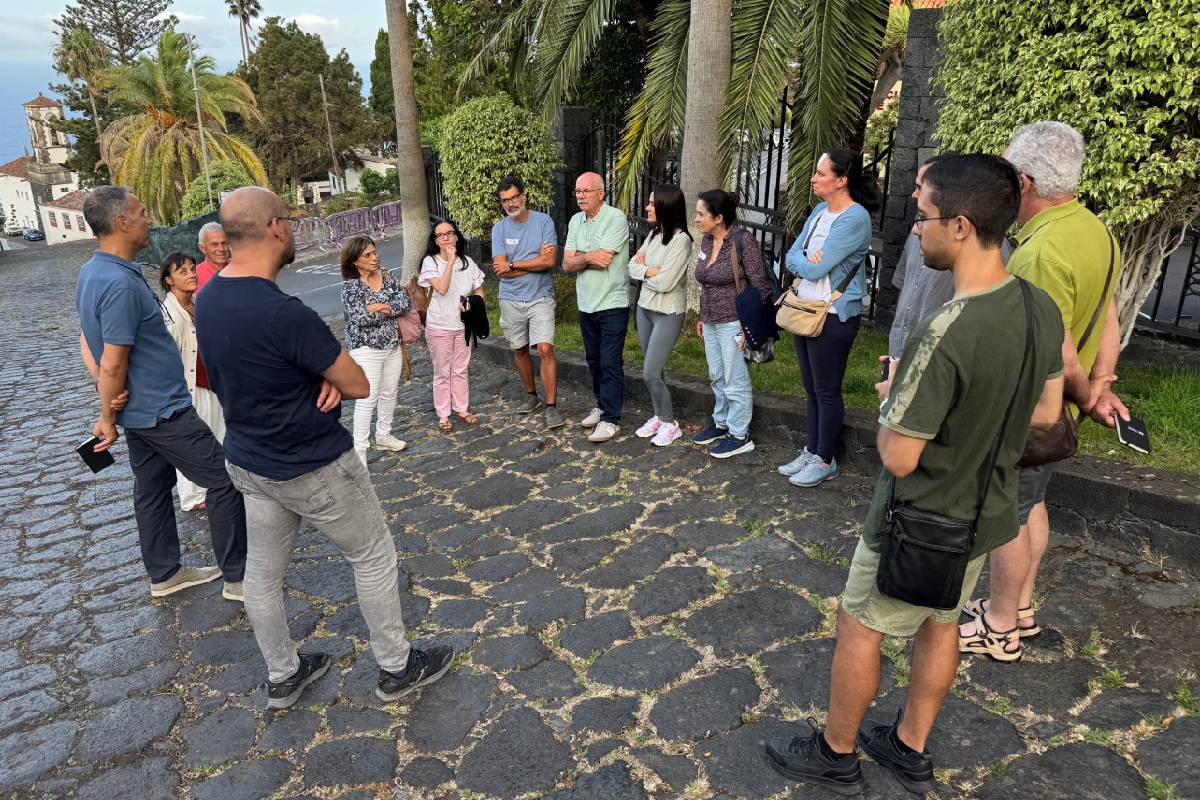
The Cultural Tourism Department of the University of La Laguna and the Association for the Safeguarding of the Heritage of Villa de Mazo (Ancestros), together with the Villa de Mazo Town Council, have developed the training course “Heritage Community: That Which Matters to Us, Transforms and Connects Us” in this municipality. Held within the framework of the Camino Viejo project, the course featured the participation of Ángel Portolés Górriz, a cultural manager affiliated with the Universitat Jaume I of Castelló, who emphasized the fundamental importance of “considering heritage as a resource and exploring its social use, which enables the development of participatory structures as the driving force behind building a heritage community.”.
During the training, multiple concepts were explored in a participatory manner, such as cultural heritage, heritage education, heritage community, and heritage dissemination, among others, drawing on the experiences of the participants. A heritage-emotional journey was also undertaken. drift through the historic center of El Pueblo, based on the people-places-histories axis, in which it was possible to contrast some of the issues addressed during the training, especially the breadth of what heritage can mean, transcending its usual pigeonholing in monumental assets.
In fact, the course focused on valuing the emotional heritage derived from personal experiences, everyday objects, elements linked to nature or human processes, memorable moments, family legacies, tools for creating other goods by hand, etc. And with this broader and richer perspective of heritage, strategies were defined for the formation of communities that appreciate, care for, and disseminate their heritage resources at the local level—processes that contribute to strengthening human relationships and social coexistence, as well as to the viability of many localities threatened by depopulation and loss of vitality.
A central idea emerges from the work carried out by the participants: heritage is not understood merely as a collection of inherited tangible or intangible assets, but as that which connects us to the course of our lives, to the places we inhabit, and to the shared memory of a community. The contributions strongly reflect a desire to revive what has been lost, to care for what we have so that we can recount and transmit our heritage in better condition to new generations. They also identify some common challenges, such as recognizing, preserving, disseminating, and defending heritage against neglect, destruction, or disrespectful use.
The participants, from various parts of La Palma, reflected in their contributions a profoundly communal vision: heritage must be known, experienced, felt, and shared, becoming a lever for strengthening coexistence, education, shared responsibility, and collective pride. In this sense, it is understood that heritage can make an enormously valuable contribution to community development processes at the local level, a strategic resource for addressing, for example, some of the challenges of demographic change in particularly vulnerable rural areas.
The course also reaffirmed that heritage conservation should not be solely an institutional task; it is also a personal and collective responsibility, which should lead to knowing, respecting, and caring for heritage, denouncing its deterioration, and actively incorporating it into the daily lives of individuals, groups, organizations, and communities. This was reinforced by the examples shared, and especially by the references to the Camino Viejo project, which has been underway in Villa de Mazo since the end of 2022 with the collaboration of the University of La Laguna (ULL), the City Council, the La Palma Island Council and its Biosphere Reserve, educational centers, the Garehagua Occupational Center, and the Nuevo Surco Association, which spearheaded the project's recognition as a form of land stewardship.
The training was led by Professor Vicente Zapata, head of the Cultural Tourism Classroom, who was pleased with the joint initiative "that links the ULL with the associative and institutional fabric of Villa de Mazo," where the 21st edition of its Seminar on thematic hiking, heritage enhancement and local development, as well as a new course at the Autumn University. According to Zapata, “training programs like this one demonstrate our University’s commitment to its statutory objectives, especially those that require interaction with social entities such as ANCESTROS to contribute to their strengthening.”.

 Spanish
 English
 French