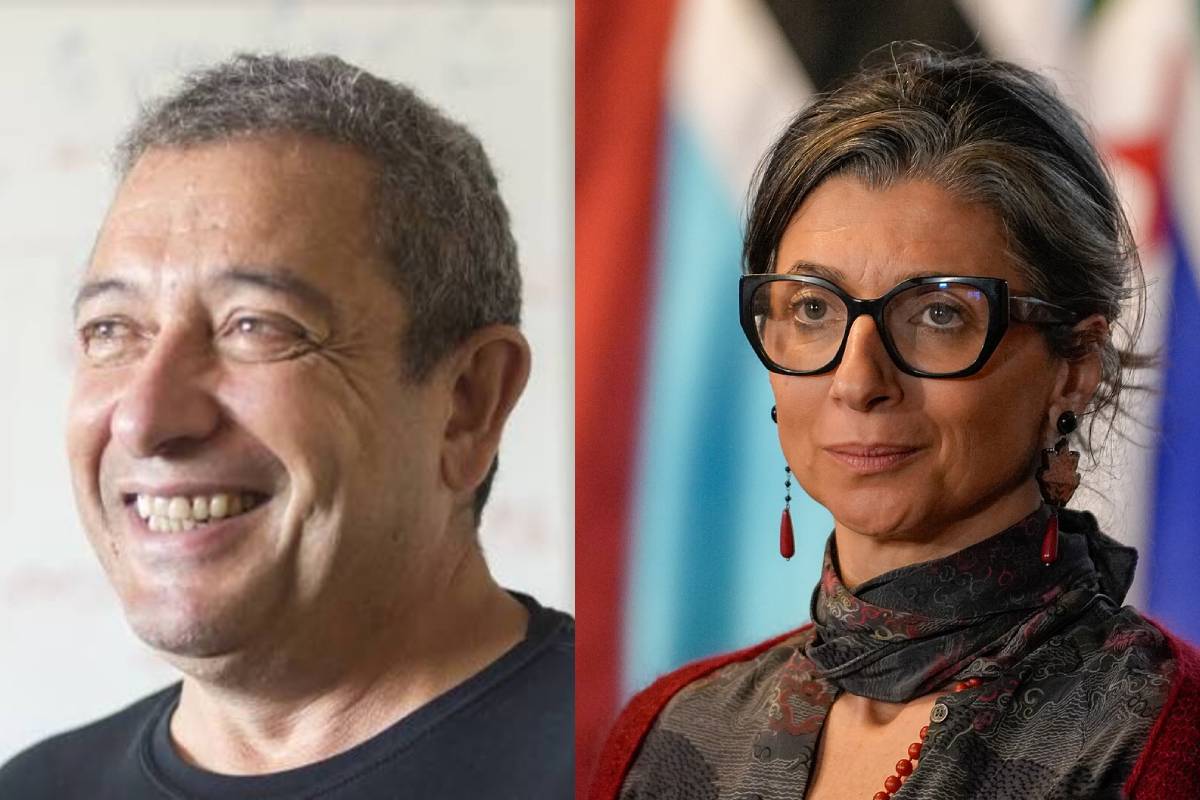
The Governing Council of the University of La Laguna has approved in its ordinary session held today, Friday, July 24, the awarding of honorary doctorates to the international lawyer and UN rapporteur for the occupied Palestinian territories Francesca Albanese, and to the macroeconomist from the University of Pennsylvania José Víctor Ríos-Rull.
Francesca Albanese's candidacy was approved by 30 votes in favor, one against and one abstention and proposed by the Department of Sociology and Anthropology of the University of La Laguna, one of whose tenured professors, José Abu-Tarbush Quevedo, was in charge of presenting it to the collegiate body.
The nomination statement highlighted that Albanese, a graduate in Law with honors from the University of Pisa and a Master in Human Rights from the University of London, is a distinguished lawyer and academic in the studies of human rights, forced displacement and refugees who has worked for a decade as a human rights expert for the United Nations, in the Office of the United Nations High Commissioner for Human Rights and also in the United Nations Relief and Works Agency for Palestine Refugees in the Near East (UNRWA).
She is the first woman to hold the position of United Nations Special Rapporteur on the Occupied Palestinian Territories, appointed in 2022 for a three-year term that has been renewed for another three. The nomination argues, among other considerations, that Albanese is a global figure recognized by numerous international institutions and organizations, as well as by transnational civil society organizations.
Despite her rigorous, critical, and humanist contribution to the global political debate, she has been the target of a campaign of slander, defamation, sanctions, and even political and institutional pressure to remove her from her position. This appointment will demonstrate the University of La Laguna's commitment to combating the genocide and "scholasticide" perpetrated against the Palestinian people, who have seen all the universities in the Gaza Strip destroyed. Additionally, Abu-Tarbush emphasized the importance of organizations supporting initiatives that uphold international law at a time when there are attempts to dismantle the existing framework of rules.
José Víctor Ríos Rull's candidacy received 30 votes in favor and two abstentions. It was proposed to the Governing Council by the Faculty of Economics, Business and Tourism, the Department of Economics, Accounting and Finance, and the Area of Foundations of Economic Analysis at the University of La Laguna. Professor Gustavo Marrero, Chair of Foundations of Economic Analysis, presented this initiative.
The report presented by José Víctor Ríos-Rull highlights that, after graduating from the Complutense University of Madrid with degrees in Economics and Sociology, he obtained his doctorate in Economics in 1990 from the University of Minnesota with a dissertation directed by Nobel laureate Ed Prescott. Since 2015, he has been the Lawrence R. Klein Professor of Economics at the School of Arts and Sciences and Professor of Finance at the Wharton School, both at the University of Pennsylvania. The Economics Department at this institution is one of the most prestigious in the world, currently ranked 15th globally.
Currently, Ríos-Rull is a member of several prestigious organizations in the field of economics such as the Econometric Society, the Society for the Advancement of Economic Theory, associate editor of the Spanish Economic Review (SERIEs), honorary member of the Spanish Economic Association, research associate of the National Bureau of Economic Research (NBER) and research associate of the Population Studies Center (PSC) of the University of Pennsylvania.
He has published over 80 top-level journals since 1986 and has also worked as a consultant for various organizations. He is considered one of the world's most influential economists, with groundbreaking contributions to the understanding of macroeconomics, particularly in the development of models with heterogeneous agents and innovative quantitative procedures for solving them, which are relevant to the study of inequality and population changes. Marrero also highlighted Ríos-Rull's strong family and personal ties to the Canary Islands, and especially to Tenerife.
Visit to Western Sahara
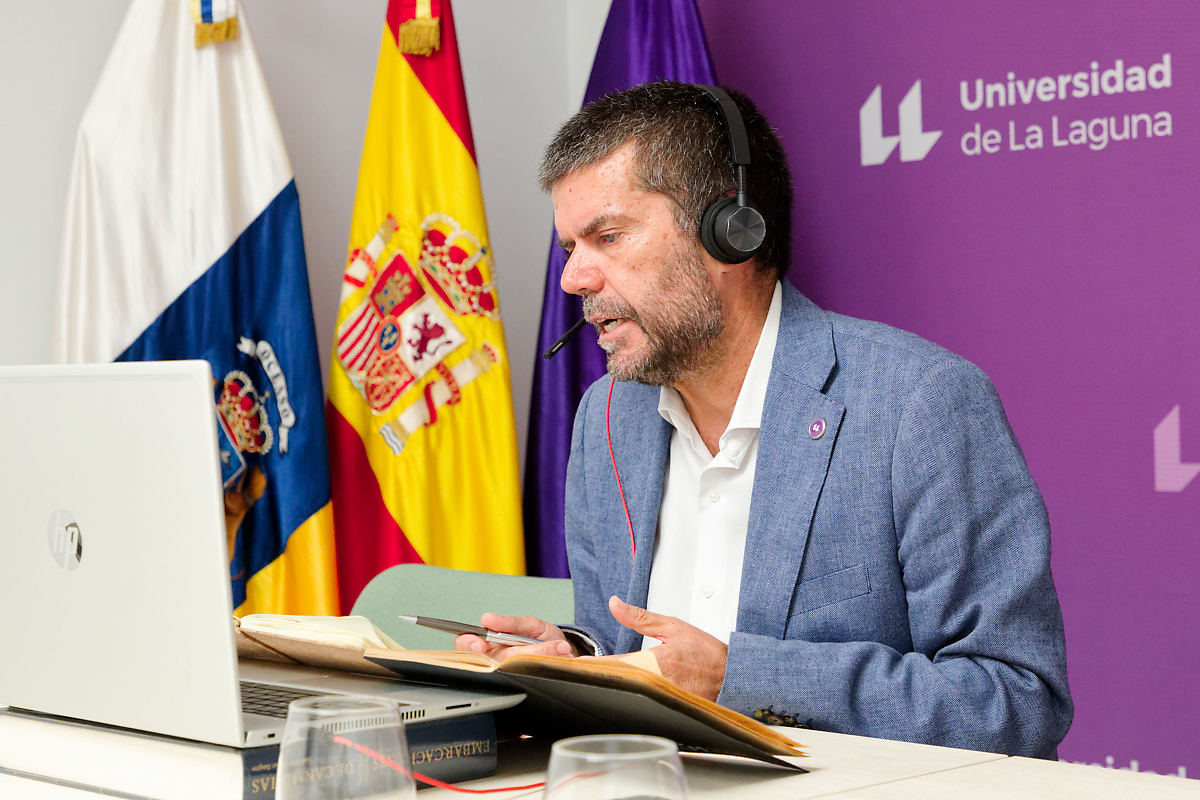
Rector Francisco García wanted to give public explanations about the visit to Western Sahara made three weeks ago as part of a delegation from the two public universities of the Canary Islands, invited by the University of Ibn Zhor, the main academic institution in Morocco in terms of student numbers and with which several collaboration agreements are maintained.
This visit included trips to the campuses in El Aaiún and Dakhla, located in the territories of Western Sahara, which, according to the Rector, has generated “unease and concern” among part of the university community and other social organizations with which there is a long and close history of collaboration. At this point, García acknowledged that mistakes had been made, “from the very planning of the visit, to the design and management of the communication by this Rector's team.”.
Therefore, the rector has apologized to the governing body and, by extension, to the university community and society in general, assuring his commitment "to work to ensure that this does not happen again.".
He reported that meetings have been held with some of the university and social organizations that expressed their concerns, such as the Center for African Studies and several Canary Islands-based associations for cooperation and solidarity with Western Sahara. He also stated that a meeting with the Polisario Front is being finalized.
“We have also responded to the University of Tifariti,” with whom we maintain a close relationship and a collaboration agreement,” García noted, adding that rectors from various institutions, including the University of Tifariti, attended the recent Bridge to Africa program, organized by the two Canary Island universities. “Its rector has invited us to visit in the coming months, which we will do as soon as possible.”.
In his address to the Governing Council, the rector announced that collaborative projects with Ibn Zhor University will focus exclusively on initiatives related to its Agadir campus. “In the coming months, we will strengthen existing collaborative efforts, both with academics from our own university and external experts, regarding the dissemination and rigorous, multifaceted analysis of the situation in Western Sahara.”.
New micro-degrees and a Dual Certificate
During the session, the Vice-Rector for Teaching, José Manuel García Fraga, presented three new micro-degree programs to the governing body for consideration. These programs have already received approval from the Social Council, which ratified them at its meeting yesterday, July 23. Specifically, they are the Micro-degree in History and Language of Film, the Micro-degree in Graphic and Visual Communication, and the Micro-degree in Technical and Digital Documentation of Cultural Heritage.
Microdegrees are a specialized program offered by the University of La Laguna, ranging from 24 to 36 credits. They are based on courses from existing degree programs, allowing students to obtain a specific certification in a particular subject. These programs are scheduled to begin in the 2026-27 academic year and are open to students who have successfully completed at least the first year of their degree program.
The Microdegree in History and Language of Cinema consists of four six-credit courses and has ten places reserved for Humanities students. The Microdegree in Graphic and Visual Communication offers five places and four courses, and is geared towards students of Journalism, Restoration of Cultural Heritage, and Fine Arts. The Microdegree in Technical and Digital Documentation of Cultural Heritage also has five places and four courses for Arts and Humanities students. Some of these programs may open enrollment to students from other backgrounds if the minimum number of applicants is not reached within each specialization.
The session also approved another specialized qualification: the Inter-University Dual Certificate in Specific Training for Digital Transformation Agents in Public Services. This certificate will be offered in a dual format (in-person and online) by the two public universities in the Canary Islands, in collaboration with the Directorate General for Digital Transformation of Public Services of the Government of the Canary Islands. It will offer 25 places for each province and a total workload of 75 credits. The program will be coordinated by Professor David López of the Department of Didactics and Educational Research at the University of La Laguna, and by Professor Cayetano Guerra at the University of Las Palmas de Gran Canaria (ULPGC).
At another point on the agenda, the Vice-Rector for Culture and Extension, Isabel León Pérez, proposed the creation of two new institutional and business chairs: one on cultural heritage sponsored by the Island Council of Tenerife, and another on territorial development and management of natural and cultural heritage, supported by the Center for Initiatives and Tourism of Northeast Tenerife.
As is typical for these endowed chairs, the sponsoring institutions provide annual funding and participate in defining work plans alongside the academic institution to promote research, training, and dissemination activities in the areas of interest to each institution. The agreements signed to establish these endowed chairs have an initial term of four years, renewable for another similar period.

 Spanish
 English
 French