An international team led by the University of Granada (UGR) and with the participation of the University of La Laguna demonstrates how animal carcasses provide information ranging from individual species behavior to the spread of diseases and environmental pollution, helping to understand numerous processes and providing new perspectives to different disciplines.
The study It has been published in the journal Biological Reviews and developed by an international team of 39 researchers affiliated with scientific institutions in eleven countries, including Zebensui Morales Reyes, researcher at the Department of Animal Biology, Soil Science and Geology of the University of La Laguna.
This work synthesizes more than twenty years of advances in the ecology of carrion. The authors analyze what science gains when it incorporates carrion into its interpretation of nature, from the individual behavior of animals to the functioning of ecosystems and the evolution of humankind itself.
According to this academic team, carrion has traditionally been considered a secondary resource consumed only by certain species, such as vultures and hyenas. However, recent studies show that it plays a much broader and more profound role.
“Animal carcasses generate concentration points of nutrients, organisms and biological interactions that strongly influence the structure and functioning of terrestrial and aquatic ecosystems,” explains Marcos Moleón, professor in the Department of Zoology at the UGR and researcher of this work.
A new perspective for ecology
The review reveals that carrion allows for a reinterpretation of some fundamental ideas in ecology. For example, the authors of the article reveal that there are numerous forms of cooperation and mutual facilitation that lead to the coexistence of species that compete for carrion.
They also point out that carrion influences herbivore populations, contributes to the stability of ecosystems, and even establishes connections with ecological networks as diverse as pollination networks, through relationships that go far beyond who eats whom.
Besides being a nutritious source of food, animal carcasses provide materials for building nests, tools and ornaments, function as centers of information and communication between individuals of the same species, and their remains offer structures where numerous species can settle and take refuge.
“We are discovering that many ecological processes cannot be fully understood if the role of carrion is ignored,” explains Eneko Arrondo Floristán, a researcher at the University of Granada who coordinates this work with Marcos Moleón. “When studying carnivorous animals, for decades we have focused primarily on their predatory role, but recognizing that they can also be scavengers has far-reaching ecological consequences,” the scientists add.
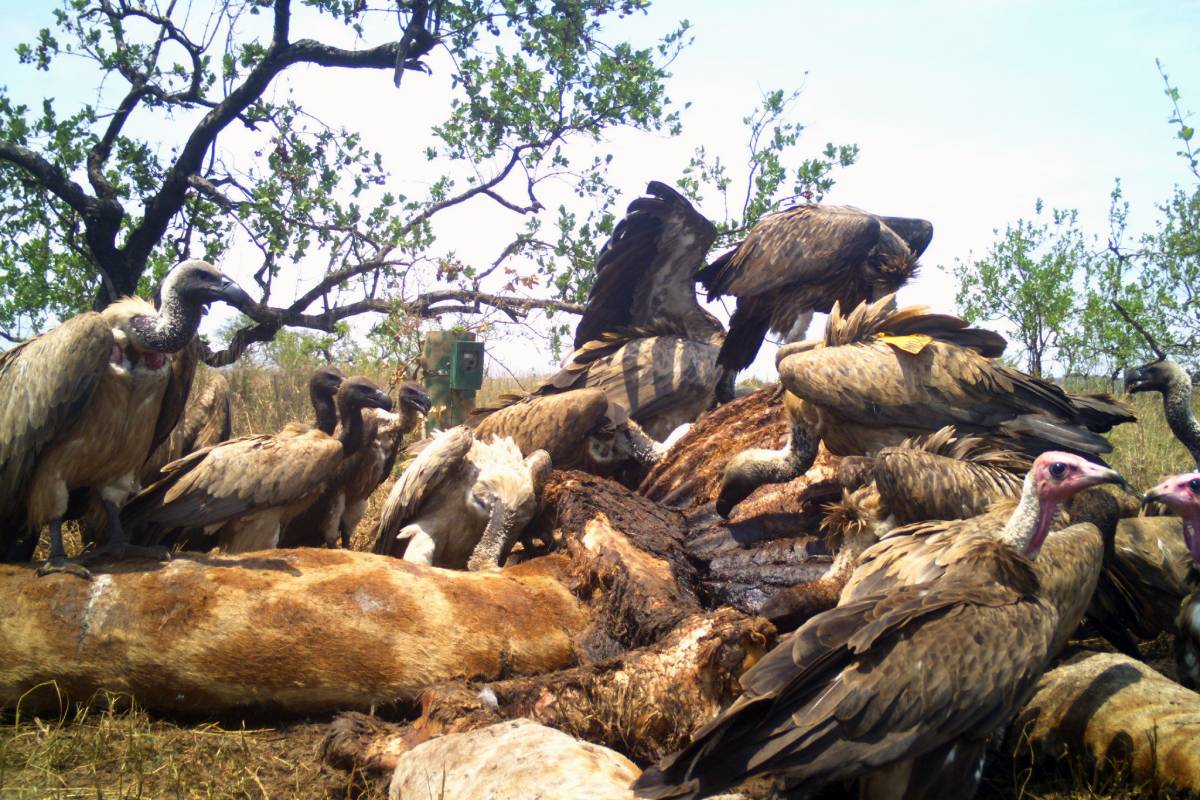
A group of African vultures and Egyptian vultures feeds on a giraffe carcass. One of the vultures has an identifying wing tag. One of the camera traps used by researchers is also visible. Photo: D. Redondo-Gómez and L. Naves-Alegre.
From public health to criminal investigation
The review's findings also show that the implications of carrion extend beyond ecology. In forensic science, a detailed understanding of decomposition processes improves the estimation of time since death. In epidemiology, understanding how different species utilize carcasses helps to understand the role of scavengers in reducing the spread of disease. In toxicology, certain scavenging species serve as excellent indicators of environmental pollution.
“Scavenging ecology provides new tools for interpreting archaeological and fossil sites, understanding animal evolution, and rethinking some hypotheses about early human meat consumption,” Marcos Moleón points out. It also offers new perspectives on analyzing the social perception of carnivorous animals and the benefits that scavengers provided to human ancestors, and continue to provide to modern societies. Furthermore, this type of study offers new solutions to problems related to monitoring and conserving biodiversity.
A paradigm shift
The main conclusion of the work is that carrion should not be understood as a marginal resource, but as a central component of ecosystems.
Therefore, the research team proposes to formally recognize carrion ecology as a distinct scientific discipline and presents a conceptual framework that integrates its multiple ecological functions and its connection with other disciplines.
“The most important thing is not just that we know much more about carrion today than we did twenty years ago,” the authors point out. “What is truly relevant is that we are beginning to understand the extent to which incorporating carrion transforms our view of the natural world and can help answer fundamental questions that until now remained incompletely explained.”.
Far from being a simple biological anecdote, carrion thus emerges as a key piece to better understand nature and connect disciplines that have long advanced along separate paths.

 Spanish
 English
 French