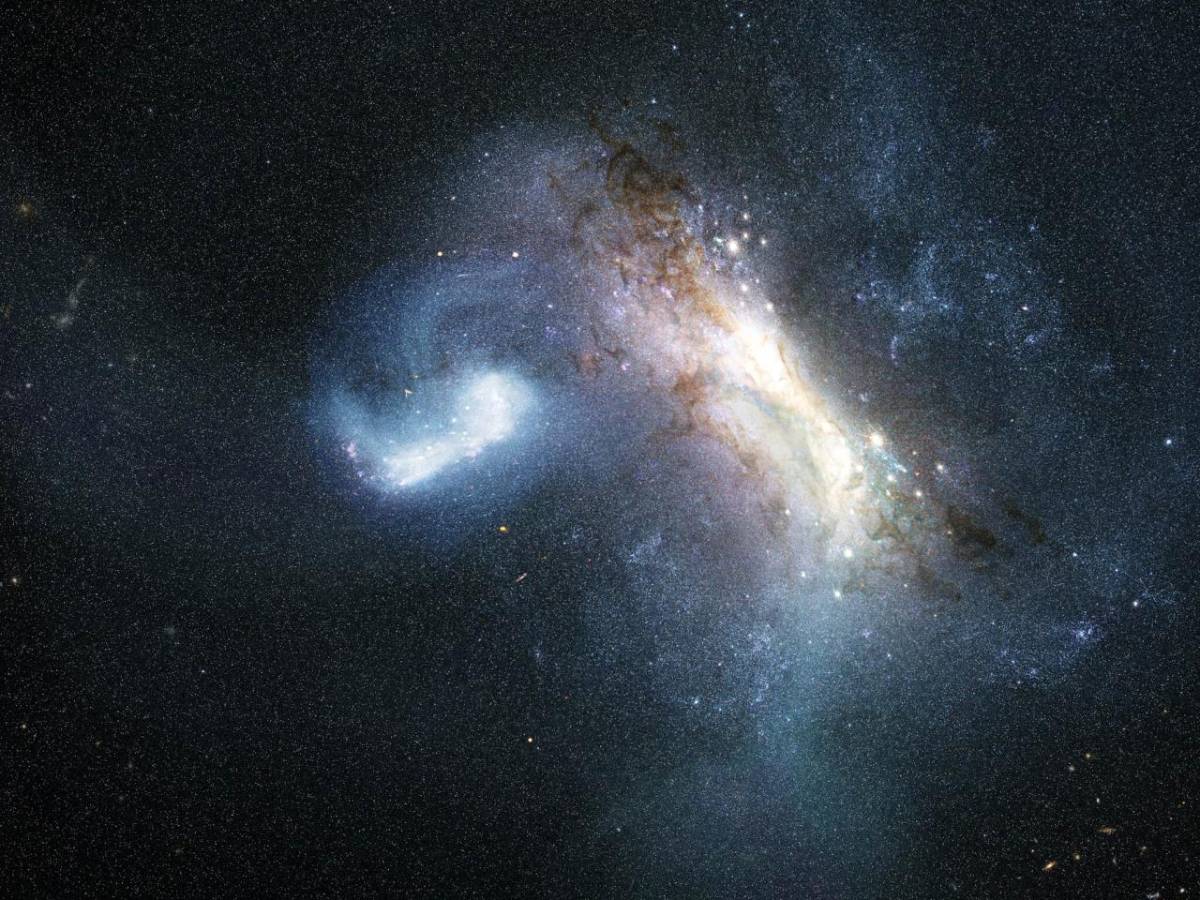
The Milky Way reached its current size, in part, by incorporating smaller galaxies. New data from the NASA/ESA Hubble Space Telescope provide definitive evidence that a dwarf galaxy merged with the young Milky Way in the early stages of its evolution. This finding extends our understanding of the history of our galaxy 1.8 billion years further back in time than previously thought. The results are published in the journal Nature Astronomy.
The Milky Way is today a vast spiral galaxy that is home to hundreds of billions of stars. However, our galaxy wasn't always so large; it has grown by forming new stars from its gas clouds, as well as by incorporating stars, gas, and dark matter from other galaxies through mergers.
The most recent massive merger in our galaxy's history took place with the Sagittarius Dwarf Galaxy, beginning more than 6 billion years ago and still ongoing today. Going back even further, researchers discovered that the Milky Way absorbed another dwarf galaxy called Gaia-Sausage-Enceladus 10 billion years ago. This ancient merger greatly affected the structure of our galaxy's stellar disk. Between these two mergers, other smaller ones occurred.
But the story of our galaxy doesn't end there. Both observations and simulations have suggested that another major merger preceded these two, although the specific details of the event have been the subject of intense debate. Now, Hubble has discovered definitive evidence of an earlier merger that took place about 11.8 billion years ago—just 2 billion years after the Big Bang.
“Our home is the Milky Way, but we don’t know how our house was built,” says Davide Massari, lead author and researcher of the Bologna Astrophysics and Space Science Observatory, in Italy. “In this article we discovered where the first significant batch of building blocks came from: a dwarf galaxy we call LKH,” he adds.
Cosmic archaeological sites
Astronomical studies and precision data from spacecraft such as the Gaia mission ESA's work has been fundamental in reconstructing the history of our galaxy. The further back in our galaxy's history we go, the harder it is to determine what happened. When the Milky Way was young, it was smaller and its size was much more similar to that of the galaxies it collided with. It was also more chaotic, and traces of mergers may have been erased over billions of years.
It is in this murky past where the Hubble has set its sights on it. The research team used this space telescope to study some of the globular clusters of the Milky Way: immense, more or less spherical groupings of tens of thousands to several million stars. Globular clusters contain some of the oldest stars in our galaxy and can act as cosmic archaeological sites, preserving stars from other galaxies that the Milky Way has incorporated.
“Thanks to the high resolution and depth of Hubble’s images, we were able to measure the age and metal content of these clusters with unprecedented precision,” says Chiara Zerbinati, co-author of the study, from the University of Bologna (Italy). “Together with the Gaia measurements, this allowed us to distinguish a population of globular clusters that differs from the rest. These are the clusters that were born in LKH, and they tell us when that galaxy was devoured by ours, as well as what its mass was,” he notes.
The team analyzed Hubble observations of 39 globular clusters located within 20,000 light-years of our galaxy, where traces of the oldest mergers should be preserved. They expected this sample to contain both globular clusters formed in the young Milky Way and others originating from the Gaia-Sausage-Enceladus dwarf galaxy, incorporated about 10 billion years ago.
Using Hubble's sensitive observations to determine the precise age of each cluster and its associated metallicity—the abundance of elements heavier than helium—a third population of globular clusters was identified in the inner regions of our galaxy. The team discovered that these clusters are older than the group resulting from the Gaia-Sausage-Enceladus merger, but younger than those born in the Milky Way, regardless of their metal content.
Therefore, these clusters originated from a separate and even older merger, in which the Milky Way absorbed a dwarf galaxy containing approximately 500 million times the mass of the Sun in stars, representing a significant fraction of our galaxy's mass at that time. They named this dwarf galaxy Low-energy-Kraken-Heracles, or LKH, in honor of three previous research papers that argued for the idea of a merger in the early stages of our galaxy's history.
A merger of this magnitude at such an early stage in the formation of the Milky Way has profound implications for its evolution. "Not only do stars born in an external galaxy become part of our own, but the impact of the merger can modify the structure of our Galaxy and even trigger the formation of new stars within it," says Carme Gallart of the IAC. "Here we have shown that this past merger was massive enough to have a profound impact on the early Milky Way," she emphasizes.
The team plans to continue its work to unravel the history of the Milky Way by studying its globular clusters, with the aim of characterizing all the massive mergers that our galaxy has experienced throughout cosmic history.
“Hubble is observing globular clusters that have never been studied before, and this will help us characterize the merger events that took place long ago in the history of the Milky Way,” says Fernando Aguado-Agelet, a researcher at the University of Vigo and the University of La Laguna, and co-author of the study.

 Spanish
 English
 French