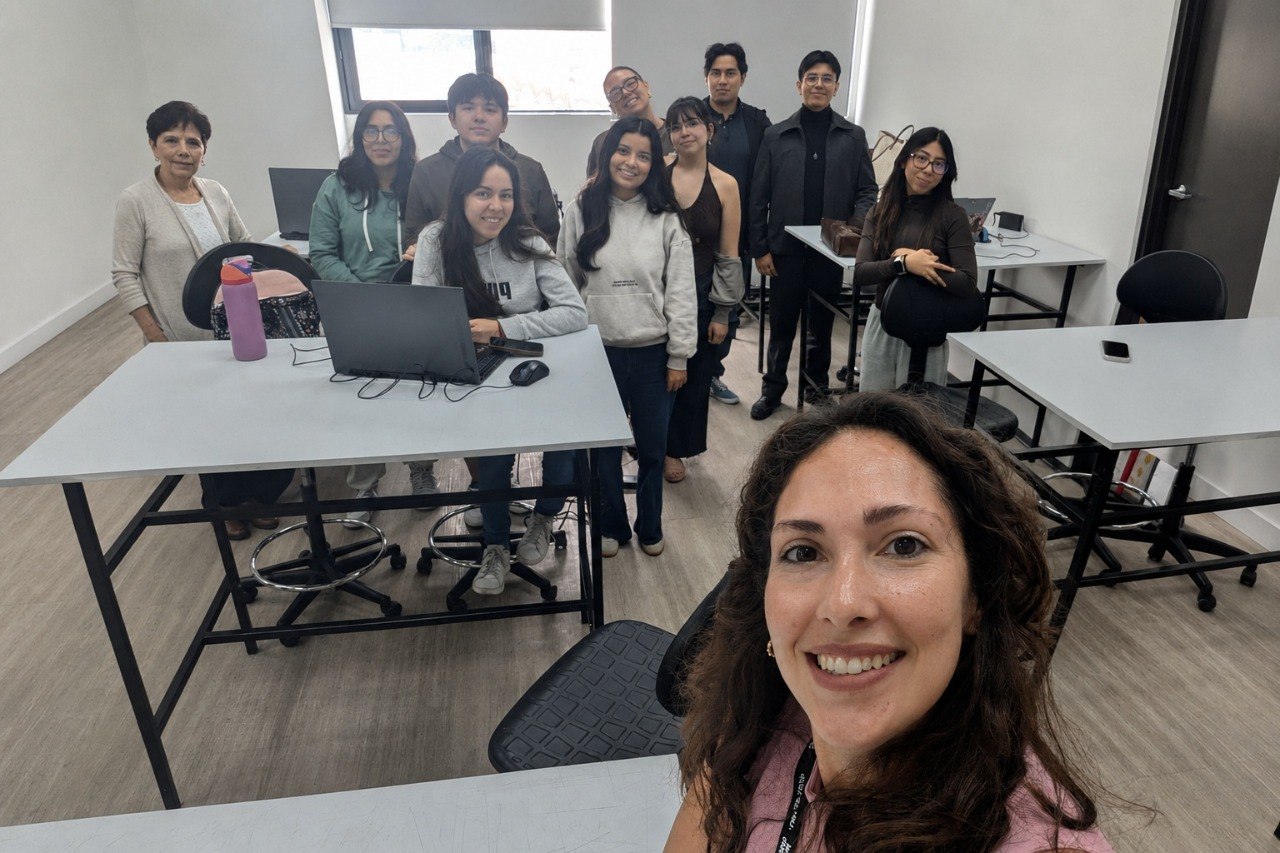
International academic cooperation and sustainability have joined forces in a pioneering project connecting the University of La Laguna, the Popular Autonomous University of the State of Puebla (UPAEP) of Mexico and the Canary Islands Government's Department of Education, through the IES San Matías (Tenerife). Students from the Sustainable Architecture Workshop at the Mexican university have designed various architectural proposals to provide the Tenerife high school with a climate shelter, a space prepared to mitigate the effects of high temperatures and promote thermal comfort in an environmentally friendly way.
The initiative arose from a one-month teaching and research stay undertaken by Noelia Cruz Pérez, Professor at the University of La Laguna, at UPAEP. During this period, she joined the international program as a professor. Global Summer, teaching the subject of Sustainable Architecture.
This international chair was jointly coordinated with Mª Lourdes Montes de Oca Menéndez, a tenured professor of the subject at UPAEP. Both professors presented the Mexican students with a real, transatlantic challenge: to analyze the climatic and spatial conditions of the IES San Matías in Tenerife in order to design passive, sustainable architectural solutions adapted to the Canary Islands environment.
The result has been a collection of presentation boards and projects of exceptional technical and aesthetic quality, which the Canary Islands institute has received with great enthusiasm. The principal of IES San Matías, Candelaria Padrón Peña, highlighted the educational value of this collaboration: «Our school is proud to receive these projects. They not only offer creative and inspiring solutions for transforming our spaces in the face of climate change, but also open a window to the world for our students, demonstrating the power of global education.».
At the request of UPAEP and in full agreement with all three institutions, the authorship of the projects will be strictly respected and made visible. The presentation boards will be publicly displayed at the IES San Matías facilities, allowing the entire educational community of the area to view the proposals developed by the Mexican students. Furthermore, as a crowning achievement of this collaboration, the participating institutions are considering awarding diplomas and official recognitions to the students and teachers involved for their outstanding participation in this international workshop.
This project exemplifies how the mobility of university faculty generates a direct and transferable impact on society, connecting cutting-edge research in bioclimatic architecture with the real needs of schools in the archipelago.

 Spanish
 English
 French