
The Canary Islands constitute a strategic enclave for the study of cetaceans. Due to their deep seabeds and the influence of their currents, the archipelago is a true biodiversity hotspot, home to 31 species of cetaceans, 10 of which are deep-diving specialists, such as beaked whales, pilot whales, and sperm whales.Physeter macrocephalusHowever, heavy maritime traffic has serious impacts on these marine populations, mainly due to noise pollution and the risk of collisions.
To address this problem, the researcher Olivia Marín Delgado has successfully defended his doctoral thesis at the University of La Laguna, with international distinction, entitled «New technologies applied to the study and conservation of deep diving whales in the Canary Island«"Directed by female biologists" Natacha Aguilar y Patricia Arranz Alonso and the engineer María de la Peña Fabiani, stands out for its interdisciplinary nature through the use of acoustic suction markers, Artificial Intelligence (Machine Learning) and infrared thermal imaging systems.
Survival at the physiological limit
The sperm whale is the world's largest toothed whale and possesses astonishing physiological adaptations that allow it to descend to depths of over 2,000 meters for more than two hours to feed. To withstand the pressure and low oxygen levels of the abyssal depths, they collapse their lungs to prevent nitrogen absorption, slow their heart rate, and selectively redirect blood flow to vital organs such as the brain and heart.
However, these extreme dives take a colossal toll on metabolism. Upon returning to the surface, sperm whales enter a state of passive rest known as "«logging”"in which they float inertly on the surface to recover. It is at this critical moment that they become highly vulnerable to being struck by high-speed vessels. In fact, scientific data shows that 401% of the sperm whales that have washed ashore in the Canary Islands in the last decade show unequivocal signs of collision with ships. The severity of this situation is such that research studies suggest the species may be suffering a population decline in the archipelago, as more whales are dying than are being born each year.".
Marín Delgado's thesis sheds light on one of the biggest mysteries surrounding the behavior of these giants: why don't they flee at the deafening noise of an approaching ship? "It's not that they lack the instinct to leave, but rather that they lack the physical ability to do so because they are already resting on the surface for the minimum time necessary to avoid dying once they dive again," the researcher explains. "They aren't sleeping at that moment; they are actively breathing, exchanging gases, and physiologically returning their entire body to normal before undertaking the next extreme dive.".
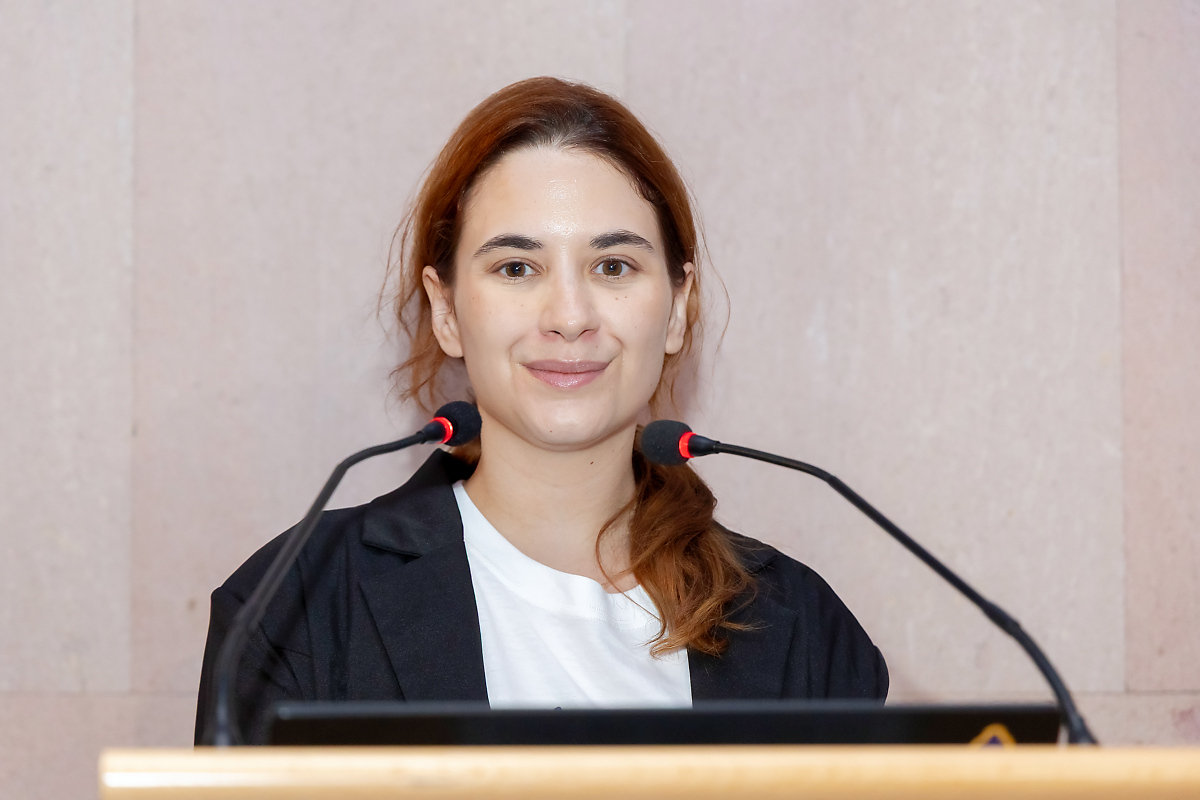
Olivia Marín.
Beaked whales and elephant seals
To better understand the limits and rigidity of these deep-rest strategies, the research adopts a valuable international comparative perspective, analyzing the diving and resting cycles of the sperm whale alongside two other extreme divers in the animal kingdom: Cuvier's beaked whale (Ziphius cavirostris) and the northern elephant seal (Mirounga angustirostris).
Cuvier's beaked whale holds the world record for diving depths, reaching 3 kilometers and dive times of around 3 hours. To avoid being exposed at the surface to lethal predators like orcas, these shy cetaceans perform shallower, shorter dives called "recovery dives," which allow them to oxygenate without having to remain motionless and vulnerable at the surface.
For its part, the elephant seal makes continuous dives for months at a time in the ocean, spending barely two minutes on the surface between dives. "It falls asleep halfway down as it passively sinks." After entering a sleep phase during freefall, it wakes up mid-descent and swims back to the surface to breathe. This drastic sacrifice of rest at sea is compensated for when they return to land, where they can spend up to 11 hours sleeping.
The sperm whale's sonar
The research has also delved into the hunting behavior of these animals by using digital acoustic tags (DTAGs) temporarily attached to the animal's back using suction cups, which simultaneously record ambient sound, movements, the animal's orientation and the depth of its dives.
In the absolute darkness of the deep sea, sperm whales locate their prey using echolocation: they emit regular, extremely powerful clicks of sound—reaching source levels of up to 240 decibels, the most powerful biological sound on the planet—in a strategy that acts as a long-distance "photo mode." When they lock onto their prey, they switch to rapid bursts of clicks called echolocation. buzz (or buzzing sounds), which function as a continuous "video mode" to guide the final attack.
Due to the enormous difficulty of directly recording the passage of a ship directly over a tagged animal in the open sea, the researcher devised an indirect method to measure their acoustic sensitivity: studying how the reverberation of their own high-power clicks bothers them when they hunt close to the seabed.
«We analyzed an acoustically uncomfortable situation for them: when they feed very close to the seabed and their own 240-decibel clicks rumble and reverberate off the rocks.» The study showed that sperm whales actively alter their feeding behavior to avoid and mitigate these bothersome effects. «This allows us to extrapolate that if they avoid and are bothered by their own echoing noise, continuous noise pollution generated by ship engines has a direct negative impact on their ability to feed efficiently.».
The more technological aspect of the thesis focuses on active prevention through the use of infrared thermal imaging cameras on the bows of ships. Since cetaceans are warm-blooded, their bodies and blows stand out clearly against the cold water surrounding them. The research team is collaborating with the shipping company Fred Olsen, conducting tests under real navigation conditions aboard two of its fast vessels.
However, strong waves, solar reflection, humidity, and haze interfere with the lenses, drastically reducing the thermal contrast of the images. To address this, Marín Delgado developed an Artificial Intelligence model capable of quantifying the quality of thermal images and predicting, with mathematical precision, the potential for actual sightings under different environmental scenarios.
The intention is for this automated system to be fully reliable in issuing early and unambiguous warnings to the bridges in real time: "You have a sperm whale 300 meters ahead, change course or you'll hit it." The doctoral thesis was reviewed by a panel of experts. Fabian Lorenzo, from the University of La Laguna; Laura Botigué, from the University of Barcelona; and Virginia Laura Ballerín, from the National University of Mar del Plata.

 Spanish
 English
 French