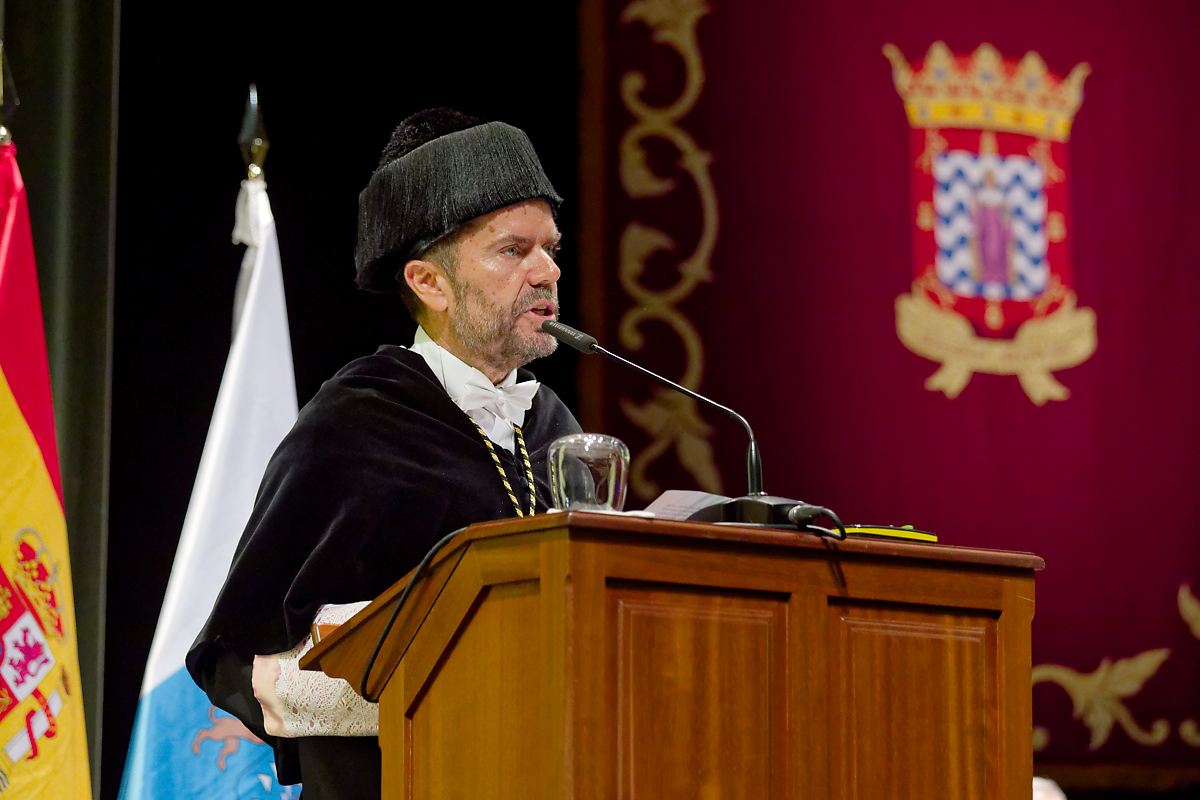
Rector Francisco J. García Rodríguez reviewed the main issues concerning the current situation of the University of La Laguna during his speech at the opening ceremony, The meeting, held today, Friday, September 11, in the Paraninfo, focused heavily on funding, given the current disagreements between the Canary Islands Government and the two public universities regarding the multi-year funding model proposed by the executive branch. "Either we finalize a stable funding mechanism for both universities now, guaranteeing their future, or we will face a serious risk of their survival in the medium term," the rector urged.
The rector explained that funding over the past few decades had kept the two public universities in the Canary Islands "on life support," with enough resources to avoid collapse, but insufficient to fully carry out the mission entrusted to them by Canarian society. He warned that, should "an unprecedented situation" of resource shortages arise, the institution's response "must also be unprecedented and rise to the occasion, always prioritizing, in that order, the interests of our society and our university community.".
In any case, the rector expressed his intention to do everything possible to avoid reaching that point, appealing to Gramsci's "optimism of the will" and to the ongoing discussions with the regional education ministry, "to finalize an agreement on the funding model in the coming weeks" that will be in effect for the next few years. García also kept in mind the upcoming 2027 elections and expressed his hope that, whatever the results, the current social pact, which recognizes the strategic role of public universities and keeps their funding "outside of partisan debate," will prevail.
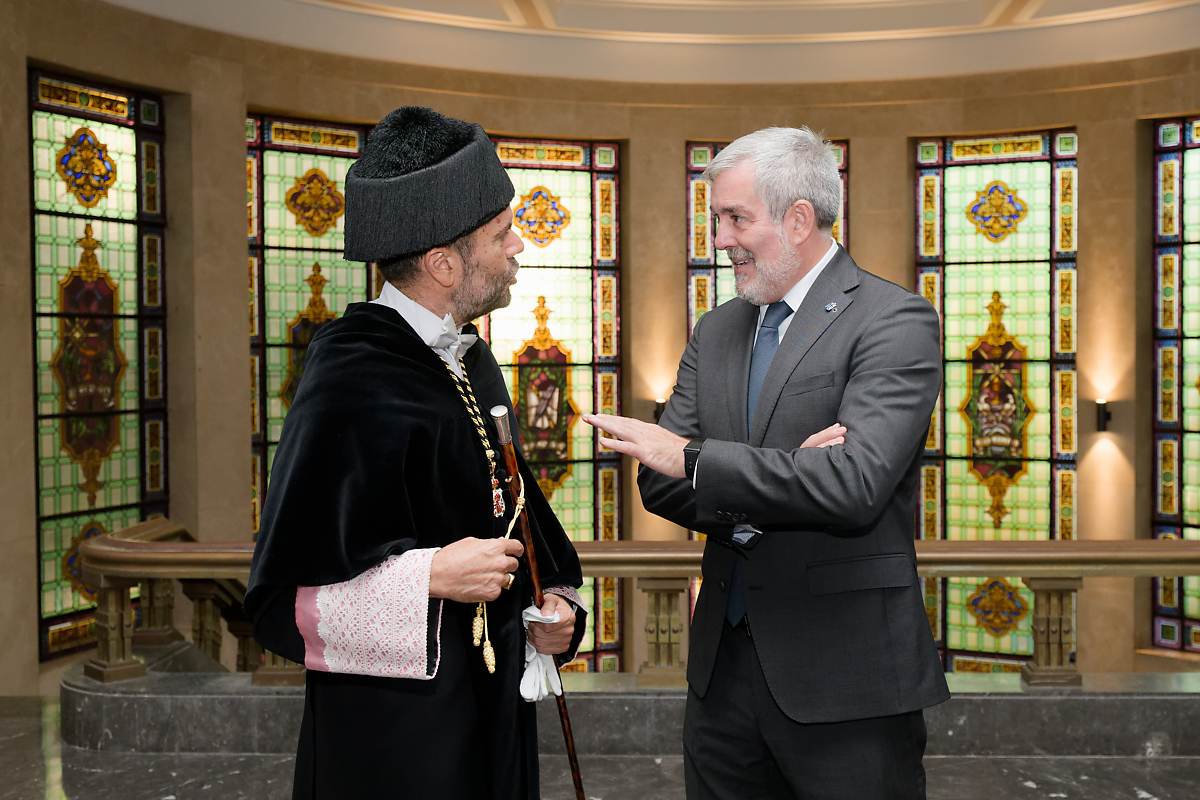
The rector of the ULL and the president of the Canary Islands talk before the ceremony.
The strategic role of universities lies not only in their potential for socioeconomic transformation and development through teaching, research, and knowledge transfer, but also in their status as intellectual bastions that uphold the validity of truth at a time when “alternative facts” allow for the fabrication of tailor-made truths. “That is why it is urgent that we renew our social and academic commitment to the fundamental mission that universities are called upon to fulfill in this era: the pursuit and defense of truth.”.
García offered three examples of truths widely corroborated by academic rigor that are nevertheless being questioned: that climate change exists and is already having effects; that migration is not a threat, although it must be managed appropriately; and that violence against women is both real and structural. “These three truths are just examples of many other areas in which we need rigorous knowledge, generated at this public university, to make appropriate decisions to face challenges where our very survival is at stake, and which, in this era of post-truth, are subject to the maelstrom of disinformation, manipulation, and hatred.”.
Apart from these issues, García also took the opportunity to review the milestones achieved during the past year in all areas of the institution, and also announced some measures that will be implemented in areas such as infrastructure improvement, the deployment of AI for management, internationalization and the celebration in 2027 of the centenary of the uninterrupted operation of the center, among other actions.
He focused particularly on the design of new undergraduate and master's degree programs: he noted that in addition to the seven new double degrees and the double master's degree launched last year, this academic year will see the introduction of a new double degree in Nautical Studies, Maritime Transport, and Marine Technologies, as well as three micro-degrees. Furthermore, next year will see the implementation of a new doctoral program in economics and society, and, for the first time at our university, a joint international double master's degree in Renewable Energies will be offered by the University of La Laguna and the University of Modena. This academic year will also see the finalization of the expansion of the catalog of official degrees, with the processing and authorization of seven new undergraduate and master's degrees, as well as three inter-university master's programs, which could begin in the 2027-2028 academic year and cover strategic areas for the Canary Islands, ranging from volcanology to the aerospace sector and biomedicine.
Speech by the President of the Canary Islands
As protocol dictates, the President of the Canary Islands, Fernando Clavijo, was responsible for officially opening the academic year on behalf of the King. He also briefly addressed the audience, responding in a relaxed tone to the requests made by the Rector moments earlier: “Understood, Fran.”.
Expanding further on the matter, he expressed his optimism about the possibility of reaching the financial agreement currently under discussion in the coming weeks. “I am convinced that we will reach an agreement. It probably won't be the maximum we would like, but it will certainly be enough to provide peace of mind to the public universities in the Canary Islands.”.
Clavijo especially congratulated the opening speaker, Nieves Luis González, because her speech emphasized the importance of not thinking short-term and being aware that the decisions made in the present will have repercussions for future generations.
He also addressed the portion of the rector's speech focused on the prevailing post-truth climate in society, emphasizing the importance of having "serious and rigorous" institutions such as public universities, which he described as "indispensable for the health of democracy." Specifically regarding the region's two public higher education institutions, Clavijo thanked them for their support during the major challenges his government has faced, providing advice when needed on matters such as regional and European funding models, the demographic challenge, and the energy transition, among others.
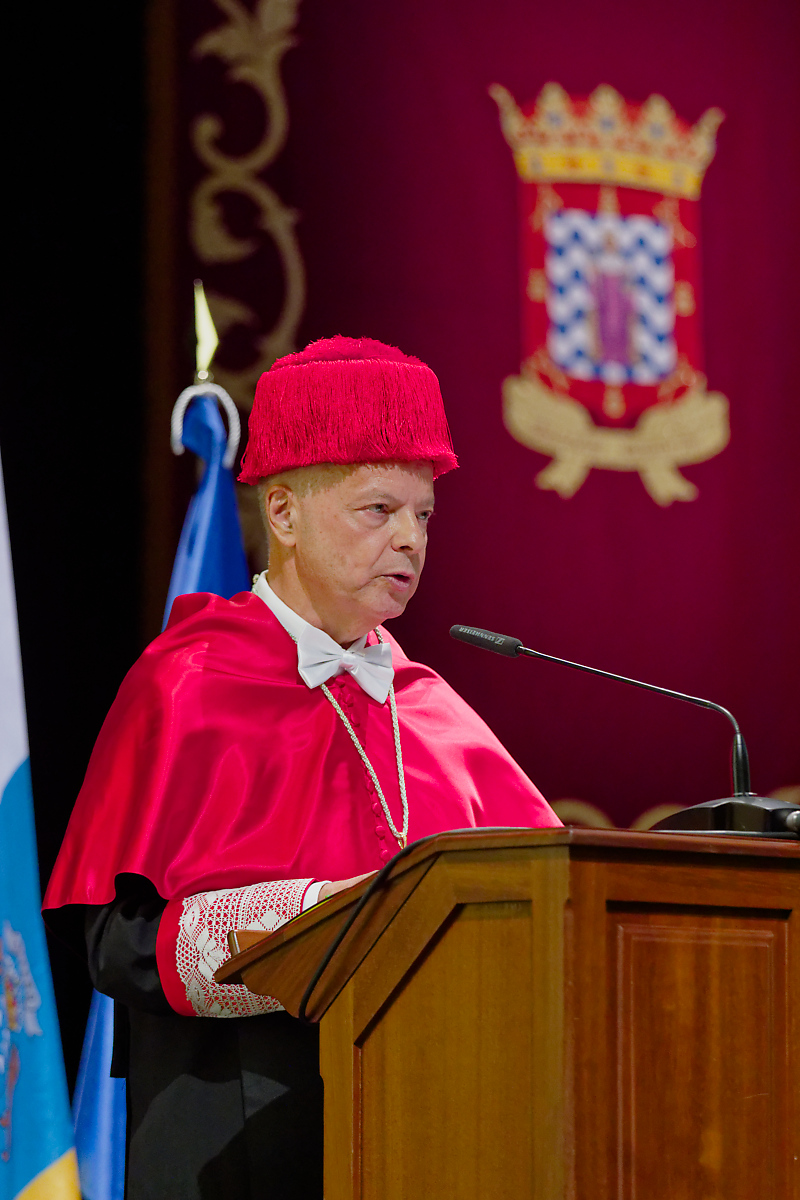
The Secretary General, Juan Antonio García.
Last year's data
As is customary, the Secretary General of the University of La Laguna, Juan Antonio García, read a summary of the main data contained in the academic paper from the previous academic year. Thus, in the 2025/26 academic year, there were 18,343 undergraduate students, 1,460 master's students, and 1,227 doctoral students. This represents three consecutive years of growth and an accumulated increase of 3.5% over the last five years. As for graduates, 2,805 people completed their undergraduate studies and 778 their master's studies.
Regarding personnel, the staff comprises 1,753 teaching and research staff, 806 technical, management, and administrative and service staff, and 282 researchers in training, postdoctoral, and support roles. In terms of research, 126 national and regional projects were awarded for a total of €15.07 million, while internationally, 41 proposals were submitted and 15 were selected, with a success rate of 37% and funding of €2.78 million.
One achievement highlighted by the Secretary General was the approval by the University Senate of the reform of the Statutes, in compliance with the mandate to adapt to the Organic Law of the University System, the text of which is currently pending legal review by the Government of the Canary Islands. Another milestone was that the University of La Laguna has retained its top rating in the Canary Islands Transparency Index.
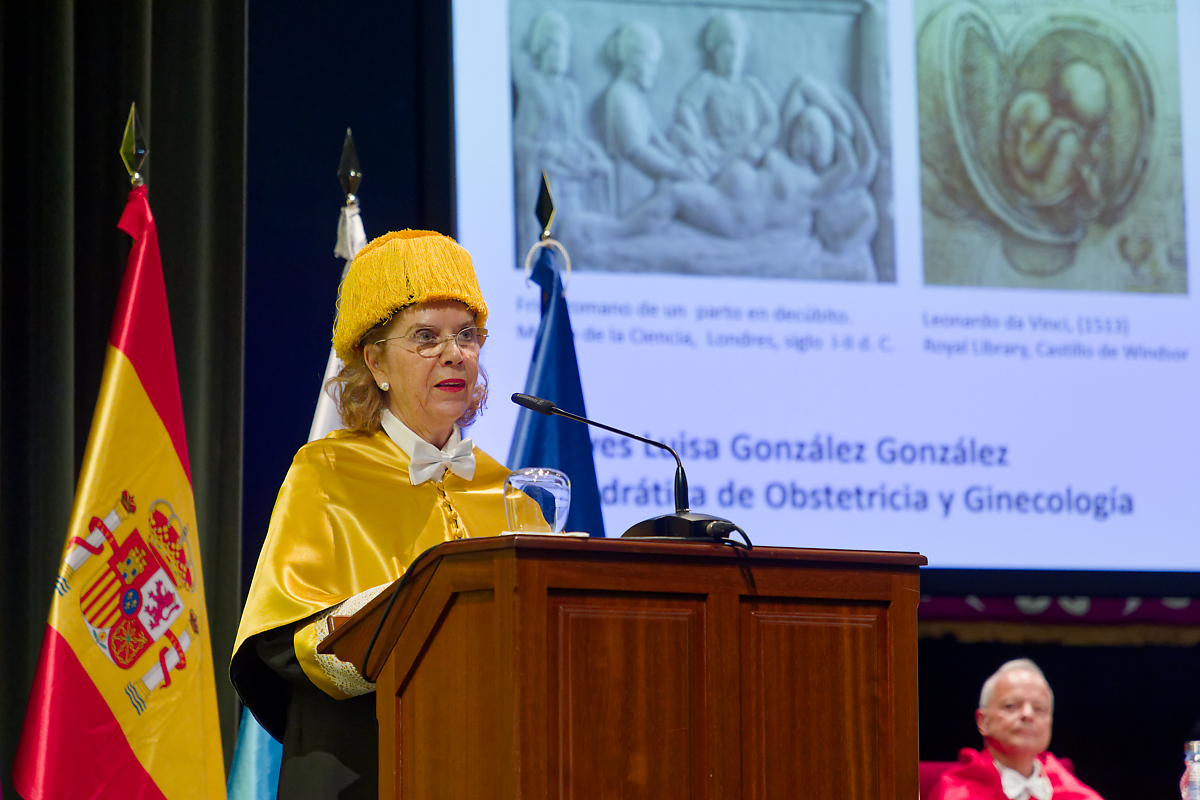
Nieves Luisa González.
Health of the pregnant woman and her offspring
The Professor of Obstetrics and Gynecology Nieves Luisa González González She was in charge of dictating the inaugural lecture, titled “Health Risks for Pregnant Women and Their Offspring in the 21st Century”. In it, she analyzed how climate change, obesity, and environmental toxins, among other factors, can affect the health of pregnant women and their offspring.
He began by contextualizing his discipline, obstetrics, which, although as old as humanity, only recently, thanks to discoveries such as anesthesia, asepsis, and penicillin, has made it possible to turn childbirth into a plannable and safe process.
Regarding the dangers related to climate change, she noted that there is evidence linking it to decreased fertility and infertility. For mothers, it increases the risk of the three medical conditions most frequently associated with pregnancy: obesity, gestational diabetes, and preeclampsia. There is also evidence of an association between air pollution and prematurity, as well as between maternal exposure to high temperatures and the risk of miscarriage, stillbirth, or low birth weight.
Therefore, he pointed out that “obesity, malnutrition and climate change should not be treated as three isolated problems, but as a global syndemic, that is, a sum of pandemics that coexist over time, reinforce each other and share the same social and economic determinants.”.
Delving deeper into the case of obesity, she explained that, among other problems, maternal diabetes, associated in most cases with obesity, can lead to alterations in the neurodevelopment of their offspring.
She also addressed the effects of endocrine disruptors, which, according to the WHO, are “exogenous substances that disrupt the functions of the endocrine system, causing adverse effects on an intact organism, its offspring, or the population.” Most of these are synthetic compounds derived from petroleum, although they also occur naturally: from phytoestrogens in soy to heavy metals such as lead and mercury. Exposure is continuous, as they are present in numerous everyday products and objects, as well as in the increasingly abundant microplastics.
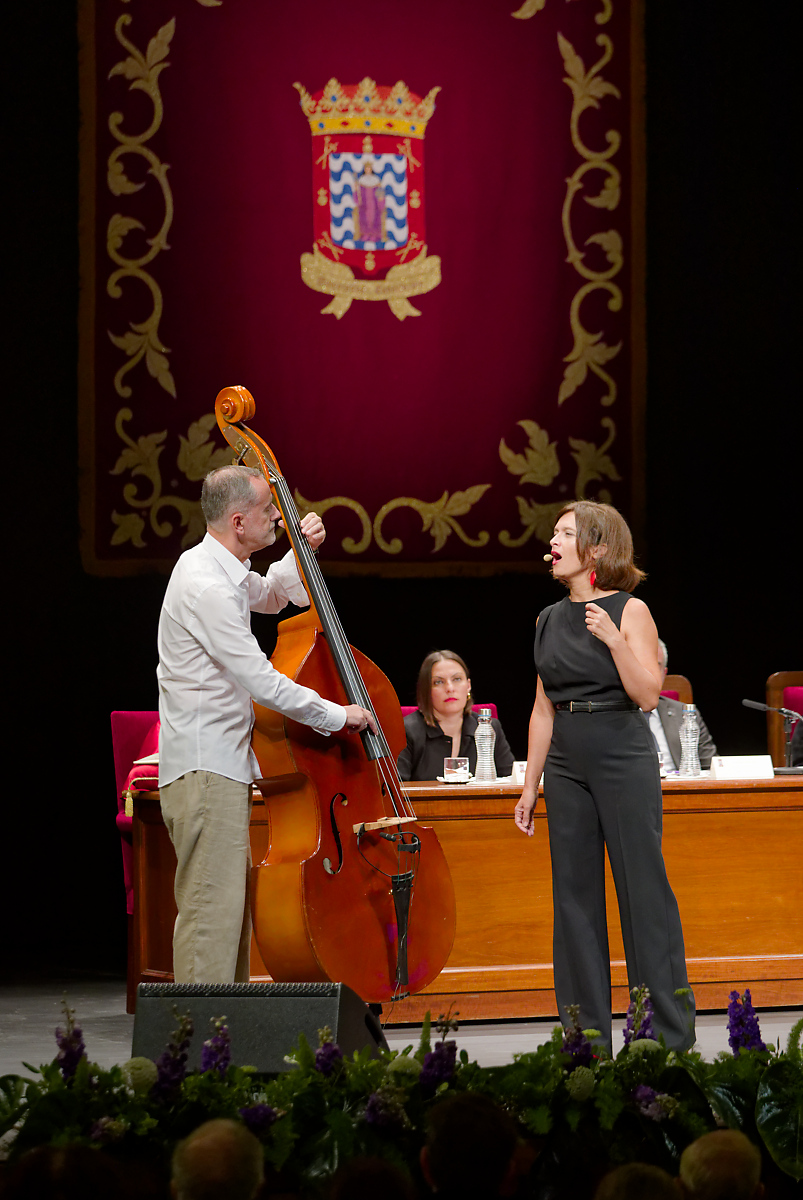
Carlos Costa and Judit Mendoza.
Regarding the interference of microplastics, she cited studies indicating their presence in blood and breast milk, in the first stools of newborns, and in the placenta. However, these studies are based on animal experimentation, so she explained that a multidisciplinary working group has been formed that has collected 48 case studies with human subjects, confirming the presence of microplastics to varying degrees. Therefore, she recommended continuing this line of research.
During the event, which was attended by the highest representatives of all the institutions of the Canary Islands, there was also a musical performance by Judit Mendoza (vocals) and Carlos Costa (double bass).

 Spanish
 English
 French