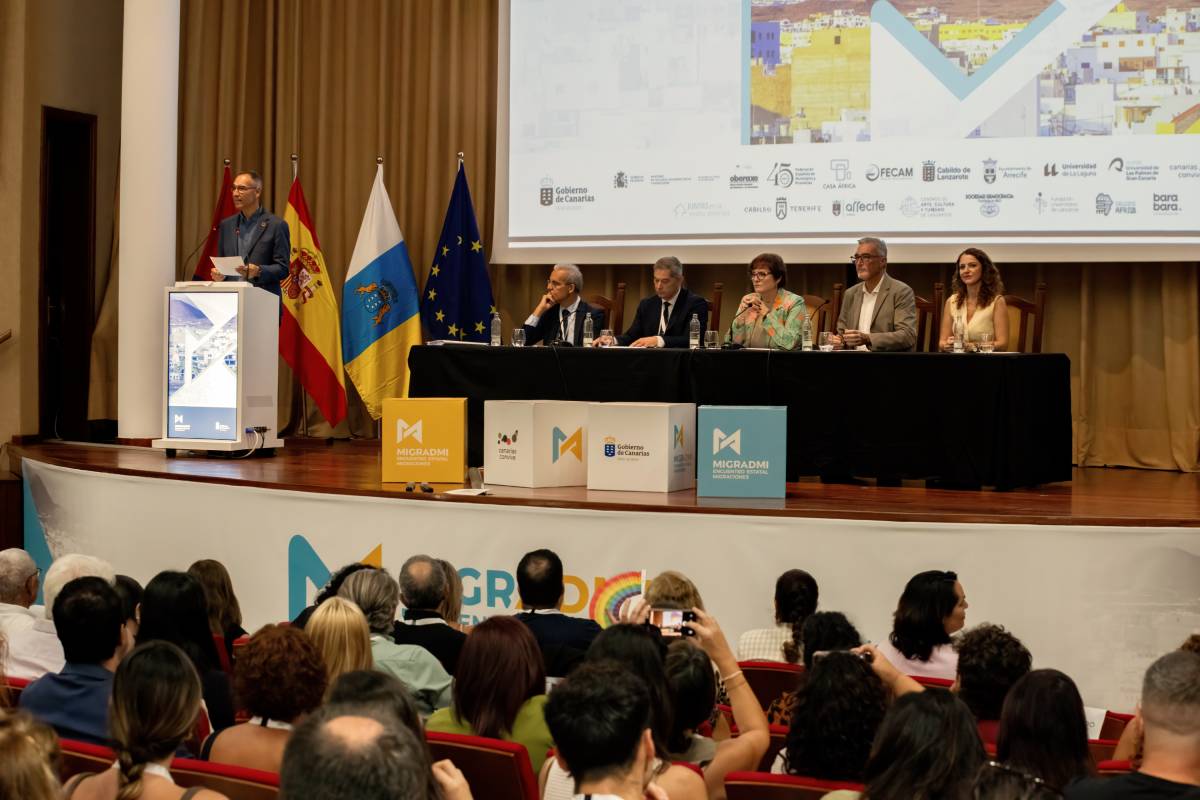
MIGRADMI It is a national meeting point for sharing knowledge and intervention experiences related to strategic planning in the areas of migration, diversity, and coexistence. The third edition, held on September 9 and 10 in Arrecife (Lanzarote), brought together 300 public sector professionals involved in the development and management of planning processes, and placed the neighborhood at the center of attention for addressing coexistence in diverse contexts and moving towards intervention models that are closer to everyday reality.
This event takes place within the framework of Canarias Convive, an intervention program for the strategic management of immigration and the promotion of intercultural coexistence in the Canary Islands, jointly promoted by the Government of the Canary Islands, through the Ministry of Social Welfare, Equality, Youth, Childhood and Families, and the University of La Laguna, through its General Foundation.
The institutional welcome included the participation of Vicente Zapata, academic director of Canarias Convive; Candelaria Delgado, Minister of Social Welfare, Equality, Youth, Childhood and Families of the Government of the Canary Islands; Tomás Fernández, director of the Spanish Observatory of Racism and Xenophobia; Luis Martínez-Sicluna, secretary general of the Spanish Federation of Municipalities and Provinces (FEMP); Marciano Acuña Betancort, Minister of Social Welfare and Inclusion; and Elisabet Santana, director general of Social Services and Immigration of the Government of the Canary Islands.
Zapata praised the participation of professionals from twelve autonomous communities and “the opportunity to share approaches to community intervention work in neighborhoods.” She also emphasized the importance of working “by identifying the needs of each territory and putting knowledge at the service of transformative processes.”.
Delgado emphasized that holding this meeting demonstrates that discussing migration, diversity, and coexistence is not a secondary issue. “It is a reality that is part of our present and that challenges all of society.”.
For his part, Fernández considered this event “necessary to learn how to address and implement best practices in the field of migration.” He also emphasized the local nature of this edition of MIGRADMI, stating, “This meeting is fundamental because it reaches people at a local level, in the neighborhood, and we believe it is essential to connect with citizens.”.
Along the same lines, Martínez-Sicluna emphasized that the FEMP is calling for a municipal-based policy on immigrant integration. “Immigration and foreign affairs fall under state jurisdiction, but they have an impact on local areas because that is where immigrants must be integrated, and we demand that the opinions of mayors be taken into account.”.
Acuña highlighted the position of the Canary Islands and Lanzarote regarding migration flows and pointed out that “no territory facing extraordinary migratory pressure should feel alone.” In this regard, he defended the need for «a national vision and a European response that combines the protection of individuals, dignified and effective reception, cooperation with countries of origin, safe and regular pathways, and proper border management, in addition to shared responsibility among territories.”.
For his part, Santana reviewed the content of the program for this third edition of MIGRADMI and highlighted as an objective "to continue building more cohesive, inclusive neighborhoods where people feel part of that community.".
Following the welcome address, a dialogue was held on the neighborhood as a unit of intervention, and the six working groups that took place during the meeting were presented. These groups addressed key aspects related to local management and diversity: entry points, reception, and initial connections in the neighborhood; resources, governance, and local coordination; coexistence, conflict, and racism prevention; participation, leadership, and representation; everyday spaces as drivers of social cohesion; and methodologies for social inclusion with a community-based approach.
Support, intervention and good practices
Isabel León, Vice-Rector for Culture and University Extension at the University of La Laguna, delivered the official welcome address on the second day of the conference. She highlighted the Canary Islands' close relationship with migration throughout their history and praised the conference for focusing on the neighborhood as a space where issues such as diversity, coexistence, and rights are realized in everyday life. Furthermore, she emphasized the role of the university as a public institution committed to its community, stating, "A public university cannot simply observe society from the outside. It must listen to it, research it, engage with it, and contribute to its transformation.".
The day ended with a talk focused on the keys to support and intervention in diverse contexts, the presentation of experiences and good practices developed from the municipal level, and the celebration of the Canary Islands Migration Day.
The third MIGRADMI meeting represents a bridge with the entire Canary archipelago to continue with the celebration of the following editions in non-capital islands, and to continue proposing new exchanges on planning in migration management, cultural diversity and social coexistence from public administrations.

 Spanish
 English
 French